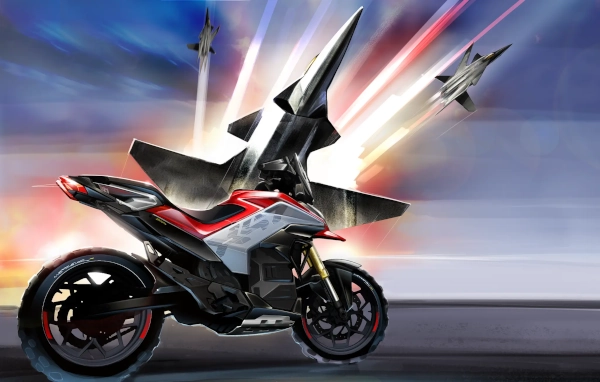
India’s electric two-wheeler market has largely developed around practical scooters and low-cost urban transport. Bengaluru-based Ultraviolette Automotive has taken a markedly different route. The company is developing electric motorcycles intended to compete through acceleration, handling, battery capacity, intelligent vehicle software and premium engineering rather than through economy alone.
Its flagship F77 platform combines a large structural battery pack, high-output electric drivetrain, connected-vehicle systems and aviation-inspired industrial design. At the experimental end of its development programme, the F99 Factory Racing Platform explores 400-volt architecture, carbon-fibre construction, active aerodynamics and electric-superbike levels of performance.
Through this approach, Ultraviolette is attempting to establish India as a designer, manufacturer and exporter of advanced electric motorcycles—not simply as a market for imported electric-vehicle technology.
An Indian Performance-Mobility Company
Ultraviolette Automotive was founded in Bengaluru in 2016 by Narayan Subramaniam, who serves as chief executive officer, and Niraj Rajmohan, the company’s chief technology officer.
The founders brought together specialists from automotive engineering, aviation, avionics, electronics, robotics, industrial design and software. Their objective was to build an electric motorcycle around a completely integrated technology platform rather than modifying an existing petrol motorcycle to accept a battery and motor.
The company’s development history included several generations of vehicle prototypes and battery systems before the F77 entered commercial production. Ultraviolette says it had reached its ninth generation of F77 prototypes and seventh generation of battery development by 2020–21, illustrating the lengthy validation required for a road-going electric performance motorcycle.
Ultraviolette’s aircraft-inspired language is visible in its product design, software interfaces, experience centres and terminology. The motorcycles use names such as Recon, Mach 2, SuperStreet and Ballistic, while the company calls its retail centres “UV Space Stations.” Beneath this branding lies a serious focus on battery safety, thermal engineering, power electronics, vehicle control and chassis development.
Why Electric Motorcycles Are More Difficult Than Electric Scooters
Electric scooters usually operate at relatively modest speeds over short urban distances. Their batteries can be placed beneath the floor or seat, while packaging requirements are generally less demanding.
A high-performance motorcycle presents a more complex engineering problem.
It must carry enough battery capacity to provide usable intercity range while remaining narrow enough for the rider to control. The drivetrain must repeatedly deliver strong acceleration without overheating, and the chassis must maintain predictable handling despite the mass of the battery.
Aerodynamics become increasingly important at motorway and racetrack speeds. Braking, suspension, tyres and structural rigidity must also match the motorcycle’s acceleration and weight.
An electric performance motorcycle therefore requires close coordination between the battery, frame, motor, inverter, cooling arrangement, software and mechanical systems. Ultraviolette has developed these components as parts of a unified vehicle architecture.
F77: Ultraviolette’s Foundational Motorcycle
The F77 is the production platform around which Ultraviolette established its engineering and commercial identity. The current family includes the more sport-oriented F77 Mach 2 and the F77 SuperStreet, which offers a more upright road-riding configuration.
The higher-performance versions use a drivetrain producing up to 30 kW of peak electrical power and 100 Nm of motor torque. The company specifies a maximum speed of 155 kilometres per hour. This places the F77 in a different category from commuter electric scooters and smaller electric motorcycles.
Power delivery can be adjusted through selectable riding modes. The control system changes throttle response, acceleration and energy use according to the selected setting, allowing the motorcycle to alternate between range-oriented riding and its highest-performance configuration.
Unlike an internal-combustion motorcycle, an electric machine does not require a multi-speed gearbox to keep the engine within a narrow power band. The motor can provide torque immediately, producing strong and uninterrupted acceleration. Delivering this performance safely, however, depends heavily on battery temperature, cell condition, motor cooling and precise electronic control.
The 10.3 kWh SRB-10 Battery System
One of the defining features of the F77 is its 10.3 kWh battery pack, called the SRB-10.
This is a large energy capacity for an electric two-wheeler. Ultraviolette currently advertises an estimated Indian Driving Cycle range of up to 323 kilometres, while the internationally used World Motorcycle Test Cycle figure is approximately 231 kilometres. The difference demonstrates why range figures must always be read alongside the testing method used.
The battery is more than an enclosure filled with cells. It contains electrical interconnections, sensors, thermal paths, structural protection, contactors, fuses and a battery-management system responsible for continuously supervising the pack.
Ultraviolette uses an aluminium enclosure with an IP67 rating to protect the battery from water and dust. The company describes five levels of battery protection covering thermal, electrical, mechanical, electronic and software-based safety.
Cell-Level Electrical Protection
Ultraviolette highlights the use of cell-level fusing within the F77 battery.
A large motorcycle battery consists of many individual cells connected to create the required voltage and energy capacity. A failure or abnormal current condition in one part of the pack can potentially affect neighbouring cells unless the electrical architecture isolates the problem rapidly.
Cell-level protection is intended to disconnect an affected cell before the fault spreads through a larger section of the battery. It forms one layer of a broader safety system that also includes voltage monitoring, current monitoring, temperature sensing, mechanical protection and software-controlled shutdown procedures.
The battery-management system analyses information from across the pack and can limit power, modify charging behaviour or isolate the battery when unsafe conditions are detected. Ultraviolette says some protection protocols can respond within microseconds.
Designing for Heat, Vibration and Impact
Performance electric motorcycles place considerable thermal stress on their batteries and power electronics. Rapid acceleration draws high current, while repeated high-speed operation generates heat in the cells, busbars, inverter and motor.
The battery pack must distribute and remove this heat evenly. Large temperature differences between cells can accelerate degradation and produce inconsistent performance.
Mechanical strength is equally important. A motorcycle battery experiences road impacts, cornering forces, vibration and environmental exposure. The enclosure must protect the cells while also becoming part of the motorcycle’s load-bearing architecture.
Ultraviolette states that its SRB-10 system has accumulated millions of kilometres of development and validation data. The company uses this testing history to support extended battery and powertrain warranty programmes reaching up to 100,000 kilometres on current products, subject to the relevant market and warranty conditions.
Motor, Inverter and Power Electronics
The electric motor converts energy stored in the battery into mechanical movement. The inverter sits between the battery and motor, changing direct current from the pack into precisely controlled alternating current.
The inverter determines how much torque the motor produces at any moment. It must respond rapidly to throttle position, wheel speed, battery status, traction conditions and thermal limits.
Ultraviolette describes the F77’s drivetrain as aviation-derived because it applies systems-engineering principles associated with high reliability, continuous monitoring and integration between hardware and software.
The powertrain controller coordinates the motor, battery and inverter while also managing regenerative braking. When the rider closes the throttle or brakes, the motor can act as a generator, converting part of the motorcycle’s kinetic energy back into electrical energy and returning it to the battery.
Software-Defined Riding Characteristics
A major difference between an electric motorcycle and a conventional mechanical vehicle is the extent to which software determines its behaviour.
Throttle response, torque delivery, regenerative braking, traction control and thermal protection can all be modified through control algorithms. Ultraviolette can therefore introduce changes to an existing motorcycle without replacing its motor or battery.
The F77 supports multiple riding modes and several levels of regenerative braking. Riders can select how strongly the motorcycle decelerates when the throttle is released.
Ultraviolette has also delivered software updates that altered vehicle behaviour and introduced additional functionality after motorcycles had reached customers. This ability to improve a vehicle through code makes the F77 a software-defined mobility platform as well as a mechanical product.
Violette A.I. and Connected-Vehicle Technology
Ultraviolette’s connected-vehicle system is branded Violette A.I.
The motorcycle remains connected to company servers through an embedded communications system, including while the ignition is switched off where connectivity is available. This enables remote monitoring, security notifications, location-based services and vehicle diagnostics.
The companion application provides access to ride data, charge limits, diagnostic information and vehicle location. Owners can receive movement, fall and towing alerts, while a lockdown function can immobilise the motorcycle when unauthorised use is suspected.
The system also collects operating data from the motorcycle. Analysing information from batteries, motors, controllers and sensors can help identify abnormal behaviour, understand component wear and improve future software calibrations.
The value of such connectivity extends beyond convenience. A manufacturer can use anonymised fleet information to study how batteries perform under different climates, charging habits, speeds and traffic conditions. These observations can influence thermal strategies, diagnostic thresholds and future hardware design.
Dynamic Stability and Regenerative-Braking Control
Regenerative braking can create a stability challenge on motorcycles because excessive deceleration at the driven wheel may reduce grip, especially during emergency braking or on slippery surfaces.
Ultraviolette’s patented Dynamic Stability Control coordinates regenerative braking with the anti-lock braking system. When ABS intervention is detected, the system can adjust regenerative deceleration to preserve stability.
The motorcycles also provide traction-control settings intended to manage wheel slip during acceleration. Other electronically managed functions include hill hold, park assist and an anti-collision warning that flashes the rear light during strong regenerative deceleration.
These features show how electrification changes motorcycle control. The motor can increase or decrease torque almost immediately, giving the software considerable authority over the behaviour of the rear wheel.
Charging the F77
The F77’s large battery provides greater potential range, although it also requires more energy and time to recharge.
Ultraviolette offers different charging equipment, including a 3 kW Boost charger. The company specifies approximately two and a half hours to charge from 20% to 80% under the appropriate conditions. The motorcycle can use commonly available 16-amp electrical connections, making overnight and destination charging possible without highly specialised infrastructure.
The company is also expanding access to two-wheeler fast-charging infrastructure. Its charging strategy is important because high-performance motorcycles are more likely to be used for longer journeys than urban electric scooters.
Interoperable charging standards could eventually allow riders to use a broader network instead of relying exclusively on one manufacturer’s equipment.
F99: India’s Electric Superbike Development Platform
The F99 represents the most ambitious expression of Ultraviolette’s engineering programme.
It was unveiled as a factory racing platform rather than an ordinary production road motorcycle. Its purpose is to test technology at performance levels far beyond those of the F77 and to establish what an Indian-developed electric superbike could achieve.
The track-specification F99 uses a 400-volt electrical architecture, compared with the substantially lower-voltage systems normally found in electric two-wheelers. Higher voltage allows a given level of power to be transmitted with lower current, reducing some electrical losses and enabling more powerful motors and inverters.
The platform is rated at 90 kW, or approximately 120 bhp, with 200 Nm of motor torque and a claimed 972 Nm of torque at the wheel. Ultraviolette lists the motorcycle’s weight at approximately 180 kilograms.
These figures place the F99 concept within the performance territory associated with large internal-combustion superbikes rather than conventional electric commuters.
High-Voltage Architecture and Liquid Cooling
Producing 90 kW from a motorcycle-sized electric drivetrain requires much more than installing a powerful motor.
The battery must deliver high current without excessive voltage drop or dangerous temperature rise. The inverter must switch large amounts of electrical energy rapidly, and the motor must withstand sustained electromagnetic and thermal loads.
Ultraviolette uses a liquid-cooled drivetrain on the F99 to control these temperatures. Liquid cooling can transfer heat more effectively than passive air cooling, although it also adds pumps, channels, hoses, radiators and control requirements.
The F99’s 10-pole interior permanent-magnet motor uses soft magnetic composite materials within its propulsion system. Ultraviolette combines this motor with high-voltage power electronics and track-oriented thermal management.
Carbon-Fibre Construction
Weight remains one of the greatest constraints on electric performance vehicles. Large batteries add mass, while motorcycles are particularly sensitive to weight because it affects acceleration, braking, cornering and rider control.
The F99 employs extensive carbon-fibre construction to reduce weight while maintaining structural rigidity. Ultraviolette describes the motorcycle as having a complete carbon-fibre exoskeleton.
Carbon fibre offers an excellent strength-to-weight ratio, although its manufacturing process is more expensive and demanding than conventional steel or moulded plastic construction. Its use on the F99 is therefore more suited to a low-volume racing and technology-demonstration platform than an affordable mass-market motorcycle.
The lessons learned from composite construction can still influence future road models through selective use of lightweight panels, structural parts and aerodynamic components.
Active Aerodynamics
The F99 also explores active aerodynamic systems.
A motorcycle’s aerodynamic requirements change according to speed, acceleration, braking and cornering. Low drag is desirable on a straight, while greater aerodynamic load can improve stability during braking or high-speed cornering.
Active surfaces can change position according to operating conditions, allowing the vehicle to alter airflow without permanently accepting the drag penalty created by fixed wings.
Ultraviolette has displayed movable aerodynamic elements around the F99’s bodywork and windscreen. The company links this work to its aviation-inspired design philosophy. The system remains part of the experimental racing platform, where engineers can assess the balance between additional downforce, drag, mechanical complexity and energy consumption.
India’s Fastest Quarter-Mile Motorcycle
The F99 demonstrated its straight-line performance at the Valley Run in December 2024.
It completed the standing quarter mile in 10.712 seconds, a result certified by the Federation of Motor Sports Clubs of India. Ultraviolette describes it as the fastest quarter-mile time recorded by an Indian-manufactured motorcycle.
The motorcycle subsequently recorded a speed of 258 kilometres per hour during a top-speed attempt in 2025. Ultraviolette’s developmental specification lists an estimated maximum capability of 265 kilometres per hour.
The achieved figure and estimated design target should be treated separately. The 258 km/h result represents the recorded test speed, while 265 km/h is the company’s estimated platform specification.
Racing as a Technology Laboratory
The strategic value of the F99 extends beyond setting records.
Motorsport compresses years of ordinary road stress into intense periods of acceleration, braking and thermal loading. Components are repeatedly operated close to their design limits, exposing weaknesses that may remain hidden during normal road testing.
The F99 allows Ultraviolette to experiment with:
- Higher-voltage battery systems
- High-power inverters
- Advanced motor materials
- Liquid cooling
- Carbon-fibre structures
- Aerodynamic control
- High-speed vehicle software
- Performance-oriented battery management
Technology proven on a racing platform can gradually move into production models after it becomes reliable, manufacturable and affordable.
The F99 should therefore be understood as an engineering test bed and electric-superbike concept. It is distinct from a homologated mass-production motorcycle currently available through normal showrooms.
Expanding Beyond the Original F77
Ultraviolette is developing a broader product architecture around the technologies created for the F77.
The company has introduced the F77 SuperStreet and X-47 Crossover while also unveiling the Tesseract and Shockwave platforms. These products extend its technology into different riding positions, vehicle classes and market segments.
The product expansion demonstrates the value of platform engineering. Battery modules, power electronics, software, connected systems and diagnostic tools can be adapted across several models rather than being designed independently for every vehicle.
Ultraviolette says its current and planned vehicles cover five segments, supported by a growing domestic and international sales network.
Made in Bengaluru for International Markets
Ultraviolette’s research, vehicle development and manufacturing base is centred in Karnataka.
Its significance for Make in India lies particularly in the ownership of vehicle architecture and intellectual property. The company develops battery packs, battery-management systems, control software, power electronics, connected technology and overall vehicle integration in India.
This does not necessarily mean that every battery cell, semiconductor, sensor or raw material originates within India. Modern electric vehicles depend on international supply chains, particularly for lithium-ion cells and specialised electronic components.
However, owning the system design allows an Indian manufacturer to select suppliers, localise components progressively, protect software and control the development of future platforms. The most valuable capability is often the knowledge required to integrate individual components into a safe, reliable and competitive vehicle.
Karnataka Manufacturing Expansion
In March 2026, Ultraviolette signed a memorandum of understanding with the Government of Karnataka for a five-year manufacturing-expansion programme.
The first phase includes a proposed investment of ₹200 crore to expand its existing capacity. A second phase envisages a new Karnataka facility with annual production capacity of approximately 150,000 motorcycles.
Before this expansion, Ultraviolette’s existing annual capacity was reported at approximately 30,000 units, with the ability to scale towards 50,000. The proposed plant would therefore represent a major increase in manufacturing capability.
The project is expected to receive state support through incentives and expedited approvals. Its success will depend on demand, financing, supplier development and the company’s ability to maintain quality while moving from specialist production towards substantially larger volumes.
Exporting an Indian Electric Motorcycle
Ultraviolette has also pursued international homologation and exports.
The F77 obtained certification for European markets, where motorcycles must comply with regulations covering braking, lighting, electromagnetic compatibility, safety and vehicle construction. Ultraviolette subsequently launched the F77 family across multiple European countries and entered the United Kingdom.
The company reported that it was present in 12 European countries by December 2025, with further expansion continuing afterwards.
This is strategically important because India has traditionally exported large numbers of commuter motorcycles, while the global premium-performance segment has been dominated by established European, Japanese and American manufacturers.
Ultraviolette is attempting to demonstrate that an Indian company can export intellectual property, design, software and advanced electric performance—not merely low-cost manufacturing.
Investment in Battery and Vehicle Technology
Ultraviolette’s investors have included TVS Motor Company, Qualcomm Ventures, TDK Ventures, Zoho Corporation, Lingotto and Speciale Invest.
In December 2025, the company announced that it had secured US$45 million from Zoho Corporation and Lingotto as part of its Series E round. Ultraviolette said the capital would support production expansion, domestic and international growth and the development of the F77, X-47, Shockwave and Tesseract platforms.
Investment from electronics and technology companies is especially relevant to an electric-motorcycle manufacturer. Battery materials, sensors, semiconductors, connectivity and power electronics are becoming as important to vehicle performance as traditional mechanical engineering.
Challenges Facing High-Performance Electric Motorcycles
Ultraviolette’s engineering achievements do not remove the commercial challenges facing premium electric motorcycles.
Large batteries increase the purchase price and vehicle weight. Performance riding consumes energy rapidly, reducing real-world range compared with gentle test-cycle operation. Charging access remains uneven, particularly during long-distance travel.
Battery cells and power semiconductors remain exposed to international supply chains. Premium components such as suspension, brakes, tyres, composites and advanced electronics also raise manufacturing costs.
The company must build a service network capable of diagnosing high-voltage batteries, software, sensors and power electronics alongside conventional motorcycle components.
Export expansion creates additional responsibilities involving regulatory compliance, spare-parts distribution, warranty support, data protection and service training across several countries.
The F99 presents an additional challenge: transforming a record-setting prototype into a reliable road motorcycle would require homologation, production tooling, durability validation and a commercially sustainable price. Until such a programme is formally completed, the F99 remains a factory racing and development platform.
Ultraviolette The Higher Level of Make in India
Ultraviolette Automotive represents a higher level of domestic value creation than assembling imported components into a conventional two-wheeler.
The company’s work spans:
- Battery-pack architecture
- Battery-management software
- Electric motors and power electronics
- Vehicle-control algorithms
- Connected-vehicle systems
- Mechanical and aerodynamic design
- Composite structures
- Manufacturing engineering
- International certification
This combination creates transferable capabilities that can benefit India’s wider electric-mobility ecosystem.
Engineers trained in battery safety, high-voltage systems, embedded software, thermal management and lightweight structures can apply their knowledge to cars, commercial vehicles, drones, robotics, aerospace systems and stationary energy storage.
From Commuter Electrification to Indian Performance Engineering
Ultraviolette is challenging the idea that electric two-wheelers must be designed only as economical urban appliances.
The F77 demonstrates that an Indian electric motorcycle can combine substantial battery capacity, highway-capable performance, connected software and advanced safety systems within a production vehicle.
The F99 pushes that ambition further. Its 400-volt architecture, 90 kW drivetrain, carbon-fibre construction, active aerodynamics and record-setting performance turn it into a laboratory for India’s electric-superbike capabilities.
Commercial success will depend on pricing, manufacturing scale, service quality, charging availability and long-term product reliability. Yet the company has already established something strategically important: an Indian-owned foundation for high-performance electric motorcycle engineering.
Ultraviolette Automotive shows how the Make in India movement can progress from manufacturing established vehicle categories to creating distinctive products capable of competing through technology, design and performance in global markets.
Reference
Ultraviolette Automotive – Official Website
https://www.ultraviolette.com/
Ultraviolette Automotive – About the Company
https://www.ultraviolette.com/about
Ultraviolette F77 Mach 2 and F77 SuperStreet
https://www.ultraviolette.com/f77
Ultraviolette F99 Factory Racing Platform
https://www.ultraviolette.com/f99
Ultraviolette – Violette A.I. and Connected-Vehicle Technology
https://www.ultraviolette.com/smarttech
Ultraviolette – News and Press
https://www.ultraviolette.com/press
Ultraviolette – Growth Capital from Zoho Corporation and Lingotto
https://www.ultraviolette.com/press-release/ultraviolette-secures-growth-capital-from-zoho-and-lingotto
Ultraviolette – Retail and International Expansion
https://www.ultraviolette.com/retail
Economic Times Manufacturing – Karnataka Manufacturing Expansion
https://manufacturing.economictimes.indiatimes.com/news/automotive/ultraviolette-signs-mou-with-karnataka-to-expand-ev-manufacturing/129842723
Economic Times – Ultraviolette’s ₹200 Crore Karnataka Expansion
https://economictimes.indiatimes.com/industry/renewables/ultraviolette-to-invest-rs-200-cr-on-capacity-expansion-in-karnataka/articleshow/129842113.cms
HT Auto – Ultraviolette’s New Karnataka Manufacturing Plant
https://auto.hindustantimes.com/auto/news/ultraviolette-plans-new-karnataka-plant-mou-with-government-signed-41774599680173.html
Image Courtesy: https://www.ultraviolette.com/
You may also like
-
India’s Economic Warfare Challenge: Strategic Autonomy, Energy Security and the Rise of a Global Power
-
India-US Trade Deal Stalemate: Why Washington’s Tariff Pressure Has Failed to Secure an Agreement
-
US Double Standards in Foreign Policy: 16 Recent Cases Involving India, Russia, China and Global Trade
-
India’s Arctic Energy Ambitions: Russian Oil, LNG and a New Sea Route to Indian Ports
-
India and Russia Explore Joint Icebreaker Construction as Maritime Industrial Cooperation Expands
