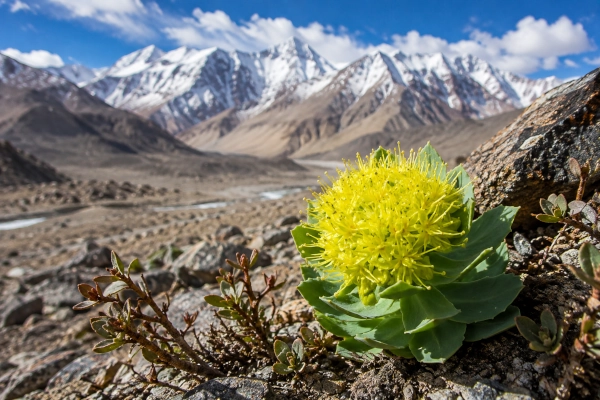
The Government of India has identified Ladakh as a region with significant potential for the cultivation, conservation and commercial development of high-altitude medicinal plants, including Seabuckthorn, Rhodiola, Artemisia and Aconitum, the Ministry of Ayush informed the Lok Sabha on Friday.
The initiative is being supported through programmes of the National Medicinal Plants Board (NMPB), the National AYUSH Mission (NAM) and the Mission for Integrated Development of Horticulture (MIDH), with a growing focus on cultivation, processing, quality testing, market access and value addition.
Ladakh’s cold-desert climate, high altitude and distinctive biodiversity make the Union Territory particularly suitable for a number of medicinal and aromatic plants that thrive under extreme Himalayan conditions.
NMPB Support for Medicinal Plant Sector
The National Medicinal Plants Board is implementing the Central Sector Scheme for Conservation, Development and Sustainable Management of Medicinal Plants across the country.
Under the scheme, project-based assistance is provided for several components of the medicinal plant supply chain.
These include development of infrastructure for production of quality planting material, farmer awareness programmes, post-harvest management, marketing infrastructure, quality testing and certification of medicinal plant raw material.
The scheme also supports research and development, conservation initiatives, marketing and trade promotion and livelihood linkages involving local communities, Self-Help Groups, Biodiversity Management Committees and other grassroots institutions.
Particular emphasis is being placed on creating both forward and backward linkages so that medicinal plant growers have access not only to quality planting material and cultivation knowledge but also to processing facilities and reliable buyers.
e-CHARAK Platform Connects Growers With Markets
To strengthen market access, the NMPB has developed the e-CHARAK mobile application and web portal, which provide information related to medicinal plants and herbs.
The platform supports multiple Indian languages and publishes fortnightly market prices of around 100 medicinal plants across 25 herbal markets, including information relevant to Ladakh.
The NMPB also facilitates direct market linkages for medicinal plant farmers and collectors by sharing procurement requirements and contact details of purchasing officials from major companies with State Implementing Agencies and Regional-cum-Facilitation Centres.
Such mechanisms could become important for Ladakh as cultivation expands beyond small-scale traditional use towards organized medicinal plant production and value-added enterprises.
Ladakh Medicinal Plant Board Expands Training and Conservation
The State Medicinal Plant Board, Union Territory of Ladakh, has identified considerable opportunities for developing the region’s high-altitude medicinal plant sector.
The Board has been conducting training programmes, seminars, workshops and buyer-seller meetings to encourage scientific cultivation, conservation and sustainable utilization of medicinal plants.
It is also working with research institutions and government departments to strengthen awareness, processing capabilities and value addition.
Capacity-building programmes are being used to address challenges faced by growers and collectors while encouraging commercially viable and environmentally sustainable cultivation.
The Regional-cum-Facilitation Centre for northern India has also supported efforts to establish post-harvest processing and quality-testing infrastructure in Ladakh, with the objective of creating local employment and improving returns from medicinal plant cultivation.
₹7.05 Crore Released Under National AYUSH Mission
The Ministry of Ayush has also been supporting Ladakh through the National AYUSH Mission.
According to the government, ₹705.11 lakh, or about ₹7.05 crore, has been released to the Union Territory of Ladakh during the last five years for approved activities and projects under State Annual Action Plans.
Of this amount, ₹534.24 lakh has been reported as utilized.
National AYUSH Mission assistance covers a wide range of activities including Ayushman Arogya Mandir (Ayush) centres, integration of Ayush services with Primary Health Centres and hospitals, upgrading Ayush hospitals and dispensaries, establishment of integrated Ayush hospitals, supply of essential medicines, public health programmes and development of Ayush educational institutions.
The Ministry clarified that district-wise fund allocation is not separately provided under the National AYUSH Mission.
₹7.89 Crore Seabuckthorn Centre of Excellence Established at Nimoo
One of the most important initiatives in Ladakh is the establishment of a dedicated Centre of Excellence for Seabuckthorn at Nimoo in Leh.
The facility has been developed under the Mission for Integrated Development of Horticulture with financial assistance of ₹789.33 lakh, or approximately ₹7.89 crore.
The project was initiated in 2020-21 by the Department of Horticulture, UT Ladakh, with technical support from the Defence Institute of High-Altitude Research (DIHAR), DRDO, Leh.
The Centre includes a scientific orchard, model nursery, demonstration and training infrastructure, a primary processing unit and capacity-building programmes.
It caters to farmers, Farmer Producer Organizations, Self-Help Groups, women entrepreneurs and other stakeholders interested in developing the Seabuckthorn value chain.
The Centre is intended to promote scientific cultivation techniques, supply quality planting material, demonstrate primary processing technologies and establish model orchards and nurseries.
It is also helping develop standardized cultivation practices and transfer technical knowledge to local growers and entrepreneurs.
Seabuckthorn Could Become Major High-Altitude Crop
Seabuckthorn is particularly important for Ladakh because it naturally thrives in harsh Himalayan terrain and has significant commercial potential.
Its berries and other plant parts are used in a variety of food, nutraceutical, cosmetic and traditional medicinal products.
Developing organized cultivation and processing could allow communities in Ladakh to capture a greater share of the value generated from the plant instead of relying largely on the sale of unprocessed raw material.
The establishment of nurseries, processing facilities and market linkages could also help create new livelihood opportunities in remote areas where conventional agriculture faces severe climatic limitations.
Research Focus on Rhodiola imbricata
The Centre is also supporting research on other important Himalayan medicinal species.
Among the projects approved by NMPB is research into Rhodiola imbricata, a high-altitude medicinal plant found in the cold deserts of Ladakh.
A project titled “Enhancement of Salidroside Content through Various Means in Rhodiola imbricata Edgew. from the Cold Desert of Leh Ladakh: In Field and in vitro Approaches” was sanctioned during 2025-26.
The project, associated with the Institute of Sowa Rigpa in Leh, received a sanctioned amount of ₹9.92 lakh.
Salidroside is one of the important bioactive compounds studied in Rhodiola species, making scientific cultivation and conservation of the plant particularly relevant for future medicinal and research applications.
Conservation Projects Across Leh and Kargil
Several medicinal plant projects have been supported in Ladakh during the last five years.
These include conferences and seminars on Himalayan medicinal plants, establishment of a herbal garden at the Central Institute of Buddhist Studies in Choglamsar, conservation and germplasm collection of priority medicinal plants in the cold deserts of Ladakh and institutional support for the State Medicinal Plant Board.
A major conservation project titled “Conservation Status, Germplasm Collection and Resource Augmentation of Priority Medicinal Plants in the Cold Deserts of Ladakh” was sanctioned for the National Research Institute for Sowa-Rigpa in Leh with an allocation of ₹13.48 lakh.
The government has also provided ₹81 lakh between 2023-24 and 2025-26 for maintenance of the Nucleus Centre of the State Medicinal Plant Board, of which ₹74.52 lakh has been utilized.
Combining Conservation With Local Livelihoods
The medicinal plant strategy for Ladakh is increasingly being built around the principle that conservation and commercialization need not operate separately.
Scientific cultivation can reduce pressure on wild medicinal plant populations while providing farmers with alternative high-value crops suited to the Himalayan environment.
At the same time, local processing, nurseries, certification, quality testing and organized marketing can help ensure that a larger portion of the economic value remains within Ladakh.
The government’s approach therefore extends beyond simply growing medicinal plants. It seeks to build an entire ecosystem connecting conservation, scientific cultivation, research, processing, certification, market access and entrepreneurship.
With species such as Seabuckthorn, Rhodiola, Artemisia and Aconitum already adapted to the region’s extreme climatic conditions, Ladakh has the potential to develop into an important Indian hub for high-altitude medicinal plants.
The information was provided by Union Minister of State (Independent Charge) for Ayush Prataprao Jadhav in a written reply in the Lok Sabha on August 7, 2026.
Reference
Press Information Bureau, Government of India
Ministry of Ayush
“High Altitude Medicinal Plants in Ladakh”
Published: August 7, 2026, 6:02 PM
PIB Release ID: 2296195
https://www.pib.gov.in/PressReleasePage.aspx?PRID=2296195
You may also like
-
Ayurveda on Cold Foods and Iced Drinks: Why Food Temperature Matters for Digestion
-
Serum Institute of India-Manufactured Ebola Vaccine Enters Clinical Trial in Uganda
-
Ayurveda and Hydration: How Much Water Should We Really Drink?
-
Warm Water in Ayurveda: When and Why It Is Recommended
-
Women Make Up 43% of India’s Ayush Workforce as Sector Supports 17.6 Lakh Livelihoods
