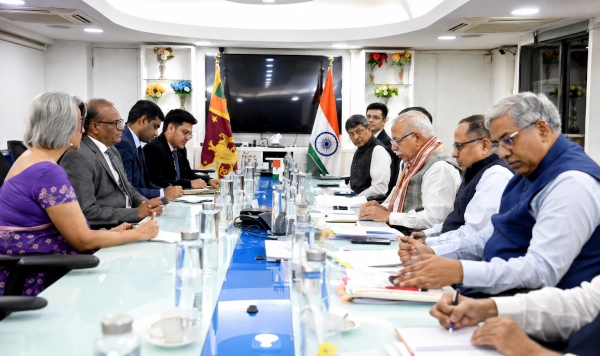
India and Sri Lanka have agreed to further strengthen cooperation in the power and energy sector, with both countries reviewing progress on key bilateral projects including the proposed India–Sri Lanka High Voltage Direct Current (HVDC) interconnection and the Sampur Solar Power Project.
The discussions were held in New Delhi between Union Minister of Power and Housing & Urban Affairs Manohar Lal and Sri Lankan Minister of Ports and Civil Aviation and Minister of Energy Anura Karunathilake.
The meeting focused on expanding bilateral energy cooperation at a time when both countries are looking to improve energy security, increase renewable-energy integration and strengthen regional electricity infrastructure.
India–Sri Lanka HVDC Interconnection Reviewed
A major focus of the meeting was the proposed India–Sri Lanka HVDC electricity interconnection, which is expected to create a direct power link between the two countries.
Such an interconnection could eventually enable cross-border electricity trade, allowing the two power systems to exchange electricity depending on demand, availability and generation conditions.
The project has broader strategic importance because it could strengthen energy connectivity between India and Sri Lanka while helping both countries make better use of renewable-energy resources.
The two sides reviewed the progress made so far under existing bilateral mechanisms and discussed ways to advance the initiative.
Sampur Solar Power Project Also on Agenda
The Ministers also reviewed developments relating to the Sampur Solar Power Project in Sri Lanka.
Renewable-energy cooperation has emerged as an important component of the India–Sri Lanka partnership, particularly as Sri Lanka seeks to increase the contribution of cleaner energy sources to its electricity system.
India has developed substantial experience in large-scale solar deployment, renewable-energy integration and transmission infrastructure, creating opportunities for deeper technical and investment cooperation with Sri Lanka.
Cross-Border Electricity Trade Discussed
Both countries explored opportunities to expand cooperation in cross-border electricity trade.
Electricity trading between interconnected national grids can help countries manage variations in demand and renewable-energy generation more efficiently.
For Sri Lanka, greater regional electricity connectivity could provide access to additional sources of power and enhance grid resilience. For India, the initiative fits into a wider approach of developing interconnected regional energy networks with neighbouring countries.
The discussions also covered cooperation in transmission infrastructure and capacity building.
India Shares TBCB Transmission Model
The Indian side shared its experience in developing electricity transmission infrastructure through the Tariff-Based Competitive Bidding (TBCB) framework.
Under this model, private-sector developers compete to build and operate transmission projects, while projects are awarded through a competitive tariff-based process.
India has increasingly used the framework as a Public-Private Partnership model for expanding its power transmission network.
Sharing India’s experience could help Sri Lanka explore different approaches for attracting private investment and improving the efficiency of future transmission projects.
Renewable Energy and Energy Security Take Centre Stage
The meeting reflected the expanding scope of the India–Sri Lanka energy relationship beyond individual power projects.
Both governments discussed cooperation in four key areas: renewable energy, transmission infrastructure, electricity trading and institutional capacity building.
These initiatives are intended to contribute to both countries’ clean-energy transition while strengthening regional energy security.
The growing share of intermittent renewable sources such as solar and wind is also increasing the importance of strong transmission networks and interconnected electricity markets.
Regional power connectivity can make it easier to balance such variations across larger electricity systems.
Both Countries Reaffirm Energy Partnership
Manohar Lal reiterated India’s commitment to the long-standing India–Sri Lanka energy partnership and expressed support for expanding cooperation between the two countries.
Anura Karunathilake appreciated India’s continued support and conveyed Sri Lanka’s commitment to further broadening bilateral energy engagement.
Both sides reaffirmed their intention to work together for sustainable development and regional energy security.
The meeting was also attended by Pankaj Agarwal, Secretary, Ministry of Power, along with senior Indian government officials.
The Sri Lankan delegation included High Commissioner of Sri Lanka to India Mahishini Colonne and other senior officials.
The latest discussions signal a continued push towards deeper energy integration between India and Sri Lanka, with the proposed HVDC interconnection, renewable-energy projects and cross-border power trade potentially forming the backbone of a more connected regional electricity system.
Reference
Press Information Bureau, Government of India
“India, Sri Lanka Discuss Deepening Cooperation in Power Sector”
Published: August 7, 2026, 5:09 PM
You may also like
-
India’s Economic Warfare Challenge: Strategic Autonomy, Energy Security and the Rise of a Global Power
-
India-US Trade Deal Stalemate: Why Washington’s Tariff Pressure Has Failed to Secure an Agreement
-
US Double Standards in Foreign Policy: 16 Recent Cases Involving India, Russia, China and Global Trade
-
India’s Arctic Energy Ambitions: Russian Oil, LNG and a New Sea Route to Indian Ports
-
Indian Navy Vice Chief Inspects Japan’s Mogami-Class Stealth Frigate as India-Japan Shipbuilding Cooperation Expands
