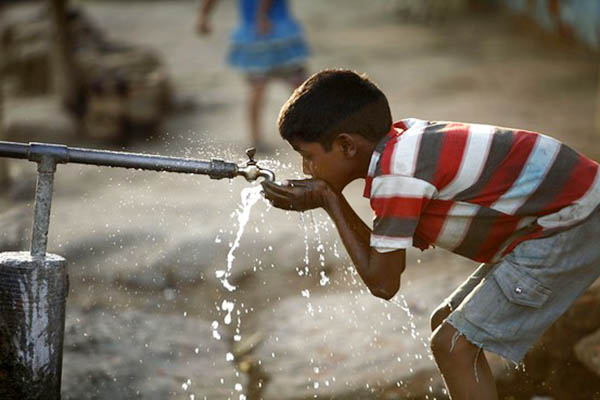
India has provided household tap-water connections to more than 82 per cent of its rural families under the Jal Jeevan Mission, marking a substantial expansion of drinking-water infrastructure across villages since the programme was launched in 2019.
According to the latest figures reported by states and Union Territories, around 15.89 crore of India’s 19.36 crore rural households had access to tap-water supply as of July 18, 2026. This represents national coverage of 82.09 per cent.
When the Jal Jeevan Mission began in August 2019, only around 3.23 crore rural households—approximately 16.71 per cent of the total—had tap-water connections. More than 12.66 crore additional households have since been connected.
The scale of this expansion has made the mission one of India’s largest rural public-infrastructure programmes. Its purpose extends beyond installing pipes and taps: the programme seeks to provide every rural household with potable water in adequate quantity, of prescribed quality, regularly and over the long term.
From 16.71% to 82.09% Coverage
The rise from less than one-fifth of rural households in 2019 to more than four-fifths in 2026 represents a major structural change in village infrastructure.
Millions of homes that previously depended on wells, hand pumps, tankers, public standposts or distant surface-water sources now have water delivered through household connections.
The mission’s service benchmark is the supply of 55 litres of potable water per person per day, conforming to the drinking-water quality requirements prescribed under BIS 10500.
The programme is being implemented by the Union government in partnership with state and Union Territory administrations. Since drinking water is a state subject, state governments remain responsible for planning, approving, constructing, operating and maintaining rural water-supply schemes, while the Centre provides financial and technical assistance.
The Next Challenge: Functional Water Supply
The 82.09 per cent figure measures households reported to have tap-water connections. The larger policy challenge is ensuring that every installed connection delivers adequate, safe and regular water.
A tap alone does not guarantee effective service. Rural systems require dependable water sources, treatment facilities, pumping equipment, electricity, storage reservoirs, distribution pipelines, trained operators and funds for repairs and maintenance.
The government’s 2024 Functionality Assessment examined 2,37,608 households across 19,812 Har Ghar Jal villages in 761 districts.
The assessment found that 98.1 per cent of sampled households possessed tap connections. However, 86.5 per cent had working connections, 80.2 per cent were receiving water in adequate quantity, 83.6 per cent were receiving water according to the prescribed schedule and 76 per cent were receiving water meeting prescribed quality standards.
These findings underline the difference between creating physical connections and sustaining reliable drinking-water services.
India’s rural water programme is therefore entering a second phase in which greater attention is being directed towards functionality, water quality, local management and the long-term sustainability of infrastructure.
Mission Extended Until December 2028
The government has extended the Jal Jeevan Mission until December 2028, allowing additional time to connect the remaining rural households and complete ongoing water-supply projects.
The revised programme has an overall outlay of approximately ₹8.69 lakh crore, including central assistance of ₹3.59 lakh crore. It seeks to shift the mission from an infrastructure-construction programme towards a citizen-centric rural water-utility model.
The extended phase will concentrate on the quality of completed works, regular service delivery, local operation and maintenance, source sustainability and community oversight.
The remaining households are often located in some of the most difficult regions to serve. These include remote habitations, hilly areas, forests, deserts, drought-prone districts and settlements facing groundwater contamination or a shortage of dependable water sources.
Reaching universal coverage may therefore require more complex and expensive engineering than the earlier phase of the programme.
Strengthening Drinking-Water Quality Monitoring
Water quality has become a central part of the mission as the network of household connections expands.
Supplying contaminated water through a tap can spread disease across an entire settlement. Rural water systems must therefore be regularly tested for bacteriological, chemical and physical contamination.
Under the mission, states and Union Territories operate a network of 2,870 water-quality testing laboratories at state, regional, district, subdivisional, block, mobile and water-treatment-plant levels, according to data reported in February 2026.
An online Water Quality Management Information System has also been developed for sample collection, reporting, surveillance and monitoring.
State governments have been advised to open water-testing laboratories to members of the public, allowing citizens to submit samples for examination at nominal charges.
Laboratory testing is particularly important in regions affected by arsenic, fluoride, iron, nitrate, salinity and microbial contamination.
The results can help local authorities identify unsafe sources, undertake corrective action and determine whether water-treatment facilities are functioning properly.
Women Trained to Test Village Water
The Jal Jeevan Mission also promotes community-level monitoring through Field Test Kits.
These kits allow trained village residents to conduct initial screening for basic water-quality indicators at household taps, schools, Anganwadi centres and local drinking-water sources.
Members of Village Water and Sanitation Committees, Pani Samitis, self-help groups and other community organisations are encouraged to conduct periodic testing.
The kits do not replace detailed laboratory analysis. They serve as a first-level surveillance mechanism that can identify possible contamination and trigger further investigation.
A major feature of the programme has been the training of women to use the testing kits. This places a basic water-monitoring capability directly within the community and gives village residents a more active role in protecting their drinking-water systems.
Earlier government data showed that around 24.8 lakh women had been trained in using Field Test Kits, while millions of samples had been screened through community-level testing.
Women’s involvement is especially significant because they traditionally bear much of the responsibility for securing and managing household water in rural areas.
Jal Arpan and Community Ownership
The government is introducing new mechanisms to involve Gram Panchayats and local communities more closely in the commissioning and management of water-supply projects.
Under the Jal Arpan initiative, completed schemes are formally handed over through community-led events involving elected representatives, Gram Sabhas, Village Water and Sanitation Committees and local residents.
A standardised handbook for community-managed piped-water systems requires a 15-day trial run before the formal transfer of a scheme. This allows local representatives to verify whether the system is operating properly and whether arrangements have been made for its maintenance.
The revised mission also proposes Jal Utsav, an annual community exercise through which villages can review the condition, performance and sustainability of their water infrastructure.
These measures are intended to prevent rural water projects from becoming neglected after construction.
Community ownership can improve the reporting of leaks, equipment failures, irregular supply and water-quality problems. It can also help villages collect reasonable user charges for electricity, operators, minor repairs and routine maintenance.
Sujalam Bharat Digital Framework
The extended Jal Jeevan Mission includes the development of a national digital system called Sujalam Bharat.
Under this framework, each village water-service area will receive a unique digital identity. The water-supply chain—from its source and treatment infrastructure to storage facilities, pipelines and household connections—will be mapped digitally.
Such mapping could improve transparency by helping administrators identify which assets are functional, where repairs are required and whether households are receiving the expected level of service.
It may also make it easier to track expenditure, examine water-quality reports and compare the performance of rural water systems across states and districts.
Digital monitoring will be most effective when combined with physical inspections and feedback from residents, since dashboard data alone cannot establish whether water is reaching a household regularly.
Benefits for Rural Women and Families
A household tap connection can produce social and economic benefits far beyond access to water.
In many rural communities, women and girls have traditionally spent significant amounts of time collecting water from wells, hand pumps, ponds or public distribution points.
Bringing water closer to the household can reduce physical strain, save time and improve personal safety. It can also give women more time for education, paid employment, farming, self-help-group activities and family care.
Children may benefit through improved hygiene and reduced exposure to waterborne diseases. Regular water availability also supports cleaner kitchens, toilets, schools, Anganwadi centres and healthcare facilities.
The World Health Organization has estimated that universal safely managed drinking-water access under the mission could save more than 5.5 crore hours every day that would otherwise be spent collecting water. It has also estimated that safe water access could prevent a substantial number of deaths from diarrhoeal diseases.
These estimates describe the potential impact of universal and safely managed supply rather than the effect of connection numbers alone.
Source Sustainability Remains Essential
The long-term success of Jal Jeevan Mission will depend on the availability of sustainable water sources.
A village pipeline can provide reliable service only when the underlying source—whether groundwater, a river, reservoir, spring or regional bulk-water system—can meet demand throughout the year.
Several regions face falling groundwater levels, recurring drought, erratic rainfall or contamination caused by natural geology and human activity.
The mission therefore includes measures such as rainwater harvesting, groundwater recharge, source strengthening, water conservation and greywater management.
These efforts are supported through coordination with programmes such as the Jal Shakti Abhiyan, Mahatma Gandhi National Rural Employment Guarantee Scheme, watershed-development programmes and Finance Commission grants to rural local bodies.
Local water-security plans will be required to ensure that newly created distribution systems remain viable during dry seasons and periods of low rainfall.
Operational and Financial Challenges
Rural water infrastructure requires continuous expenditure after construction.
Pumps consume electricity, treatment plants require chemicals and trained operators, pipelines develop leaks and storage facilities need periodic cleaning. Water sources must also be tested and protected against pollution.
State governments have been advised to establish comprehensive operation-and-maintenance policies, transfer suitable responsibilities to Gram Panchayats and Village Water and Sanitation Committees and create arrangements for financing local systems.
Women’s self-help groups may be involved in collecting user charges and managing selected operational responsibilities.
The objective is to ensure that local systems have enough financial and technical capacity to remain functional rather than depending entirely on emergency government repairs.
Other implementation challenges include delays in the release of state funds, rising construction costs, shortages of skilled personnel, difficult terrain, scattered habitations and the time required to obtain statutory clearances.
Addressing these constraints will be essential for connecting the remaining households and maintaining the infrastructure already created.
A Major Transformation of Rural Infrastructure
The increase in rural tap-water coverage from 16.71 per cent in 2019 to 82.09 per cent in July 2026 represents one of the most extensive expansions of basic household infrastructure undertaken in India.
The achievement has created a national network capable of bringing treated water directly to nearly 16 crore rural homes.
The mission’s next stage will be judged not only by the number of taps installed but by whether those taps consistently provide sufficient and safe water.
Water testing, source sustainability, trained local operators, timely repairs, community participation and transparent monitoring will determine whether the infrastructure produces lasting improvements in public health and rural living standards.
Crossing the 82 per cent threshold is therefore a major milestone, but universal access will require India to complete the remaining connections while strengthening the quality, reliability and sustainability of every rural water-supply system.
References
DD News, reports and background information on the progress and extension of the Jal Jeevan Mission.
Press Information Bureau, Ministry of Jal Shakti, “From 16.71% to 82.09%: Jal Jeevan Mission Transforming Rural Tap Water Coverage,” July 27, 2026.
Press Information Bureau, Ministry of Jal Shakti, parliamentary replies on household tap connections, functionality assessment, Field Test Kits and water-quality laboratories, 2026.
Jal Jeevan Mission, Department of Drinking Water and Sanitation, Ministry of Jal Shakti.
You may also like
-
CG Power Strengthens India’s Semiconductor Manufacturing Ecosystem with ₹7,600 Crore Sanand Investment
-
Kargil Gets Its First Heat-Pump Dehydration and Cold Storage Facility to Boost Ladakh’s Agricultural Economy
-
Ayurveda on Cold Foods and Iced Drinks: Why Food Temperature Matters for Digestion
-
India Explores 3,000 km Power Corridor to Supply 2,000 MW of Clean Electricity to Singapore
-
Serum Institute of India-Manufactured Ebola Vaccine Enters Clinical Trial in Uganda
