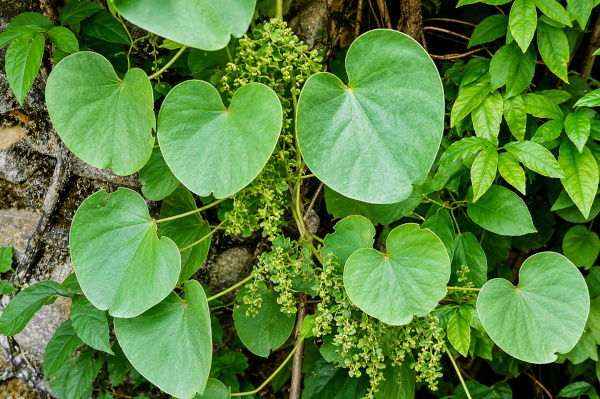
Patha, more accurately written in Sanskrit as Pāṭhā / पाठा, is an important Ayurvedic medicinal plant traditionally identified with Cissampelos pareira Linn. of the Menispermaceae family. In English, it is commonly called Velvet Leaf or Velvetleaf, though this name should not be confused with the unrelated weed also called velvetleaf in modern agriculture. In Ayurveda, the main medicinal part used is the root. The Ayurvedic Pharmacopoeia of India identifies Patha as the roots of Cissampelos pareira and describes the plant as a perennial climbing shrub found in warm and dry tropical and subtropical regions of India up to about 1500 metres altitude.
Patha is a herb of movement, digestion, cleansing and correction. It is used in classical Ayurveda for abdominal pain, diarrhoea, vomiting, fever, itching, skin disorders and disorders connected with breast milk impurity. Its bitter-pungent taste, sharp quality and heating potency make it a powerful herb for clearing stagnation, supporting digestion and purifying channels.
Botanical Identity
Sanskrit name: Pāṭhā / पाठा
Common name: Patha, Padh, Velvet Leaf, Velvetleaf
Botanical name: Cissampelos pareira Linn.
Family: Menispermaceae
Part used: Root
Classical synonym: Ambaṣṭhaki / Ambashthaki
Hindi names: Patha, Padh, Akanadi
Tamil name: Vatta tiruppi
Malayalam name: Patha
Telugu names: Adivibankatiga, Chiru Boddi, Boddi Tiga
The Ayurvedic Pharmacopoeia records several regional names for Patha, including Akanadi in Bengali, Kalipath and Venivel in Gujarati, Pahadavela in Kannada, Pashadvel in Marathi, Kanabindhi in Odia and Patha in Punjabi.
Description of the Plant
Patha is a slender, spreading and climbing shrub. It grows by twining over nearby support and can be seen in scrublands, forest edges, dry regions and tropical habitats. The stem is often nodose, meaning it has visible nodes or joint-like swellings. The plant may be glabrous or softly hairy depending on the form and growing condition.
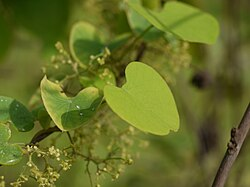
The leaves are one of the most recognisable features of the plant. They are usually rounded, broadly ovate or almost circular, with a soft velvety texture. The leaf stalk is attached slightly inside the blade rather than exactly at the margin, giving the leaf a peltate or shield-like appearance. This feature is one reason the plant is called Velvet Leaf. Botanical descriptions also describe the plant as a climber with ovate-orbicular leaves, minute greenish-yellow flowers and small deep red drupes when ripe.
The flowers are small and inconspicuous. They are usually greenish or yellowish and occur separately as male and female flowers. The fruits are small drupes, around 4–6 mm across, globose and red when mature. The seeds are characteristically curved or horseshoe-shaped.
The root, which is the main Ayurvedic drug, is cylindrical, often twisted, light brown to yellowish in colour, rough on the surface and marked by wrinkles, cracks and fissures. The Pharmacopoeia describes the root as having a faint aromatic odour and bitter taste.
Ayurvedic Nature of Patha
Patha is understood in Ayurveda through its rasa, guna, virya, vipaka and karma. These properties explain its use in digestive, cleansing, skin and channel-related conditions.
Rasa: Katu and Tikta — pungent and bitter
Guna: Laghu and Tikshna — light and sharp
Virya: Ushna — heating potency
Vipaka: Katu — pungent post-digestive effect
Main karma: Bhagnasandhanakrit, Grahi, Raktashodhaka, Vishaghna, Tridoshashamana and Stanyashodhana
The Ayurvedic Pharmacopoeia records Patha as having katu-tikta rasa, laghu-tikshna guna, ushna virya and katu vipaka. It also lists its actions as grahi, raktashodhaka, vishaghna, tridoshashamana and stanyashodhana.
Patha and Digestion
Patha is a valuable herb for the digestive system. Its bitter and pungent taste helps awaken sluggish digestion, while its sharp and heating nature helps clear obstruction. Ayurveda uses Patha in conditions where ama, kapha, vata disturbance and weak agni create abdominal discomfort.
The Pharmacopoeia lists shularoga, atisara and chardi among its therapeutic uses. These correspond broadly to abdominal pain, diarrhoea and vomiting in Ayurvedic terminology.
Its grahi action is especially important. Grahi herbs help absorb excess fluid, support intestinal tone and restore balance in conditions of loose motions when selected properly. This does not mean Patha should be used casually for every case of diarrhoea. In Ayurveda, the cause, dosha, strength of patient, presence of fever, dehydration, infection and other symptoms must be understood before using any herb.
Patha for Fever and Ama
Patha is traditionally mentioned in relation to jvara, or fever. Its bitter taste, sharp quality and channel-clearing nature make it useful in classical formulations where fever is connected with ama, digestive disturbance and doshic obstruction.
In Ayurveda, fever is not treated only as high temperature. It is understood through agni, dosha, ama, strength and the affected channels. Patha’s role is most suitable where the physician sees the need for lightness, digestion, cleansing and removal of stagnation.
Patha and Skin Health
Patha is listed in the Ayurvedic Pharmacopoeia for kandu and kushtha, which refer to itching and broad categories of skin disorders in Ayurvedic understanding.
The action raktashodhaka, meaning blood-purifying in the Ayurvedic sense, explains its classical use in selected skin conditions. Ayurveda links many skin disorders with rakta, pitta, kapha, ama and impaired digestion. Patha’s bitter-pungent and sharp nature helps clear channels and support internal purification when used in a proper formulation.
It is especially suited to conditions where itching, stagnation, kapha accumulation or ama involvement is present. In strongly burning, bleeding or highly inflamed skin conditions, professional assessment is important because the herb has heating potency.
Patha and Stanyashodhana
One of the special actions of Patha is stanyashodhana, meaning purification or correction of breast milk in Ayurvedic terminology. The Pharmacopoeia lists stanyadushti among its therapeutic uses.
This is a specialised classical indication. It does not mean nursing mothers should self-medicate with Patha. Herbs used during lactation must be chosen carefully because they affect both mother and child. Patha in this context belongs to physician-guided Ayurvedic care, especially when there is doshic disturbance affecting digestion, milk quality or maternal health.
Patha as Vishaghna
Patha is also described as vishaghna, a term used in Ayurveda for substances that help counter toxic states or poison-like conditions within the traditional framework. This does not mean it is an emergency antidote for poisoning. It means classical Ayurveda valued the herb for clearing harmful states, ama-like toxicity, impurities and certain conditions where the body required purification and channel correction.
The vishaghna idea should be presented carefully in modern writing. For actual poisoning, snakebite, chemical exposure, drug overdose or severe allergic reaction, emergency medical care is essential.
Important Classical Formulations
Patha appears in several important Ayurvedic formulations. The Ayurvedic Pharmacopoeia lists Brihat Gangadhara Churna, Pushyanuga Churna, Pradarantaka Lauha, Sarasvata Ghrita and Stanyashodhana Kashaya Churna among formulations associated with Patha.
This shows that Patha was rarely treated as a casual household spice. It was valued as a strong formulation herb used with other ingredients to direct its action properly. In such combinations, Patha contributes digestive correction, scraping, cleansing, grahi action, skin support and channel purification.
Identity Confusion: Laghu Patha, Raja Patha and Substitutes
Patha is one of the Ayurvedic drugs where botanical identity has sometimes created confusion in trade and regional practice. A comparative phytochemical study notes that the Ayurvedic Pharmacopoeia recognises the roots of Cissampelos pareira as Patha, while other plants such as Cyclea peltata and Stephania japonica have also been used as sources or substitutes in different traditions. The same study notes that Cissampelos pareira is often referred to as Laghu Patha and Cyclea peltata as Raja Patha in various literature.
This is important for quality and safety. A herb’s Ayurvedic action depends on correct identity, correct part used, correct processing and correct dose. For Patha, the root of authenticated Cissampelos pareira should be used when the article or formulation specifically refers to this botanical source.
Classical Recipe: Yavani Nagaradya Takra from Charaka Chikitsa Sthana
A classical preparation connected with Patha is Yavani Nagaradya Takra, also described as Ginger Carom Spiced Buttermilk. The reference is given as Charaka Chikitsa Sthana 14/99, and the preparation belongs to the category of Pana, meaning a drinkable medicinal preparation. This recipe uses Takra or buttermilk as the base and combines it with Yavani, Nagara, Patha, Dadima, Guda and Saindhava Lavana. The ingredients are finely powdered and mixed thoroughly with buttermilk to prepare the drink.
Ingredients and Preparation
The main ingredient is Takra or buttermilk, used as one part. To this are added Yavani or carom fruit (Trachyspermum ammi), Nagara or dry ginger rhizome (Zingiber officinale), Patha or velvet leaf root (Cissampelos pareira), Dadima or pomegranate seed (Punica granatum), Guda or jaggery, and Saindhava Lavana or rock salt in suitable quantity. All the ingredients are ground into a fine powder and mixed well with Takra.
The preparation is described as ushna in potency, with amla, madhura and tikta taste elements, along with ruksha and laghu qualities. Traditionally, it is indicated as beneficial in Arsha, or piles, and for vata-varcha anulomana, meaning the proper downward movement of flatus and faeces.
Ayurvedic Understanding of the Recipe
Yavani Nagaradya Takra is a good example of Ayurveda’s intelligent use of buttermilk as medicine. Takra supports digestion, lightness and grahi action. Yavani helps reduce gas and kindle agni. Nagara supports digestion, warmth and vata-kapha balance. Patha adds its grahi, raktashodhaka and channel-clearing qualities. Dadima supports digestion while adding a sour-sweet balance. Guda provides mild sweetness and nourishment, while Saindhava Lavana supports taste, digestion and vata anulomana.
The recipe is especially meaningful in the context of Patha because it shows how this herb was used as part of a digestive and downward-moving formulation. In Ayurvedic understanding, Arsha and disturbed bowel movement are closely linked with agni, vata, mala movement and local channel obstruction. This preparation brings together warming, digestive, grahi and anulomana ingredients in a drinkable form.
Manuscript and Classical Reference Note
The recipe is attributed to the Charaka Samhita, Chikitsa Sthana, chapter 14, verse 99. Chikitsa Sthana is the therapeutic section of the Charaka tradition, where disease management, dietetic preparations, medicinal drinks, formulations and clinical principles are explained in detail. The presence of Patha in Yavani Nagaradya Takra shows its respected role in classical Ayurveda as a herb for digestion, bowel regulation, channel purification and vata-kapha correction. Such manuscript-based recipes also reveal that Ayurveda preserved medicine not only as powders, decoctions and pills, but also through food-like preparations such as Takra-based drinks designed for specific clinical needs.
Safety Note
Yavani Nagaradya Takra contains heating and active ingredients such as Yavani, Nagara and Patha. It should not be used casually in pregnancy, severe acidity, ulcers, burning sensation, bleeding piles, chronic bowel disease, serious abdominal pain or while taking medication without advice from a qualified Ayurvedic physician. Classical formulations should always be used according to constitution, disease stage, digestive strength and medical history.
Modern View of Cissampelos pareira
Modern studies have examined Cissampelos pareira for its phytochemical profile. The Ayurvedic Pharmacopoeia records constituents such as alkaloids, saponin, quaternary ammonium bases, flavonol and sterol.
A comparative study on Patha sources found that roots of Cissampelos pareira could be distinguished from other market-used sources by their phytochemical profile, including a higher concentration of alkaloids and the presence of bebeerine.
Such research supports the importance of proper botanical authentication. In Ayurveda, the herb is understood not only by chemical constituents but also by rasa, guna, virya, vipaka, karma, formulation context and suitability for the individual.
Dose and Safe Use
The Ayurvedic Pharmacopoeia gives the adult dose of Patha as 3–6 g of the drug in powder form.
This is a classical adult dose range and should be interpreted by a qualified Ayurvedic practitioner. Patha is sharp and heating. It should be used carefully in people with high pitta, burning sensation, gastritis, ulcers, pregnancy, lactation, chronic illness, liver or kidney disease, severe dehydration, children, elderly people or those taking prescription medicines.
Self-medication is especially unsuitable in fever, diarrhoea, vomiting, skin disease, poisoning-like conditions or lactation-related concerns. These conditions need proper medical assessment.
Conclusion
Patha, or Cissampelos pareira, is a respected Ayurvedic climber whose root carries bitter, pungent, sharp and heating qualities. Its velvety rounded leaves, twining habit, small greenish flowers and red drupes make it a distinctive plant in the wild, while its root gives it an important place in classical medicine.
Ayurveda values Patha for digestion, abdominal disorders, fever, itching, skin conditions, rakta purification, grahi action and stanyashodhana. It is a herb of correction and clearing, used where the body needs lightness, movement, purification and proper channel function.
Patha also teaches the importance of correct identification. Because several plants have been used under the name Patha in different regions, authenticated botanical sourcing is essential. When used properly, Patha stands as a fine example of Ayurvedic intelligence: a climbing forest herb transformed into a precise medicine through observation, classification and clinical tradition.
References
- The Ayurvedic Pharmacopoeia of India, Part I, Volume I. Government of India / Department of AYUSH. Entry on Patha / Cissampelos pareira.
https://www.ayurveda.hu/api/API-Vol-1.pdf - Charaka Samhita, Chikitsa Sthana, Chapter 14. Classical reference for Arsha Chikitsa and Takra-based preparations.
https://www.siva.sh/caraka-samhita/chikitsa-sthana/14 - Recipe source supplied for this article: “03.19 Yavani Nagaradya Takra (Ginger Carom Spiced Buttermilk), Reference: Charaka Chikitsa Sthana 14/99.” Ingredients listed: Takra, Yavani, Nagara, Patha, Dadima, Guda and Saindhava Lavana.
- India Biodiversity Portal / India Flora. “Cissampelos pareira L.” Botanical description and plant identification details.
https://indiaflora-ces.iisc.ac.in/herbsheet.php?cat=13&id=2589 - Comparative phytochemical study on Patha sources: Cissampelos pareira, Cyclea peltata and Stephania japonica.
https://pmc.ncbi.nlm.nih.gov/articles/PMC2883225/ - Kew Science, Plants of the World Online. “Cissampelos pareira L.” Botanical taxonomy reference.
https://powo.science.kew.org/ - National Center for Biotechnology Information. “Cissampelos pareira” related phytochemical and botanical literature.
https://www.ncbi.nlm.nih.gov/
Disclaimer: This article is for educational purposes only and is not medical advice. Ayurvedic herbs should be used with guidance from a qualified physician or Ayurvedic practitioner, especially during pregnancy, breastfeeding, chronic illness, childhood, old age or while taking medication.
You may also like
-
How Much Exercise Is Enough According to Ayurveda?
-
AIIA and 132 ECO Task Force Launch 10,000-Plant Ashwagandha Research Initiative in Delhi’s Aravalli Landscape
-
Dr Reddy’s to Bring India’s First CDSCO-Approved Dengue Vaccine QDENGA to Private Market in 2027
-
The Ayurvedic Approach to Exercise and Physical Activity
-
FSSAI Moves to Reserve ‘Paneer’ Name for Milk-Derived Products
