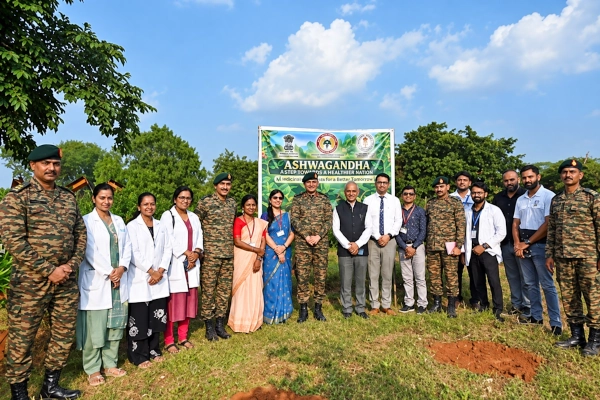
The All India Institute of Ayurveda (AIIA) and the 132 Infantry Battalion (Territorial Army) ECO RAJPUT have launched a major Ashwagandha plantation and research initiative at the Terriers Herbal Garden in Bhatti Mines, South Delhi, bringing together Ayurveda, medicinal-plant research, biodiversity conservation and ecological restoration in the Aravalli landscape.
Under the initiative, 10,000 Ashwagandha saplings will be planted and scientifically monitored to study their growth, adaptation and performance under the climatic and environmental conditions of the region. The programme also seeks to demonstrate how India’s traditional knowledge of medicinal plants can be combined with systematic scientific observation and landscape restoration.
The initiative was formally launched on September 24, 2026, under the leadership of Prof. (Vaidya) Pradeep Kumar Prajapati, Director of AIIA, and Colonel Mohan Singh, Commanding Officer of 132 Infantry Battalion (Territorial Army) ECO RAJPUT.
10,000 Ashwagandha Plants to Undergo Scientific Monitoring
The project will involve the plantation of 10,000 saplings of Ashwagandha, or Withania somnifera, one of the best-known medicinal plants used in Ayurveda. Rather than limiting the programme to plantation alone, the collaborating institutions intend to regularly observe, document and scientifically evaluate the plants as they establish themselves within the Bhatti Mines-Aravalli environment.
Researchers will examine the growth and adaptation of Ashwagandha under local climatic and ecological conditions. The resulting observations could contribute to a better understanding of medicinal-plant cultivation in semi-arid and environmentally restored landscapes.
AIIA will bring its expertise in Ayurveda, Dravyaguna, medicinal plants and research, while the Territorial Army’s Ecological Battalion will contribute its experience in afforestation, biodiversity conservation and restoration of degraded land.
The collaboration therefore combines two areas that are often treated separately: the scientific study of medicinal plants and the rehabilitation of damaged ecosystems.
Connecting Ayurvedic Knowledge With Modern Research
Ashwagandha occupies an important place in classical Ayurvedic practice and has traditionally been associated with the maintenance of health and vitality. The Bhatti Mines initiative aims to extend the study of the plant beyond its medicinal applications by examining how it performs within a restored ecological landscape.
According to AIIA Director Prof. Pradeep Kumar Prajapati, systematic cultivation, conservation and scientific documentation of medicinal plants can simultaneously contribute to knowledge generation and biodiversity protection.
The initiative reflects a broader approach in which Ayurveda is connected with plant science, ecology and sustainability, rather than being confined solely to clinical applications. Long-term observation of the plantation could also provide useful field-level information for future medicinal-plant cultivation and conservation programmes.
Bhatti Mines and the Ecological Restoration of the Aravallis
The location of the project gives the programme additional environmental significance. Bhatti Mines forms part of Delhi’s Southern Ridge and the wider Aravalli landscape, an ecologically important region that has faced considerable pressure from mining and other human activity.
The 132 Infantry Battalion (Territorial Army) ECO RAJPUT has been involved in plantation and ecological restoration work in areas affected by mining. Ecological battalions of the Territorial Army have played an important role in restoring degraded landscapes through afforestation and environmental conservation programmes.
Introducing scientifically monitored medicinal plants into such restoration areas creates an opportunity to examine whether selected species can contribute both to ecological rehabilitation and to the conservation of India’s medicinal-plant resources.
The initiative therefore goes beyond establishing a medicinal garden. It places Ashwagandha cultivation within a larger programme of biodiversity recovery and Aravalli restoration.
Terriers Herbal Garden Conserves Around 200 Medicinal Plant Species
The Terriers Herbal Garden at Bhatti Mines already contains around 200 species of medicinal and Ayurvedic significance. Plants conserved at the site include Parijata or Harshringar, Amla or Indian Gooseberry and Ghritkumari or Aloe Vera, along with numerous other medicinal species.
AIIA has been entrusted with providing technical support for the scientific management, maintenance and development of the herbal garden. Its involvement can help ensure that the plants are maintained according to appropriate botanical and medicinal-plant conservation practices.
The garden can consequently function not only as a plantation site but also as a living resource for the study, documentation and conservation of medicinal plants.
AIIA Researchers to Support the Project
The programme involves specialists from AIIA’s Department of Dravyaguna, the branch of Ayurveda concerned with medicinal substances and their properties.
Participants included Dr. Meena Deogade, Head of the Department of Dravyaguna, Associate Professor Dr. Shivani Ghildiyal, Assistant Professor Dr. Bidhan Mahajon, PhD research scholars and personnel from the 132 Infantry Battalion.
The planning and implementation of the collaboration were coordinated by Major Jai Singh Shekhawat of the 132 Infantry Battalion and Major (Dr.) Ashish Kumar of AIIA.
The participation of researchers and doctoral scholars could allow observations from the plantation to be systematically recorded and incorporated into broader medicinal-plant research.
Ashwagandha and India’s Medicinal Plant Conservation Efforts
Ashwagandha, scientifically known as Withania somnifera, is among the medicinal plants widely associated with Ayurveda and is cultivated in several parts of India.
The National Medicinal Plants Board under the Ministry of Ayush has also promoted public awareness of the plant through its “Ashwagandha – A Health Promoter” campaign.
The growing scientific and commercial interest in medicinal plants has made sustainable cultivation and conservation increasingly important. Programmes that combine research, cultivation and habitat restoration can help build a stronger knowledge base while reducing pressure on medicinal plants collected from natural habitats.
The Bhatti Mines project provides an opportunity to observe how a significant Ayurvedic species performs when incorporated into a larger ecological restoration programme.
Ayurveda, Biodiversity and Landscape Restoration Come Together
The partnership between AIIA and the 132 ECO Task Force represents an unusual convergence of medicinal-plant science and environmental rehabilitation.
By planting and scientifically monitoring 10,000 Ashwagandha plants in the Aravalli landscape, the programme could generate useful information about plant adaptation while simultaneously expanding medicinal-plant conservation within a restored ecosystem.
Its underlying message — “Roots in Ayurveda – Conserve Biodiversity – Restore Ecosystems” — captures the broader objective of the initiative: connecting India’s traditional medicinal-plant knowledge with scientific research and the restoration of degraded natural landscapes.
At Bhatti Mines, that approach is now taking physical form through thousands of Ashwagandha plants taking root in a landscape that itself is undergoing ecological renewal.
References
Press Information Bureau, Ministry of Ayush, Government of India — “AIIA and 132 ECO Task Force Join Hands for Ashwagandha Plantation and Research in Aravalli Landscape,” published September 25, 2026.
All India Institute of Ayurveda, Ministry of Ayush, Government of India.
National Medicinal Plants Board, Ministry of Ayush, Government of India — Ashwagandha medicinal-plant awareness and conservation initiatives.
You may also like
-
The Ayurvedic Approach to Work-Life Balance: Restoring Harmony Between Work, Health and Personal Life
-
Ayurveda and Mental Fatigue in the Digital Age: Ancient Wisdom for a Calm and Focused Mind
-
Bharat Biotech’s Nucelion and VeGen Bio Partner to Manufacture Advanced Dual-Target CAR-T Cancer Therapy in India
-
Ayurveda and Anger: How Emotional Excess Affects Physical and Mental Health
-
Ayurveda and Stress: Daily Practices for Mental Balance and Emotional Well-Being
