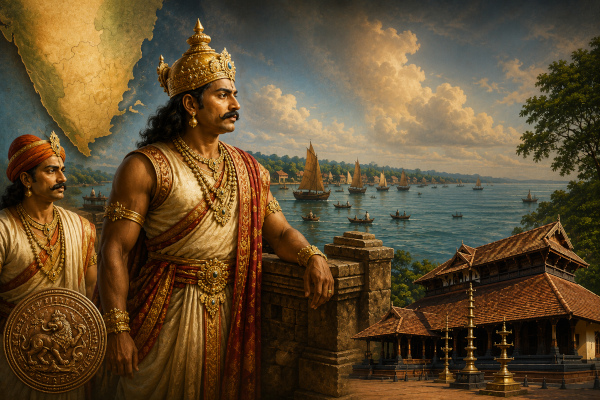
Desinganad Rajas were rulers associated with the historic Kollam region, one of Kerala’s oldest maritime and royal centres. The name Desinganad is closely linked with old Kollam, also known as Quilon, and with the wider Venad royal tradition that later became part of the political foundation of Travancore. The official Kollam district history records that the oldest name of Kollam was Desinganadu, connected with King Jayasimha, from whom the Venad dynasty is traditionally said to have originated.
Desinganad was more than a local chieftaincy. It represented the Kollam-centred branch of a larger royal world that connected the old Chera legacy, Venad, the port economy of Quilon, temple patronage, martial politics and Kerala’s transition into the Travancore age. Kollam’s position on the Arabian Sea gave these rulers access to trade, diplomacy and wealth, making the region one of the most important political landscapes of southern Kerala.
The Meaning Of Desinganad
The name Desinganad is generally connected with Jayasimha, also rendered as Jaya Simha or Jayasimhan. Jayasimhanadu gradually became Desinganadu in local usage. This gives the name both a royal and territorial meaning: it refers to the land associated with Jayasimha and the Kollam-based political world that carried his memory. Kollam district’s official history directly links the name Desinganadu with King Jayasimha and the Venad origin tradition.
In historical usage, Desinganad is closely tied to Kollam, the old port city known to travellers as Quilon. It was one of the key seats of Venad, and the Desinganad Rajas belonged to the royal network that shaped the region’s medieval identity.
Kollam: The Royal And Maritime Heartland
Kollam was one of the most important cities of medieval Kerala. It served as a hub of royal administration and was the capital of the ancient Venad province during the 9th to 12th centuries CE. Its location near the sea and the natural harbour at Neendakara made it a centre of trade with foreign merchants from early times. References to Kollam appear in Roman and Phoenician accounts, and later in the writings of Chinese, Arab and European travellers such as Ibn Battuta, Sulaiman Al-Tajir and Marco Polo.
This maritime background shaped the power of the Desinganad Rajas. Their authority grew in a region where ships, pepper, ports, temples, palaces and royal administration worked together. The ruler of such a landscape needed military strength on land, diplomatic skill at sea and the ability to protect trade routes.
Jayasimha And The Rise Of Desinganad
Jayasimha is remembered as one of the important figures in the Venad tradition. A study of Venad epigraphical records describes Jayasimha as a notable warrior king, after whom the kingdom came to be known as Jayasimhanad or Desinganadu. The same study notes that Jayasimha succeeded Ravi Varma as ruler of Venad and was remembered for skill in both war and peace.
This image of Jayasimha is important because it gives Desinganad a heroic royal identity. He appears in memory as a ruler who combined battlefield ability with statecraft. Through him, the Kollam region gained a name that survived in historical tradition, local identity and royal memory.
Link With Venad And The Chera Legacy
The Desinganad Rajas were part of the wider Venad political structure. Venad itself emerged from the southern portion of the old Chera world and became one of the major powers of medieval Kerala. The early Venad royal seat was at Kollam. A lineage history of the Travancore royal family notes that Ayyan Adikal Thiruvadikal, one of the earliest Venad kings known through inscriptional evidence, issued a copper plate grant from his royal seat at Kollam. The same source says Sanskrit and Malayalam literary works such as Sukasandesam and Unnuneeli Sandesam remembered Kollam as a capital of the Venad/Kupaka kings.
The royal family later developed different branches or thavazhis, including Thrippapur, Desinganad or Jayasimhanadu, Elayidathu Swaroopam of Kottarakara and Perakam Swaroopam of Nedumangad. This shows that Desinganad was part of a larger royal network rather than an isolated house.
Political Importance Of The Desinganad Rajas
The Desinganad Rajas ruled in a region where control of Kollam meant access to ports, customs, trade links and fertile hinterlands. Kollam’s maritime reputation made it one of the prized regions of Kerala. The District Court of Kollam records that old Desinganadu had a sustained commercial reputation from the days of the Phoenicians and Romans, was fed by Chinese trade, and was regarded by Ibn Battuta as one of the five ports he had seen during his long travels in the 14th century.
This commercial strength gave the rulers of Desinganad a political weight that extended beyond the borders of Kollam. A king who commanded Kollam had influence over pepper movement, coastal exchange, temple wealth, artisan networks and interactions with foreign traders. This made Desinganad a powerful coastal kingdom within Kerala’s medieval political map.
Administration And Royal Order
The Desinganad Rajas followed the Kerala model of royal authority, where kingship worked through palace households, temple institutions, warrior groups, landholding elites and local administrative units. Venad’s branches followed the matrilineal succession system, and the royal structure was built through swaroopams and thavazhis. The Travancore lineage account records that the wider royal family developed different branches, including Desinganad, and that the senior competent member from these branches could rule as Kulasekhara Perumal.
This system gave Kerala kingship its distinctive character. Authority was tied to family seniority, ritual legitimacy, military strength and temple duty. The ruler was expected to protect the land, support temples, maintain order, secure trade and preserve the dignity of the royal house.
Trade, Pepper And The Port Of Quilon
The economic power of Desinganad was inseparable from Kollam’s port. Kerala Tourism describes Kollam as a historic trade hub of the ancient world, celebrated by travellers such as Marco Polo and Ibn Battuta, and as a port active in the global spice trade.
Pepper was one of the great commodities that connected Kollam with the wider Indian Ocean. The port drew Arab, Chinese and later European attention because it was placed on the maritime route between West Asia, India and East Asia. For the Desinganad Rajas, this trade network meant wealth, influence and constant interaction with foreign powers.
Cultural And Religious Patronage
Like other Kerala rulers, the Desinganad Rajas operated in a sacred cultural environment. Kollam district is known for temples, palaces, festivals and royal heritage. Kerala Tourism highlights Kollam’s religious and cultural heritage through temples, palaces and festivals, including the famed Krishnapuram Palace and the district’s old temple traditions.
The Desinganad royal world would have been shaped by the Kerala pattern of temple-centred society. Temples functioned as spiritual centres, landholding institutions, cultural patrons and community anchors. Royal legitimacy was strengthened through temple offerings, festival protection, land grants and the defence of sacred institutions.
Desinganad And The Travancore Transition
Over time, the different branches of Venad became part of the wider political consolidation that produced Travancore. Marthanda Varma, who ruled from 1729 to 1758, expanded and consolidated the kingdom by bringing together branches and neighbouring territories. The Travancore lineage account states that he amalgamated the branches of the dynasty, including Attingal, Nedumangad, Kottarakara and Kollam, before extending Travancore further northward.
This marked a major transformation. Desinganad’s independent royal identity became part of the larger Travancore state system. Yet Kollam retained its importance as a major administrative, commercial and cultural centre. At the time Travancore and Cochin were integrated in 1949, Kollam remained one of the state’s revenue divisions.
Legacy Of The Desinganad Rajas
The legacy of the Desinganad Rajas lives in the historic identity of Kollam. The name Desinganad still carries the memory of Jayasimha, the Venad royal house, the port of Quilon, the spice trade and the political culture of medieval Kerala. It reminds us that Kollam was a royal seat, a maritime gateway and a civilisational contact point between Kerala and the wider world.
The Desinganad Rajas represent a phase of Kerala history where kingship was tied to sea trade, temple culture, martial duty and regional identity. Their story is also the story of Kollam itself: a city of ports and palaces, traders and rulers, inscriptions and legends, royal memory and living heritage.
Conclusion
Desinganad Rajas were among the important royal figures associated with Kollam’s historic rise. Their world stood at the meeting point of Venad politics, Chera memory, Arabian Sea trade and Kerala’s sacred geography. Through Jayasimha and the Desinganad tradition, Kollam gained a royal identity that remained alive even after the rise of Travancore.
For Kerala’s history, Desinganad is not merely an old name. It is a reminder that Kollam was once a powerful royal and maritime centre whose rulers helped shape the political, economic and cultural destiny of southern Kerala.
References:
District Kollam, Government of Kerala. “History.” Official district website.
District Court Kollam, Government of India. “History.” Official District Court Kollam website.
Kerala Tourism. “District of Kollam / Quilon.” Department of Tourism, Government of Kerala.
Swathi Thirunal official website. “History of Swathi Thirunal’s Lineage.”
Royal Titles, Epithets and Kingship: An Archaeological Analysis into the Epigraphical Records of Venad Kings. ResearchGate / Human and Heritage: An Archaeological Spectrum of Asiatic Countries.
You may also like
-
Kishkindha — The Boulder Kingdom of Pampa, Rishyamukha and the Tungabhadra
-
Setu — The Sacred Southern Crossing Between Rameswaram and Lanka
-
One Voice – One Resolve – One India: Namami Bharatam Marks 150 Years of Vande Mataram Across the Nation
-
Dravida — The Ancient Tamil Country of Rivers, Temples and the Southern Ocean
-
Pandya — The Southern Kingdom of the Vaigai, Tamiraparani and the Pearl-Rich Sea
