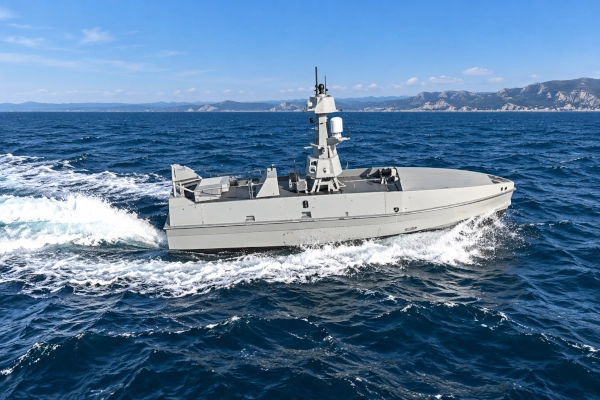
French naval defence company Naval Group has demonstrated its Seaquest S unmanned surface vessel to the Defence Attaché of the Embassy of India in France, bringing one of the company’s latest autonomous maritime platforms directly before an Indian defence representative.
Naval Group India confirmed the demonstration on September 25, 2026, stating that the Defence Attaché visited a Naval Group facility where the company showcased the Seaquest S USV and other unmanned systems. The company described the engagement as an opportunity to present advanced autonomous naval technologies while highlighting the expanding India–France defence partnership.
The demonstration does not constitute an announced Indian Navy procurement or formal acquisition programme. It nevertheless provides India with direct exposure to a new generation of European unmanned maritime systems at a time when autonomous platforms are becoming increasingly important in naval warfare.
Seaquest S Represents Naval Group’s Push Into Autonomous Maritime Systems
The Seaquest S forms part of Naval Group’s expanding portfolio of naval drones and autonomous systems.
The vessel has been developed by SIREHNA, Naval Group’s specialist subsidiary working on naval hydrodynamics, control systems and autonomous maritime technologies. Naval Group describes Seaquest S as a system designed around integrability, adaptability and operational testing at sea, allowing the platform to support different mission configurations.
Rather than designing an unmanned vessel around a single permanent mission, the Seaquest concept emphasises a modular architecture capable of integrating different sensors and mission payloads.
This flexibility is increasingly important as navies explore unmanned vessels for surveillance, reconnaissance, environmental monitoring, mine warfare, force protection and other missions where sending a crewed warship may be unnecessary or expose personnel to additional risk.
Demonstration Included Other Naval Drones
Naval Group’s announcement makes clear that the Indian Defence Attaché was shown not only the Seaquest S, but also other drones from the company’s autonomous naval portfolio.
That broader demonstration is significant because Naval Group has been building a wider family of unmanned systems covering both surface and underwater operations.
Autonomous platforms are becoming increasingly integrated with conventional naval forces, allowing crewed ships, submarines and aircraft to operate alongside remotely controlled or increasingly autonomous systems.
For the Indian Navy, such technologies are particularly relevant because of the enormous maritime area that India must monitor across the Arabian Sea, Bay of Bengal and wider Indian Ocean Region.
No Indian Procurement Has Been Announced
The demonstration should not be interpreted as confirmation that the Indian Navy is purchasing Seaquest S.
Neither the Ministry of Defence nor the Indian Navy has announced a procurement programme for the platform, and Naval Group’s statement describes the interaction specifically as a technology demonstration.
The engagement is therefore better understood as an opportunity for an Indian defence representative to examine the capabilities and technological direction of Naval Group’s unmanned maritime systems.
Such demonstrations can precede future technical discussions, industrial partnerships or formal requirements, but they do not by themselves establish that an acquisition process has begun.
India and France Deepen Cooperation in Advanced Defence Technology
The Seaquest S demonstration comes during a period of substantial expansion in India–France defence cooperation.
India and France elevated their relationship to a Special Global Strategic Partnership in 2026. During bilateral discussions in June, Prime Minister Narendra Modi and French President Emmanuel Macron expressed satisfaction with the depth of defence cooperation across multiple domains and agreed to intensify collaboration in co-design, co-development and co-production of advanced defence platforms and technologies.
Earlier in February 2026, the two countries renewed their defence cooperation agreement for another ten years during the India–France Annual Defence Dialogue in Bengaluru.
The two sides also emphasised closer cooperation between Indian and French defence industries, particularly in niche and advanced technologies.
Emerging Technologies Now Part of India–France Defence Agenda
The India–France relationship is increasingly moving beyond conventional defence purchases toward joint work on emerging military technologies.
An official India–France statement issued in February 2026 called for greater cooperation in joint research, co-design, co-development and co-production of advanced defence platforms across the air, land and naval domains.
The two countries also agreed to establish a Joint Advanced Technology Development Group to identify opportunities for developing emerging and critical defence technologies while reducing supply-chain vulnerabilities.
Autonomous naval systems fit naturally within this expanding area of cooperation because drones, artificial intelligence, distributed sensors and unmanned platforms are increasingly shaping the future architecture of maritime warfare.
Indian Navy and France Maintain a Strong Maritime Relationship
The demonstration also coincided with active engagement between the Indian Navy and French Navy.
INS Trishul arrived at Toulon, France, on September 22, 2026, for the 24th edition of the bilateral maritime exercise VARUNA.
The Ministry of Defence said the exercise includes professional engagements ashore and at sea, operational interactions and exchanges intended to strengthen interoperability between the two navies. The ministry described the deployment as reflecting the expanding scope of India–France maritime cooperation.
Naval Group personnel also visited INS Trishul during its Toulon port call, adding an industrial dimension to the continuing naval interaction between the two countries.
Naval Group Already Has Deep Links With India
Naval Group is not a newcomer to India’s maritime defence sector.
The French company has played a central industrial role in Project 75, under which six Kalvari-class Scorpene submarines were constructed in India through cooperation with Mazagon Dock Shipbuilders Limited.
India and France have repeatedly highlighted the programme as an example of Make in India and technology cooperation in naval shipbuilding. Official bilateral statements have also referred to ongoing work related to the integration of an Indian-developed Air Independent Propulsion system into the Scorpene platform.
Naval Group India now operates from Mumbai, New Delhi and Karwar, supporting submarine programmes, localisation and lifecycle services for the Indian Navy.
Naval Group Expands Cooperation With Indian Industry
The company is simultaneously expanding relationships with Indian private-sector defence manufacturers.
In September 2026, Naval Group and NIBE Limited signed a strategic memorandum of understanding covering cooperation in advanced naval technologies, including medium-sized underwater drones, mine countermeasure systems and modular launching systems.
Naval Group India described the partnership as supporting Atmanirbhar Bharat and the development of sovereign naval capabilities within India.
This makes the Seaquest demonstration particularly noteworthy because it occurs alongside a broader effort by the French company to establish industrial relationships around autonomous and unmanned maritime technologies in India.
Why Unmanned Surface Vessels Matter to Modern Navies
Unmanned Surface Vessels, or USVs, are emerging as an important component of future naval force structures because they can perform tasks that would otherwise require crewed ships or expose sailors to greater danger.
Persistent maritime surveillance is one of their most obvious applications. Autonomous vessels equipped with electro-optical systems, radar, electronic sensors or acoustic equipment can patrol areas for extended periods while feeding information into a larger maritime surveillance network.
Mine countermeasures represent another important application. Sending an unmanned platform into waters suspected of containing naval mines can reduce the risk to conventional ships and their crews.
USVs may also eventually operate as part of distributed naval formations in which larger warships coordinate groups of unmanned surface, underwater and airborne systems.
Autonomous Platforms Could Expand India’s Maritime Surveillance Reach
India faces a particularly demanding maritime surveillance environment.
The country sits astride important international shipping routes while maintaining security responsibilities across an extensive coastline, island territories and a vast Exclusive Economic Zone.
The Indian Navy must also monitor developments across the wider Indian Ocean Region, where commercial shipping, submarines, naval vessels and increasingly sophisticated unmanned systems operate simultaneously.
Autonomous platforms could supplement aircraft, satellites, warships and shore-based sensors by providing persistent surveillance without requiring the same manpower and operating costs as conventional vessels.
The strategic value lies not simply in replacing crewed vessels, but in allowing the Navy to distribute sensors across a much larger maritime area.
Seaquest Demonstration Reflects a Wider Shift in Naval Warfare
Naval warfare is steadily moving toward mixed formations in which crewed ships operate alongside autonomous systems above, on and below the surface.
The Seaquest S demonstration to India’s Defence Attaché in France provides another indication of how rapidly these technologies are entering mainstream defence engagement between major maritime powers.
There is currently no announced Indian procurement of Seaquest S, and the demonstration should not be portrayed as one. Its significance instead lies in direct Indian exposure to a developing family of French autonomous naval technologies at a time when India and France are actively expanding cooperation in advanced defence systems.
With India increasingly emphasising defence indigenisation, autonomous systems, maritime surveillance and unmanned warfare, technologies such as Seaquest S could form part of a much broader conversation about how the Indian Navy structures its future surface and underwater autonomous fleet.
References
Naval Group India — Official company announcement, September 25, 2026, confirming demonstration of the Seaquest S USV and other drones to the Defence Attaché of the Indian Embassy in France.
Naval Group — Official information on Seaquest S and Naval Group’s autonomous naval systems developed through SIREHNA.
Press Information Bureau, Prime Minister’s Office — India–France bilateral talks, June 14, 2026; cooperation in co-design, co-development and co-production of advanced defence technologies.
Press Information Bureau, Ministry of Defence — Sixth India–France Annual Defence Dialogue, February 17, 2026.
Government of India — India–France Joint Statement — Expansion of defence-industrial cooperation and establishment of the Joint Advanced Technology Development Group.
Press Information Bureau, Ministry of Defence — INS Trishul deployment to Toulon for the 24th edition of Exercise VARUNA, September 24, 2026.
You may also like
-
Indian Army Special Forces Depart for Indonesia for Exercise Garuda Shakti 2026
-
India to Train 600 Nigerian Army Soldiers in Specialised Jungle and Mountain Warfare
-
India Moves Towards Five-Year Assured Orders for Defence Startups Under New Procurement Reforms
-
Zen Technologies Introduces Indigenous Hyper-Strike Falcon AI-Guided Counter-Drone Interceptor
-
L&T and Germany’s SCHOTTEL Expand Partnership for Controllable Pitch Propeller Systems in Indian Shipbuilding
