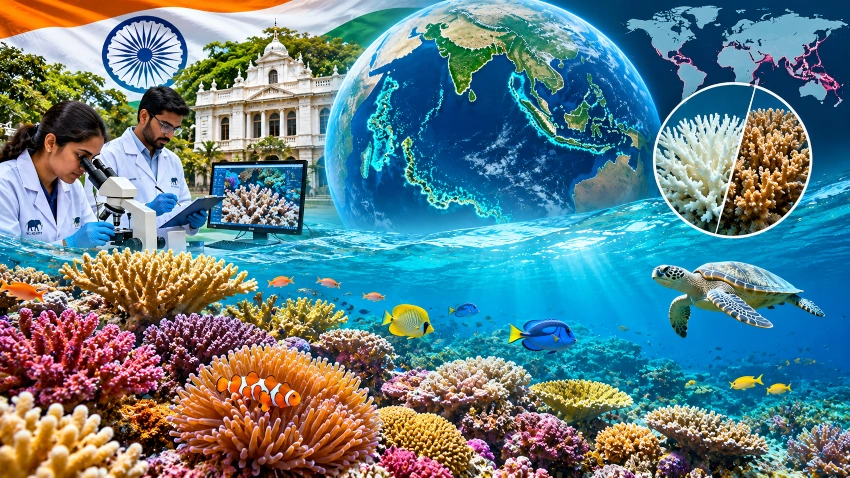
Scientists from the Zoological Survey of India (ZSI) have made a significant contribution to the first comprehensive global assessment of coral reef ecosystems conducted under the International Union for Conservation of Nature’s (IUCN) Red List of Ecosystems framework. The assessment, unveiled at the United Nations Biodiversity Conference (COP17) in Yerevan, Armenia, provides an extensive scientific evaluation of the threats facing coral reefs worldwide, with particular emphasis on rising ocean temperatures, marine heatwaves and the growing risk of ecosystem collapse.
According to an announcement issued by the Ministry of Environment, Forest and Climate Change on 3 November 2026, four scientists from the Zoological Survey of India participated as co-authors of the South Asian regional assessment. Their contribution drew upon decades of Indian research involving marine biodiversity surveys, coral taxonomy, reef mapping and long-term ecosystem monitoring. The findings highlight India’s expanding role in international marine scientific research and provide important evidence for the conservation of coral reefs across the Indian Ocean.
Global Assessment Reveals Critical Risks to Coral Reef Ecosystems
The IUCN assessment examined 127 coral reef ecoregions across more than 80 countries and territories, covering approximately 188,362 square kilometres of warm, shallow-water coral reefs. The study evaluated the condition of these ecosystems using historical observations, environmental monitoring and scientific projections of future ocean warming.
The findings indicate that 122 of the 127 assessed coral reef ecoregions, representing 96% of the total, fall within the Critically Endangered category when future climate-related pressures are considered. These ecosystems account for approximately 99.8% of the coral reef area included in the assessment, highlighting the geographical extent of the projected threat.
The classification reflects the exceptionally high risk that coral reef ecosystems could lose their defining ecological characteristics over the coming decades. It does not mean that these reefs have already disappeared or ceased functioning. Most assessed reefs continue to support living coral communities, although increasing environmental pressures threaten their capacity to recover from successive disturbances.
A particularly important finding concerns the difference between observed historical deterioration and projected future risks. Based exclusively on environmental changes recorded over the preceding 50 years, approximately 24% of assessed coral reef ecosystems would qualify as Critically Endangered. When projected marine heat stress over the next 50 years is incorporated, that proportion increases to 96%, demonstrating the substantial additional risks associated with continued ocean warming.
Four Indian Coral Reef Ecoregions Identified as Critically Endangered
The South Asian component of the assessment examined 13 coral reef ecoregions covering approximately 8,282.6 square kilometres across India, Bangladesh, Sri Lanka, the Maldives and the Chagos Archipelago. These ecosystems collectively represent approximately 4% of the world’s coral reefs and support an extensive range of marine biodiversity.
India contains four of the ecoregions included in the regional assessment: the Andaman and Nicobar Islands, Lakshadweep Islands, the southern coast encompassing the Gulf of Mannar and Palk Bay, and the western coast encompassing the Gulf of Kachchh. These regions contain diverse coral formations, ranging from island reefs and atolls to mainland coastal reef ecosystems.
Historical observations placed the Andaman and Nicobar Islands, Lakshadweep Islands and Gulf of Kachchh ecoregions in the Vulnerable category, while the southern coastal reefs of the Gulf of Mannar and Palk Bay were classified as Endangered. However, incorporating projected marine heat stress under climate scenarios elevated all four Indian ecoregions to the Critically Endangered category.
Across South Asia, the historical assessment classified seven ecoregions as Vulnerable, four as Endangered and two as Critically Endangered. When projected warming over the next five decades was incorporated, all 13 ecoregions were assessed as Critically Endangered.
These findings provide an important scientific basis for understanding the environmental challenges facing India’s coral reef ecosystems. They also demonstrate the value of combining historical monitoring records with climate projections to identify long-term risks across different marine habitats.
Indian Scientists Provide 46.3% of Regional Monitoring Sites
The Zoological Survey of India’s contribution formed an important component of the scientific evidence used in the South Asian assessment. Four ZSI researchers—Dr C. Raghunathan, Dr Tamal Mondal, Dr J.S. Yogesh Kumar and Dr Chandran Rethinaraj—participated as co-authors, contributing expertise developed through extensive marine biodiversity research and field investigations.
Their work supported the assessment through coral reef mapping, ecological monitoring, species identification and analysis of changes affecting marine ecosystems. These activities are essential for establishing reliable scientific information about coral distribution, ecosystem condition and the environmental pressures influencing reef communities.
India also contributed the largest national share of monitoring locations used under Criterion A of the regional assessment. Of the 350 monitoring sites included in this component, 162 were located within Indian coral reef ecoregions, accounting for 46.3% of the regional total.
This substantial contribution reflects the value of India’s long-term marine research programmes and the scientific datasets accumulated by national institutions. Reef monitoring requires repeated field surveys, standardised observations and specialised expertise to identify changes in coral cover, species composition and ecosystem structure.
The participation of Indian scientists demonstrates how nationally developed scientific capabilities can contribute to international biodiversity assessments. It also strengthens the evidence available for marine conservation planning across the Indian Ocean region.
Rising Ocean Temperatures Emerge as the Principal Threat
The assessment identifies ocean warming and marine heatwaves as the most consistent threats to coral reef ecosystems worldwide. Corals live in close association with microscopic algae that provide much of their energy through photosynthesis. When sea temperatures rise beyond their tolerance limits, this relationship can break down, causing corals to expel the algae and undergo bleaching.
Although bleached corals may recover when favourable environmental conditions return, prolonged or repeated heat stress can cause widespread mortality. Successive marine heatwaves also reduce the time available for damaged reef communities to regenerate, increasing the possibility of long-term ecological deterioration.
The assessment draws attention to major historical bleaching events, including those recorded in 1998 and 2016, which affected coral reefs across the Indian Ocean and other tropical marine regions. These events demonstrate the sensitivity of reef-building corals to elevated sea temperatures and provide evidence for assessing future environmental risks.
Beyond ocean warming, coral ecosystems face pressures from coastal development, dredging, sedimentation, marine pollution and unsustainable fishing practices. The depletion of important herbivorous and predatory fish populations can alter ecological relationships within reefs, further reducing their capacity to withstand environmental disturbances.
The combined effects of climate-related and local pressures are especially significant because coral reefs depend on complex interactions among corals, algae, fish and other marine organisms. Disruption of these relationships can gradually reduce biodiversity and weaken the ecological functions that sustain healthy reef environments.
Coral Reefs Support Marine Biodiversity and Coastal Economies
Coral reefs are among the most biologically diverse ecosystems on Earth, providing habitats, breeding grounds and feeding areas for numerous marine organisms. Although they occupy less than 1% of the ocean floor, reef ecosystems support approximately one-quarter of marine fish species, alongside extensive communities of invertebrates and other marine life.
In India, coral reef ecosystems contribute to marine biodiversity in the Andaman and Nicobar Islands, Lakshadweep, the Gulf of Mannar, Palk Bay and the Gulf of Kachchh. These regions support a variety of reef-associated fish, molluscs, crustaceans and other organisms that form interconnected marine food webs.
Coral reefs also provide important ecological services to coastal communities. Their complex physical structures help reduce the energy of incoming waves, offering natural protection against coastal erosion and storm-related impacts. Healthy reef ecosystems additionally support fisheries, marine tourism and other economic activities associated with coastal environments.
The conservation of coral reefs therefore extends beyond the protection of individual species. It involves safeguarding entire ecosystems that contribute to marine food security, coastal resilience and the livelihoods of communities dependent upon ocean resources.
Scientific Monitoring Provides a Foundation for Reef Conservation
The global assessment demonstrates the importance of sustained scientific monitoring in understanding the changing condition of marine ecosystems. Long-term records allow researchers to distinguish temporary environmental fluctuations from persistent ecological deterioration and identify regions experiencing particularly severe pressures.
For India, the extensive monitoring data contributed to the South Asian assessment provides an important resource for marine conservation programmes. Research on coral health, bleaching events, species diversity and reef recovery can support the management of protected marine habitats and inform measures to reduce local environmental pressures.
Improving coastal water quality, limiting damaging activities, protecting important reef-associated fish populations and restoring degraded habitats can strengthen the resilience of coral ecosystems. Such measures are particularly relevant in regions where local environmental pressures compound the effects of rising ocean temperatures.
The IUCN assessment also identifies reductions in global greenhouse gas emissions as essential to limiting the long-term risks associated with marine warming. Combining local ecosystem management with broader climate action provides a scientifically supported approach to protecting coral reef biodiversity.
The collaboration between the Zoological Survey of India and international research institutions illustrates the importance of sharing ecological data, monitoring methodologies and scientific expertise. Regional partnerships can help improve understanding of environmental changes across interconnected marine ecosystems and strengthen coordinated conservation programmes.
India’s Marine Research Capabilities Gain International Recognition
The Zoological Survey of India’s contribution to the first global IUCN coral reef ecosystem assessment represents an important achievement for Indian biodiversity research. Through the participation of four scientists and the contribution of 162 regional monitoring sites, India has provided a substantial scientific foundation for evaluating the condition of South Asian coral reef ecosystems.
The assessment highlights the environmental challenges facing marine biodiversity while demonstrating the importance of the scientific knowledge generated through long-term national research programmes. India’s extensive coral reef monitoring activities have contributed to an international evaluation covering marine ecosystems across more than 80 countries and territories.
The findings also reinforce the significance of India’s coral reef regions within the wider Indian Ocean ecosystem. Protecting these habitats requires continued scientific observation, effective marine conservation measures and cooperation among research institutions and coastal nations.
By contributing its research expertise and monitoring data to this landmark international assessment, the Zoological Survey of India has demonstrated the growing importance of Indian scientific institutions in addressing global biodiversity challenges. The collaboration strengthens the knowledge base for coral reef conservation and advances India’s contribution to international marine environmental research.
You may also like
-
National Zoological Park Records 46 Bird Species During 67th Foundation Day Celebrations
-
Scientists Discover New Microscopic Land Snail Species in Maharashtra’s Western Ghats
-
Thousands of Butterflies Migrate Across Tamil Nadu as Northeast Monsoon Arrives
-
Indian Researcher Surveys Over 3,000 Western Ghats Frogs to Track Deadly Amphibian Fungus
-
Zoological Survey of India Discovers Three New Centipede Species in Western Ghats of Kerala and Karnataka
