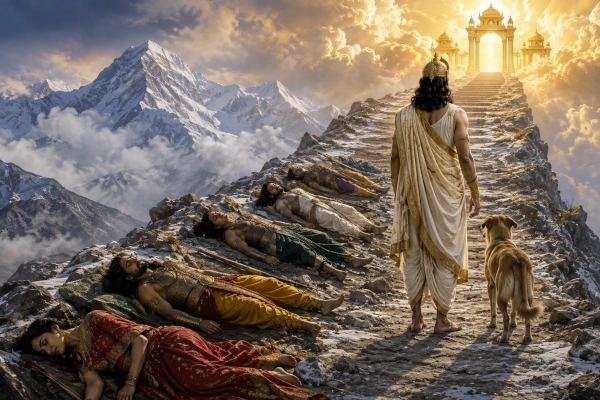
The Mahabharata does not end with the Pandavas’ victory at Kurukshetra. Many years after the war, after Yudhishthira has ruled Hastinapura and the great heroes of the age have begun to disappear, the five Pandava brothers and Draupadi renounce the world and set out on their final journey. This last pilgrimage, known as the Mahaprasthana or Great Departure, becomes one of the most profound spiritual episodes in the epic.
During this journey, an apparently ordinary dog begins following Yudhishthira. One by one, Draupadi, Sahadeva, Nakula, Arjuna and Bhima fall along the difficult path, but the dog continues beside him. Eventually, Yudhishthira stands alone at the threshold of heaven with only this faithful animal for company.
When Indra arrives in a celestial chariot and offers Yudhishthira entry into heaven, the king faces his final test. Indra refuses to allow the dog to accompany him, but Yudhishthira declares that he will not abandon a creature that has remained loyal to him. At that moment, the dog reveals itself as Dharma, Yudhishthira’s divine father, who had taken animal form to test his compassion, loyalty and commitment to righteousness.
The Pandavas Renounce Their Kingdom
Years had passed since the Kurukshetra War, and Yudhishthira had ruled the Kuru kingdom for a long period. The Pandavas had survived exile, war and immense personal loss, but the world to which they belonged was gradually coming to an end. The destruction of the Yadava clan and the departure of Krishna marked a decisive turning point, and the brothers understood that their own time on earth was nearing completion.
Yudhishthira therefore placed Parikshit, the son of Abhimanyu and grandson of Arjuna, upon the throne of Hastinapura. Having secured the succession of the kingdom, the Pandavas gave up their royal garments, wealth and political authority. Yudhishthira, Bhima, Arjuna, Nakula, Sahadeva and Draupadi then began their final pilgrimage, knowing that they would never return to the kingdom they had fought so hard to regain.
A Dog Joins the Journey
As the Pandavas travelled away from their kingdom and toward the northern mountains, a dog began following them. The Mahabharata initially presents the animal without any extraordinary description. It appears simply to be a stray dog that has attached itself to the travellers and chosen to remain beside Yudhishthira.
The animal does not speak, perform miracles or reveal any divine qualities. Yet it continues walking behind Yudhishthira as the journey becomes more difficult. The simplicity of its presence becomes increasingly significant because the Pandavas are gradually abandoning every connection to their former lives, while the dog remains with them.
Draupadi Falls First
The travellers eventually entered increasingly harsh terrain, and Draupadi became the first of the group to fall. Bhima was disturbed by her death and asked Yudhishthira why a woman who had endured so much suffering and remained devoted to the Pandavas should fall before reaching the end of the journey.
Yudhishthira answered that Draupadi had carried an inner partiality toward Arjuna, even though she had been the wife of all five brothers. He did not turn back, because the Mahaprasthana was not an ordinary journey from which fallen companions could simply be rescued. Each person who fell had reached the end of his or her earthly path, while Yudhishthira was required to continue forward.
The dog continued beside him.
Sahadeva and Nakula Fall
Sahadeva was the next to fall. When Bhima again asked for an explanation, Yudhishthira said that Sahadeva had secretly believed that no one equalled him in wisdom. Though outwardly modest, he had retained an inner pride in his knowledge.
Nakula then collapsed along the road. Yudhishthira explained that Nakula had possessed great pride in his remarkable physical beauty and had believed few men could equal him in appearance. Once again, Yudhishthira continued without turning back, accepting that the final journey was stripping each traveller of the attachments and imperfections carried through life.
Arjuna Falls
Arjuna eventually fell as well. This was the warrior who had fought Bhishma, Karna and countless other heroes of the Kurukshetra battlefield, wielded the Gandiva bow and received the teachings of Krishna in the Bhagavad Gita. Yet even such greatness did not carry him to the end of the Mahaprasthana.
Yudhishthira said that Arjuna had once boasted that he could destroy his enemies within a single day but had failed to fulfil that declaration. His pride in his own martial ability therefore remained one of the imperfections that accompanied him to the end of his earthly life.
Yudhishthira continued forward with Bhima and the dog.
Bhima Is the Last Brother to Fall
Finally, Bhima himself fell. Of all Yudhishthira’s brothers, Bhima had been one of his strongest protectors throughout their lives. He had fought their enemies during exile, killed powerful warriors at Kurukshetra and repeatedly used his enormous physical strength to defend the Pandava family.
As he lay upon the ground, Bhima asked Yudhishthira why he too had fallen. Yudhishthira replied that Bhima had often taken excessive pride in his strength and had also possessed an excessive attachment to food. With those words, Yudhishthira continued his journey.
Now every human companion who had begun the Mahaprasthana was gone. Draupadi had fallen, and all four of Yudhishthira’s brothers had followed her. Only the dog remained beside the eldest Pandava.
The King Who Had Lost Everything
The image of Yudhishthira at this point is striking. He had once been emperor, performed the Rajasuya sacrifice and ruled over a powerful kingdom, while some of the greatest warriors of the age had fought on his behalf. Krishna himself had stood with the Pandavas during the decisive struggles of their lives.
None of those things remained. Yudhishthira had abandoned his throne, his wealth and his royal identity. Draupadi was gone, Bhima and Arjuna were gone, and Nakula and Sahadeva were gone as well. The king who had once been surrounded by armies now walked alone with a dog.
The Mahabharata had stripped Yudhishthira of nearly everything through which worldly success could be measured. Only then did the epic present him with the final moral choice of his earthly life.
Indra Arrives with the Celestial Chariot
As Yudhishthira continued his journey, Indra, king of the Devas, appeared before him in a celestial chariot. Indra told Yudhishthira that he had earned admission into heaven and invited him to ascend the chariot in his physical body, an extraordinary privilege rarely granted to mortals.
Yudhishthira did not immediately accept the invitation. His first concern was for Draupadi and his brothers, and he declared that he did not wish to enter heaven without them. Indra assured him that they had already reached the celestial realms and that Yudhishthira would meet them there.
With that concern resolved, one final issue remained. The dog still stood beside Yudhishthira.
Indra Refuses the Dog
Yudhishthira told Indra that the dog must accompany him into the celestial chariot. Indra refused, explaining that the animal could not enter heaven and urging Yudhishthira to leave it behind. From Indra’s perspective, the request appeared insignificant compared with the reward being offered.
Yudhishthira had endured exile, war, grief and the loss of almost everyone he loved. Heaven now stood before him, and the only apparent condition was that he abandon a stray dog. He could have entered the chariot immediately and ended his long journey.
Instead, Yudhishthira refused.
Yudhishthira Will Not Betray a Loyal Companion
Yudhishthira explained that the dog had followed him faithfully and had placed its trust in him. To abandon such a companion merely because heaven had been offered would be an act of cruelty and betrayal. He therefore declared that he would not enter heaven if the price was abandoning a creature that depended upon him.
Indra attempted to persuade him by pointing out that Yudhishthira had already left behind Draupadi and his brothers. If he had continued after their deaths, Indra argued, why should he refuse heaven because of an animal?
Yudhishthira made an important distinction. Draupadi and his brothers had already died, and he had possessed no power to restore them or prevent the end of their earthly journeys. The dog, however, was alive and remained dependent upon him. Abandoning it voluntarily for personal benefit would therefore be entirely different from continuing after the deaths of his companions.
Dharma Is More Important Than Heaven
Yudhishthira’s response reveals the central lesson of the episode. He does not practise dharma merely because he expects a reward after death. If righteousness were only a means of earning heaven, then abandoning the dog would have been easy because the reward had already been placed directly before him.
Instead, Yudhishthira demonstrates that dharma remains binding even when violating it appears to offer the greatest possible personal advantage. He is prepared to surrender heaven rather than commit an act that he considers unjust.
The choice transforms the meaning of the entire scene. Heaven itself becomes secondary, while righteousness remains supreme. Yudhishthira proves that he values dharma more than the reward supposedly granted for following dharma.
The Dog Reveals Himself as Dharma
The test was now complete. The dog abandoned its ordinary appearance and revealed itself as Dharma, the divine embodiment of righteousness and Yudhishthira’s celestial father.
Dharma had followed Yudhishthira in disguise to determine whether the king’s lifelong commitment to righteousness would survive when no worldly advantage remained. He wanted to know whether Yudhishthira would protect a helpless companion even when that decision appeared to cost him heaven itself.
Yudhishthira passed because he did not know that the animal was divine. He believed it was simply a loyal dog and still chose to protect it. His compassion was therefore genuine rather than motivated by knowledge that a god was testing him.
Dharma Had Tested Yudhishthira Before
The revelation recalls another famous episode from the Mahabharata, the Yaksha Prashna. During the Pandavas’ exile, Yudhishthira encountered a mysterious Yaksha who questioned him on life, morality, knowledge and duty. After successfully answering the questions, Yudhishthira was permitted to choose one fallen brother to be restored to life.
Instead of choosing Bhima for his strength or Arjuna for his unmatched skill with weapons, Yudhishthira chose Nakula. He explained that Kunti still had one living son in himself, so Madri should also have one living son. His decision placed fairness above personal advantage.
The Yaksha then revealed himself as Dharma. Near the end of Yudhishthira’s life, Dharma returns with another test. The earlier test asks whether Yudhishthira will place justice above usefulness, while the final test asks whether he will place compassion above heaven itself.
Why Dharma Chose the Form of a Dog
The choice of a dog as Dharma’s disguise gives the episode much of its moral power. If Dharma had appeared as a sage, king or Brahmin, Yudhishthira would have known that protecting him carried obvious religious or social significance. A powerful or respected companion might also have been capable of rewarding Yudhishthira.
The dog possessed none of these advantages. It had no wealth, rank or apparent importance, and it could offer Yudhishthira nothing in return. Its only claim upon him was its loyalty and dependence.
This makes Yudhishthira’s decision far more revealing. He protects the animal not because it is useful, powerful or sacred in appearance, but because it has trusted him. His compassion extends to a vulnerable being from whom he expects no reward.
Compassion Beyond Human Beings
Animals appear repeatedly in the Mahabharata as part of profound ethical stories. King Shibi protects a dove, Nala communicates with the golden swan, and other narratives use animals to explore sacrifice, hospitality, duty and compassion. Yudhishthira’s final test belongs to this larger tradition.
The dog does not speak during the argument with Indra, nor does it demand protection. Yudhishthira himself recognises that the animal’s dependence creates an obligation. His understanding of dharma therefore extends beyond formal duties toward kings, warriors and family members.
At the very end of his earthly life, the measure of Yudhishthira’s righteousness is not how he treats another emperor or a powerful sage. It is how he treats a helpless animal that has trusted him.
Loyalty Without Attachment
The story also makes an important distinction between attachment and responsibility. Yudhishthira has learned to relinquish his kingdom, possessions, family relationships and even concern for his own physical survival. Yet renunciation does not make him indifferent to the needs of another living being.
He does not insist that the dog accompany him because he regards it as his possession. His concern arises because the animal has remained loyal and dependent upon him. He understands that abandoning a trusting companion for personal benefit would violate the very dharma he has spent his life trying to uphold.
In this way, the Mahabharata presents renunciation not as emotional coldness but as freedom from selfish attachment combined with continued responsibility toward others.
The Final Companion Becomes the Final Teacher
Throughout Yudhishthira’s life, some of the greatest figures in the Mahabharata instructed him in dharma. Bhishma taught him about kingship and duty, Krishna guided the Pandavas through their political and moral crises, and Vyasa repeatedly appeared during decisive moments of their lives.
Yet Yudhishthira’s final lesson arrives through a silent dog walking beside him. The symbolism is characteristic of the Mahabharata because dharma does not always appear in majestic or obvious forms. Sometimes it appears as an inconvenience, a burden or a powerless being who offers no reward.
Yudhishthira recognises his duty without recognising the god. That is precisely why Dharma knows that his son has understood the deeper meaning of righteousness.
Yudhishthira’s Greatest Victory
Yudhishthira’s life contains very few victories without suffering. He becomes emperor but later loses his kingdom in the dice game. He eventually regains the throne, but only after the Kurukshetra War destroys much of his family and leaves him burdened by grief.
His final victory is very different. There is no army, no battlefield and no kingdom to win. He simply refuses to abandon a dog.
Yet this quiet decision may represent one of his greatest triumphs. At Kurukshetra, victory required armies, strategy and weapons. At the gateway to heaven, victory requires only character.
The Meaning of the Faithful Dog
Within the story, the dog is literally Dharma in disguise, but its symbolic meaning extends further. It represents the vulnerable being whose worth does not depend upon wealth, social rank or usefulness. It also represents loyalty, because the dog remains beside Yudhishthira after every other companion has fallen.
The dog can also be understood as Dharma itself accompanying Yudhishthira through the final stage of his life. The king loses his kingdom, his brothers, Draupadi and every remaining worldly possession, but Dharma continues walking beside him.
When Yudhishthira refuses to abandon that last companion, Dharma finally reveals its true form. The symbolism is complete: after relinquishing everything else, Yudhishthira proves that he will never relinquish righteousness.
The Final Lesson of Yudhishthira’s Journey
The story of Yudhishthira and the faithful dog provides one of the most memorable conclusions to a character’s journey in the Mahabharata. Throughout the epic, Yudhishthira struggles with difficult questions involving truth, duty, family, kingship, war, forgiveness and justice.
His final test is much simpler. A living creature has trusted him, and he must decide whether he will betray that trust for his own benefit.
Yudhishthira chooses compassion. He is prepared to surrender heaven itself rather than abandon a loyal companion who depends upon him. Only after making that choice does he discover that the creature he protected was Dharma.
The episode therefore presents a profound understanding of righteousness. Dharma is not proven by words, ritual or the expectation of reward. It is proven when a person chooses what is right even when no reward seems possible and when doing so appears to carry a personal cost.
At the very threshold of heaven, Yudhishthira demonstrates that he would rather lose paradise than abandon Dharma. In doing so, he passes the final test of his extraordinary life.
You may also like
-
Gnani AI Launches Nationwide Challenge Offering Up to 100 Paid AI Internships
-
NMMSS Scholarship Application Deadline Extended to October 31, 2026
-
DGCA Introduces Training Framework for Gyroplane Pilots in India
-
DRDO CASDIC Opens 30 Paid Internships for Engineering and Science Students
-
Duryodhana Wins Shalya Through Hospitality: Gifts, Obligation and Political Leverage Before the Kurukshetra War
