Primary Text: Śrīmad Bhāgavata Purāṇa, Skandha 10, Chapters 62–63
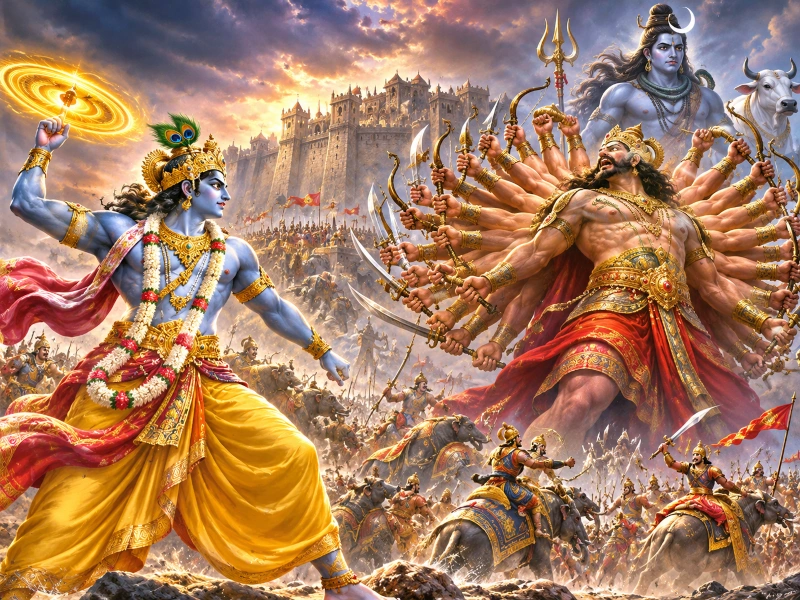
The confrontation between Krishna and Bāṇāsura represents one of the most elaborate military engagements narrated in the Bhāgavata Purāṇa. The conflict brings together the Yādava military establishment, the formidable forces of Bāṇāsura and the divine intervention of Lord Shiva, who had undertaken to protect his devoted follower. What begins as a dispute involving the captivity of Aniruddha develops into a major confrontation involving fortified urban defences, large military formations, powerful alliances and extraordinary weapons.
From the perspective of warfare and strategic studies, the narrative offers insights into the limitations of numerical superiority, the responsibilities associated with military alliances, the escalation of regional conflicts and the importance of clearly defined war objectives. Krishna’s campaign ultimately demonstrates that strategic victory does not necessarily require the complete destruction of an adversary. The preservation of Bāṇāsura’s life, following his defeat, becomes an integral part of the political and ethical resolution of the conflict.
The Strategic Background: Bāṇāsura and the Protection of Shiva
Bāṇāsura, the son of Mahābali, ruled from the fortified capital of Śoṇitapura. The Bhāgavata Purāṇa describes him as a powerful ruler endowed with a thousand arms and an ardent devotee of Lord Shiva. Pleased by his devotion, Shiva granted him protection and agreed to guard his city, providing Bāṇāsura with an extraordinary degree of strategic security.
However, Bāṇāsura gradually became intoxicated with his strength and complained to Shiva that he could find no opponent worthy of his martial abilities. Shiva warned him that the opportunity to confront a formidable adversary would eventually arise, heralded by the breaking of his flagstaff. The episode establishes the underlying cause of Bāṇāsura’s eventual downfall: military power accompanied by arrogance and an absence of strategic restraint.
In the language of strategic studies, Bāṇāsura enjoyed both substantial indigenous capabilities and the protection of an exceptionally powerful ally. Yet his confidence in these advantages encouraged an exaggerated perception of his own invulnerability. The narrative illustrates how overwhelming military strength and external security guarantees can become sources of strategic miscalculation when they are not accompanied by responsible leadership.
The Capture of Aniruddha: From Dynastic Dispute to War
The immediate cause of the confrontation was the relationship between Uṣā, the daughter of Bāṇāsura, and Aniruddha, the grandson of Krishna. Uṣā encountered Aniruddha in a dream and subsequently identified him with the assistance of her companion Chitralekhā. Through her extraordinary yogic abilities, Chitralekhā brought Aniruddha from Dvārakā to Śoṇitapura, where he remained with Uṣā.
When Bāṇāsura discovered Aniruddha’s presence within the royal palace, he confronted him with armed personnel. Aniruddha resisted, but Bāṇāsura eventually subdued him through the nāga-pāśa, a supernatural serpent-binding weapon described in the Purāṇic narrative. The imprisonment caused considerable distress to Uṣā and transformed a personal and dynastic dispute into a confrontation between two powerful ruling houses.
The strategic significance of this episode lies in the escalation of a local security incident into a wider military conflict. Bāṇāsura’s decision to imprison a prominent member of the Yādava dynasty created circumstances in which Krishna and the Yādava leadership became directly involved. The narrative demonstrates how decisions taken within a royal household can have consequences extending far beyond the immediate dispute.
Intelligence Gathering and the Yādava Mobilisation
The relatives of Aniruddha remained unaware of his whereabouts throughout the four months of the rainy season. The situation changed when Sage Nārada communicated information concerning his captivity and the circumstances surrounding it. This intelligence enabled the Yādavas to identify the location of Aniruddha and organise a military expedition against Śoṇitapura.
Krishna and Balarāma led a force comprising twelve akṣauhiṇīs, accompanied by distinguished Yādava warriors including Pradyumna, Sātyaki, Gada, Sāmba, Sāraṇa, Nanda, Upananda and Bhadra. In the traditional military vocabulary of Sanskrit literature, an akṣauhiṇī represents a large composite formation incorporating infantry, cavalry, elephants and chariots. The mobilisation described in the Bhāgavata Purāṇa reflects the magnitude of the campaign undertaken by the Yādavas.
The sequence highlights the relationship between intelligence and military decision-making. The Yādavas initiated their expedition after receiving information regarding Aniruddha’s captivity rather than directing their forces against an unidentified adversary. Accurate intelligence transformed uncertainty into a clearly defined military objective centred on the recovery of Aniruddha.
The Siege of Śoṇitapura: Neutralising Fortified Defences
The Yādava army surrounded Śoṇitapura from all directions, bringing sustained military pressure upon Bāṇāsura’s capital. The Bhāgavata Purāṇa describes the destruction of defensive structures and features of the city, demonstrating the severity of the confrontation. The fortified capital, which had previously represented Bāṇāsura’s security and authority, became the central theatre of the campaign.
The siege illustrates the strategic vulnerability of a fortified city confronted by a sufficiently organised external force. Fortifications provide considerable defensive advantages, but their effectiveness also depends upon the strength of the defending army and its ability to resist sustained military pressure. In this narrative, the scale of the Yādava mobilisation compelled Bāṇāsura and his allies to engage the invading force directly.
The campaign also demonstrates the importance of concentrating military resources against a defined strategic objective. Krishna’s expedition was directed towards the capital where Aniruddha was held rather than an unrestricted campaign of territorial expansion. The subsequent resolution reinforces the interpretation that the principal purpose was to recover Aniruddha and overcome the resistance preventing his release.
Shiva’s Intervention: The Responsibilities of Military Alliances
Lord Shiva entered the battlefield in fulfilment of his commitment to protect Bāṇāsura. Accompanied by Kārtikeya, Nandi and his supernatural attendants, Shiva confronted the Yādava forces and transformed the siege into a conflict involving extraordinary divine capabilities. His intervention represented the fulfilment of a protective commitment previously granted to his devotee.
The confrontation can be examined as a Purāṇic representation of the responsibilities and complications associated with military alliances. A protector may become involved in a conflict arising from the independent actions of a protected ruler, even when those actions were not initiated by the protector. Bāṇāsura’s imprisonment of Aniruddha thus generated circumstances that brought Krishna and Shiva into direct confrontation.
The theological dimension of the narrative must, however, remain distinct from its strategic interpretation. The encounter should not be understood as evidence of permanent hostility between Krishna and Shiva or between their respective devotional traditions. The eventual reconciliation between the two divine figures is central to the meaning of the episode and demonstrates that the confrontation existed within a broader framework of dharma.
Division of Battlefield Responsibilities and Command Organisation
The Bhāgavata Purāṇa describes several simultaneous confrontations involving commanders and warriors from the opposing forces. Krishna engaged Shiva, while Pradyumna confronted Kārtikeya, Balarāma engaged Kumbhāṇḍa and Kūpakarṇa, and Sātyaki fought Bāṇāsura. Sāmba also confronted Bāṇāsura’s son, creating multiple centres of combat within the wider battlefield.
This distribution of responsibilities illustrates the significance of command organisation in large military engagements. The Yādava army did not depend exclusively upon Krishna’s individual martial capabilities, despite his central position in the narrative. Other experienced warriors independently confronted significant adversaries, contributing to the overall effectiveness of the expedition.
From a strategic perspective, the episode highlights the relationship between central leadership and distributed battlefield responsibilities. A military formation becomes more resilient when capable subordinate commanders can act effectively within the broader objectives of a campaign. The participation of several distinguished Yādava warriors reflects the importance of collective military capability alongside exceptional individual leadership.
Divine Astras and the Principle of Counter-Capability
The confrontation between Krishna and Shiva involved the deployment of several divine astras, each possessing extraordinary characteristics within the Purāṇic framework. The narrative describes Krishna responding to Shiva’s Brahmāstra with another Brahmāstra, countering the Vāyavyāstra with the Parvatāstra and neutralising the Āgneyāstra through a weapon associated with water. Krishna also countered Shiva’s Pāśupata weapon with the Nārāyaṇāstra.
The strategic significance of these exchanges lies in the principle that a powerful capability does not necessarily guarantee victory when an adversary possesses an effective counter-capability. The effectiveness of an individual weapon depends not only upon its destructive potential but also upon the opposing side’s ability to withstand or neutralise its effects. Within the narrative, Krishna demonstrates the ability to respond appropriately to changing battlefield conditions.
These divine weapons belong to the theological and literary world of the Purāṇas and should not be represented as verified examples of ancient modern-style military technology. Nevertheless, their narrative employment provides a conceptual framework for examining the enduring relationship between offensive capabilities, defensive responses and adaptability in warfare.
Bāṇāsura’s Thousand Arms: The Limitations of Numerical Superiority
Bāṇāsura’s thousand arms constitute the most distinctive representation of his extraordinary martial strength. During his confrontation with Krishna, the Bhāgavata Purāṇa describes him employing five hundred bows simultaneously, demonstrating the immense offensive capability associated with his supernatural form. Krishna, however, overcame this numerical advantage through superior martial effectiveness.
The thousand arms represent Bāṇāsura’s personal supernatural power rather than an army literally composed of thousand-armed soldiers. His military establishment and Shiva’s supporting forces were distinct components of the defending coalition. This distinction is important for maintaining fidelity to the original Purāṇic account.
From a strategic standpoint, the confrontation illustrates the difference between possessing a large quantity of military resources and employing them effectively. Numerical superiority can provide significant advantages, but it cannot independently compensate for weaknesses in judgement, adaptability or the ability to respond to a more capable adversary. Bāṇāsura’s extraordinary strength ultimately proved insufficient to secure victory against Krishna.
The Confrontation of the Jvaras: Warfare Beyond Conventional Combat
The narrative introduces another extraordinary dimension through the confrontation between the Śiva-jvara and the Viṣṇu-jvara. The Śiva-jvara manifests as a supernatural force associated with intense heat, while Krishna counters it with the Viṣṇu-jvara, associated with overwhelming cold. The confrontation concludes with the Śiva-jvara seeking refuge in Krishna.
Within the theological framework of the Bhāgavata Purāṇa, these manifestations illustrate divine sovereignty over forces extending beyond conventional physical combat. The episode expands the battlefield from an engagement between armies and individual warriors into a confrontation involving supernatural manifestations of opposing powers. Its conclusion also reinforces the recurring themes of surrender, protection and divine grace.
A strategic reading may interpret this episode as a literary representation of conflict across multiple domains, where an adversary must respond to challenges extending beyond ordinary battlefield capabilities. Such an interpretation remains an analytical analogy rather than a claim that the Purāṇic account describes historically documented biological, climatic or technological warfare.
Strategic Disarmament: Krishna Reduces Bāṇāsura’s Military Power
Krishna ultimately employed the Sudarśana Chakra to sever Bāṇāsura’s numerous arms, leaving him with only four. The defeat removed the extraordinary physical advantage that had contributed to Bāṇāsura’s arrogance and desire for confrontation. His transformation from an overwhelmingly powerful warrior into a defeated ruler represents the decisive turning point of the campaign.
The significance of this outcome lies in the distinction between destroying an adversary’s capacity to sustain aggression and eliminating the adversary himself. Krishna deprived Bāṇāsura of his excessive martial strength without taking his life. The military objective was thereby achieved without requiring the complete destruction of the defeated ruler.
In strategic terminology, this outcome can be interpreted as a form of limited disarmament. The removal of the capability associated with Bāṇāsura’s aggression reduced his capacity to renew the confrontation, while preserving the possibility of reconciliation. The narrative presents military force as an instrument for correcting an imbalance rather than an end in itself.
Shiva’s Intervention and the Preservation of Bāṇāsura
Following Bāṇāsura’s defeat, Shiva approached Krishna and requested that his devotee’s life be spared. Krishna accepted the request and explained that he had previously promised not to kill the descendants of Prahlāda. Bāṇāsura, as the son of Mahābali and a descendant of Prahlāda, was therefore protected by an earlier divine commitment.
Krishna further explained that the reduction of Bāṇāsura’s extraordinary strength was intended to remove his arrogance. He assured Shiva that Bāṇāsura would retain his four remaining arms, remain free from fear and continue as one of Shiva’s principal attendants. The settlement preserved both Krishna’s previous commitment to Prahlāda and Shiva’s protective relationship with his devotee.
The resolution demonstrates that strategic victory can coexist with respect for an adversary’s legitimate commitments and relationships. Krishna did not require Shiva to abandon his devotee as a condition for ending the conflict. Instead, the outcome accommodated the obligations of both divine figures while ensuring that Bāṇāsura’s excessive power no longer represented the same threat.
Conflict Termination and the Return to Dvārakā
Following his defeat and reconciliation with Krishna, Bāṇāsura brought Aniruddha and Uṣā forward and seated them together in a chariot. Krishna subsequently departed with the couple under military protection and with Shiva’s approval. The returning party was welcomed at Dvārakā, bringing the campaign to its conclusion.
The outcome did not involve the annexation of Śoṇitapura or the extermination of Bāṇāsura’s lineage. Instead, the conflict concluded through the recovery of Aniruddha, the reduction of Bāṇāsura’s excessive strength and the reconciliation of the opposing parties. A dispute that had generated a major military confrontation ultimately resulted in the union of Aniruddha and Uṣā.
This conclusion highlights the importance of defining an achievable political end state before extending military operations beyond their original purpose. Krishna’s victory was complete because the principal objectives of the campaign had been fulfilled, not because every opposing institution had been destroyed. The narrative consequently offers a framework for understanding conflict termination, proportionality and the restoration of stability.
Enduring Strategic Lessons from the Battle of Śoṇitapura
Military Strength Without Restraint Encourages Miscalculation
Bāṇāsura possessed extraordinary individual strength, substantial military resources, a fortified capital and divine protection. These advantages nevertheless contributed to an exaggerated perception of his own invulnerability. The narrative demonstrates that military capability must be accompanied by sound judgement, humility and an understanding of the consequences of confrontation.
Intelligence Precedes Effective Military Action
The Yādava campaign became possible after Nārada communicated information regarding Aniruddha’s captivity. Intelligence provided clarity concerning the location of the captive and the circumstances requiring intervention. The episode illustrates the enduring importance of accurate information in defining military objectives and directing available resources.
Alliances Must Be Accompanied by Responsible Leadership
Shiva’s protection of Bāṇāsura provided the ruler with considerable security, but it did not prevent the consequences of his actions. The resulting confrontation imposed responsibilities upon Shiva that extended beyond the original circumstances of his protective commitment. The narrative highlights the importance of responsible conduct by rulers who benefit from powerful alliances.
Adaptability Can Overcome Numerical Superiority
Bāṇāsura’s thousand arms and extensive martial capabilities failed to secure victory against Krishna. Throughout the confrontation, Krishna demonstrated the ability to neutralise opposing capabilities and respond to changing circumstances. The episode reinforces the distinction between the possession of military resources and their effective employment.
Military Victory Must Serve a Defined Political Objective
Krishna concluded the campaign after securing Aniruddha’s release, reducing Bāṇāsura’s excessive strength and restoring stability. The preservation of Bāṇāsura’s life demonstrates that an adversary’s complete destruction is not always necessary to achieve a decisive outcome. Strategic success is measured by the fulfilment of legitimate objectives and the establishment of a sustainable peace.
Conclusion: The Supremacy of Dharma over Military Power
The battle between Krishna and Bāṇāsura stands among the most strategically significant warfare narratives in the Bhāgavata Purāṇa. It brings together intelligence gathering, military mobilisation, siege warfare, command organisation, divine alliances, counter-capabilities, strategic disarmament and conflict termination within a unified theological narrative. Its central message, however, extends beyond the mechanics of warfare to the responsibilities associated with possessing and exercising power.
Krishna’s victory did not culminate in territorial conquest, vengeance or the elimination of a defeated ruler. Instead, it resulted in the recovery of Aniruddha, the correction of Bāṇāsura’s arrogance, the preservation of previous divine commitments and the restoration of harmonious relations with Shiva. The episode demonstrates that the highest expression of strategic leadership lies not merely in the ability to defeat an adversary but in the wisdom to recognise when the legitimate purposes of warfare have been accomplished.
Within the civilisational understanding of dharma, military strength acquires its true significance when guided by responsibility, discernment and restraint. The battle of Śoṇitapura remains an enduring Purāṇic illustration of how decisive power, ethical commitments and reconciliation can coexist within the pursuit of a just and stable order.
References
| Scripture | Chapter and Verses | Subject |
|---|---|---|
| Śrīmad Bhāgavata Purāṇa | 10.62.1–11 | Bāṇāsura’s strength, devotion and Shiva’s protection |
| Śrīmad Bhāgavata Purāṇa | 10.62.12–33 | Uṣā, Chitralekhā and Aniruddha’s captivity |
| Śrīmad Bhāgavata Purāṇa | 10.63.1–6 | Intelligence, mobilisation and siege of Śoṇitapura |
| Śrīmad Bhāgavata Purāṇa | 10.63.7–17 | Battlefield engagements and divine astras |
| Śrīmad Bhāgavata Purāṇa | 10.63.18–27 | Confrontation of the Jvaras |
| Śrīmad Bhāgavata Purāṇa | 10.63.28–45 | Bāṇāsura’s defeat and Shiva’s intercession |
| Śrīmad Bhāgavata Purāṇa | 10.63.46–53 | Krishna’s assurance, reconciliation and return to Dvārakā |
Textual Sources: Śrīmad Bhāgavata Mahāpurāṇa, Daśama Skandha, Adhyāyas 62–63.
You may also like
-
Satyabhāmā in the Narakāsura Campaign: Warrior Queens, Combat Readiness and Battlefield Resilience
-
Rāma and the Ocean: Persuasion, Patience and Coercive Diplomacy Before the Lanka Campaign
-
Warcraft in the Purāṇas: Krishna’s Destruction of Mura and the Defences of Pragjyotiṣa
-
Ramayana Diplomacy: Bharata’s Pādukā Diplomacy — Preserving Political Legitimacy Without Claiming the Throne
-
Fortifications in the Arthaśāstra: Urban Defence, Water Security and Strategic Geography
