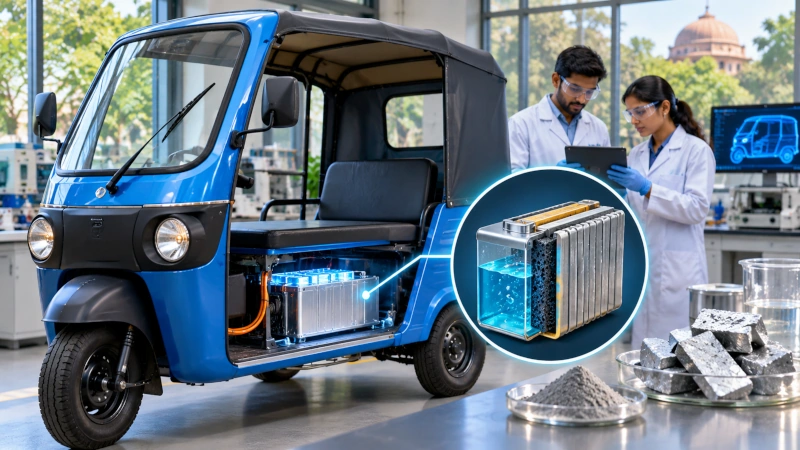
Hindustan Zinc Limited, in collaboration with the Indian Institute of Technology Madras (IIT Madras), has unveiled an electric three-wheeler prototype incorporating an approximately 1 kWh zinc-air battery designed to function as a range extender. Announced through a stock exchange disclosure on 26 November 2026, the development marks a significant milestone in India’s research into alternative battery technologies for electric mobility. The prototype was unveiled during the recently concluded IIT Madras Energy Summit 2026, demonstrating the progression of the research partnership from laboratory experimentation to vehicle-level integration.
Dual-Battery Architecture for Electric Mobility
The electric three-wheeler prototype incorporates both lithium-ion and zinc-air batteries, with the latter contributing nearly 10 per cent of the vehicle’s overall energy requirements. The lithium-ion battery supplies power during acceleration and other high-demand operating conditions, while the zinc-air system supplements the primary battery through sustained energy delivery. This complementary arrangement demonstrates how different battery chemistries can be integrated within a single electric mobility platform.
Rather than attempting to replace conventional lithium-ion batteries entirely, the research investigates the potential of zinc-air technology to complement existing energy storage systems. Such an approach could provide additional flexibility in electric vehicle design and reduce dependence on a single battery chemistry. The actual improvement in driving range, however, has not been quantified in the company’s announcement.
Understanding Zinc-Air Battery Technology
Zinc-air batteries generate electricity through electrochemical reactions involving zinc and oxygen drawn from the surrounding atmosphere. Unlike conventional batteries that internally store both principal active reactants, zinc-air systems obtain oxygen externally, offering the potential for improved energy density at the cell level. The technology also employs a water-based, non-flammable electrolyte, which could provide certain safety advantages over battery systems using flammable organic electrolytes.
Despite these advantages, zinc-air batteries present engineering challenges involving power density, electrode durability, electrolyte management and rechargeability. Their suitability for electric vehicles depends on addressing these limitations while maintaining reliable performance under varying operating conditions. The dual-battery approach provides a framework for investigating how zinc-air technology can be utilised without requiring it to independently satisfy the vehicle’s peak power demands.
Leveraging India’s Domestic Zinc Resources
The research assumes particular significance in the context of India’s efforts to diversify its energy storage supply chains. While conventional lithium-ion battery manufacturing depends on several critical minerals and specialised materials, India possesses substantial domestic zinc resources and an established zinc mining and processing industry. Developing value-added applications for zinc in advanced energy storage could create new opportunities within the country’s industrial ecosystem.
Zinc’s availability, recyclability and potential cost advantages make it an important material for exploring alternative battery technologies. Successful development of commercially viable zinc-based energy storage systems could help diversify India’s battery material requirements and strengthen domestic manufacturing capabilities. These potential benefits would depend on further technical validation, economic assessment and the development of appropriate manufacturing infrastructure.
From Laboratory Research to Vehicle-Level Demonstration
The research partnership between Hindustan Zinc and IIT Madras was initiated in 2024, with the objective of exploring advanced applications of zinc in energy storage. The project is led by Dr. Aravind Kumar Chandiran of the Department of Chemical Engineering at IIT Madras. Integration of the zinc-air battery into an electric three-wheeler represents an important transition from laboratory-scale investigation to demonstration within a practical mobility platform.
Hindustan Zinc’s Integrated Annual Report for 2025–26 had identified the demonstration of a 1 kWh zinc-air battery as a vehicle range extender among its planned research milestones. The unveiling of the prototype establishes progress towards that objective and highlights the role of industry–academia collaboration in translating scientific research into engineering applications. Further development will be necessary to establish the system’s operational durability, economic viability and suitability for large-scale manufacturing.
Beyond Conventional Zinc Applications
Zinc has traditionally been used extensively in galvanisation, corrosion protection, metal alloys and various industrial applications. The emergence of advanced zinc-based battery technologies introduces opportunities to expand the metal’s role within the global clean energy transition. For Hindustan Zinc, research into energy storage represents an avenue for developing higher-value applications beyond established metallurgical markets.
The potential applications of zinc-based energy storage are not necessarily restricted to electric mobility. Depending on their technical characteristics and economic performance, such systems could also find applications in stationary energy storage, renewable energy integration and distributed power infrastructure. These opportunities remain subject to further research and the successful development of application-specific battery architectures.
Strengthening India’s Indigenous Battery Technology Ecosystem
The collaboration between Hindustan Zinc and IIT Madras demonstrates the importance of connecting India’s mineral resources, industrial capabilities and academic research institutions. Moving beyond the extraction and processing of metals towards advanced material applications can help strengthen domestic technological capabilities and create opportunities for industrial value addition. Such research partnerships are particularly relevant as India expands its electric mobility and renewable energy ecosystems.
The electric three-wheeler prototype represents a research and engineering milestone rather than the commercial introduction of a new battery technology. Nevertheless, its successful integration provides a foundation for further investigation into indigenous zinc-based energy storage solutions. By combining domestic resource availability with scientific innovation and industrial expertise, India can progressively develop a more diversified, resilient and technologically self-reliant energy storage ecosystem.
References
- Hindustan Zinc Limited — Hindustan Zinc, IIT Madras Advance Zinc-Air Battery Technology for Next-Generation Electric Mobility, official stock exchange disclosure, 26 November 2026.
- Hindustan Zinc Limited — Integrated Annual Report 2025–26, Innovation in Critical Minerals and Energy Transition.
- Hindustan Zinc Limited — Integrated Annual Report 2025–26, Driving Climate Action and Accelerating the Energy Transition.
You may also like
-
India’s Auto PLI Scheme Attracts ₹52,806 Crore in Investment
-
MECL Strengthens Deep Coal Exploration Capabilities with Advanced KRAT-1500 Drill Rig
-
Unimech Aerospace Announces ₹45 Crore Surface Engineering Expansion
-
Harmal Chilli: Goa’s Distinctive Fiery Spice and Its Geographical Indication Heritage
-
NSE Becomes World’s Third-Largest Listed Exchange Operator
