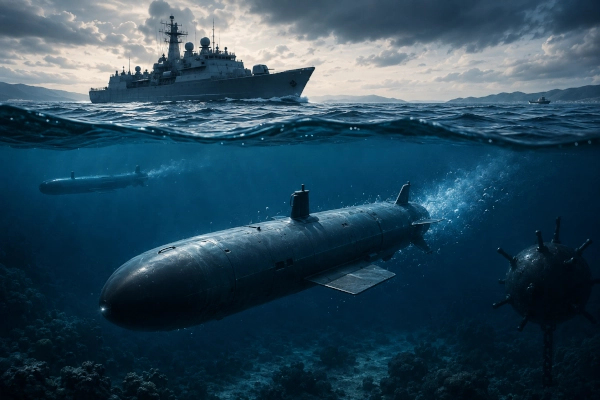
India’s rapidly growing private defence industry is beginning to move beneath the surface of the oceans.
Delhi-based defence technology company VEDA Aeronautics is developing an underwater decoy for the Indian Navy, with plans to subsequently evolve the platform into a miniature underwater attack drone, opening a potentially important new front in India’s development of autonomous naval warfare systems.
The project was publicly revealed by VEDA Aeronautics Managing Director Dipesh Gupta during Milipol India 2025. Asked about the company’s programmes for the Indian Army and Navy, Gupta said VEDA was designing an underwater decoy and intended eventually to develop it into a mini attack drone.
Significantly, he also indicated that the underwater system would build upon technologies the company has already been developing for swarm drones and long-range communications.
The programme represents a substantial expansion for a company that has so far become better known for aerial unmanned systems.
And there are indications that VEDA’s naval ambitions have continued to advance.
In a recent statement in 2026, VEDA said it was working on cutting-edge technology stacks covering air, land and naval applications, while adding that its platforms for naval attack and counter-attack remained “under wraps”. The company did not disclose the configuration or specifications of those systems.
Taken together, the statements suggest that underwater autonomous warfare has become an important part of VEDA’s future development portfolio.
From Aerial Drones to Underwater Warfare
VEDA Aeronautics has built much of its expertise around unmanned aerial platforms.
Its programmes include the Sureshastra Mk-1, developed under the Indian Air Force’s Meher Baba programme, an interceptor for counter-drone missions, canister-launched loitering munitions and work on High Altitude Pseudo Satellite technologies.
Moving underwater, however, involves an entirely different engineering environment.
Radio communication that works easily through the atmosphere cannot propagate effectively through seawater over comparable distances.
Satellite navigation signals are unavailable once a vehicle dives beneath the surface.
Water creates enormous drag compared with air.
Pressure increases rapidly with depth.
Navigation must therefore depend on combinations of inertial systems, acoustic positioning, sonar, depth sensors and autonomous guidance.
An underwater drone must consequently be able to make far more decisions independently than many conventional remotely piloted aerial vehicles.
That makes VEDA’s decision to move into underwater systems technologically significant.
What Would an Underwater Decoy Do?
VEDA has not publicly revealed exactly how its proposed underwater decoy will operate.
That distinction is important.
No publicly confirmed information currently establishes its dimensions, operating depth, speed, endurance, propulsion system, launch mechanism, sensor package or acoustic characteristics.
But the basic military purpose of underwater decoys is well established.
Modern submarines and surface warships operate in an underwater battlespace dominated by sonar and acoustic detection.
Torpedoes increasingly employ sophisticated homing systems designed to locate and follow their targets.
An underwater decoy can be introduced into this environment to complicate an adversary’s detection and targeting process.
Depending on its design, such a system could potentially imitate some of the characteristics of a genuine naval platform, present alternative acoustic contacts or manoeuvre away from the protected vessel in an attempt to divert hostile sensors or weapons.
VEDA has not confirmed which, if any, of these approaches its system will use.
However, the importance of this technological area is evident from India’s broader defence research priorities.
DRDO’s official technology-development roadmap lists work on AI and machine-learning algorithms for underwater weapons and decoys, autonomous underwater targets, cooperative guidance for autonomous underwater vehicles and swarm algorithms for multiple AUVs.
This indicates that underwater deception and autonomous systems are becoming integral components of India’s future naval warfare architecture.
From Decoy to Mini Attack Drone
The second phase of VEDA’s plan is potentially even more consequential.
According to Dipesh Gupta, the company intends eventually to evolve the underwater decoy into a mini attack drone.
That changes the vehicle’s role fundamentally.
A decoy is primarily intended to deceive, distract or confuse an adversary.
An attack-capable underwater unmanned vehicle could eventually become an offensive system.
Exactly what VEDA means by “mini attack drone” remains undisclosed.
It should therefore not yet be assumed that the vehicle will necessarily function as a miniature torpedo, autonomous mine or anti-ship weapon. Those details have not been made public.
Nevertheless, the concept fits a rapidly developing trend in naval warfare: using smaller autonomous vehicles to perform missions that previously required large submarines, surface ships or crewed platforms.
Such vehicles could theoretically be designed for missions including reconnaissance, harbour surveillance, mine warfare, target identification or attack against selected maritime objectives depending upon their payload and guidance architecture.
The attraction is obvious.
A small unmanned vehicle can be cheaper and more expendable than a conventional submarine while removing sailors from dangerous missions.
The Underwater Battlefield Is Becoming Unmanned
The transformation taking place beneath the oceans increasingly resembles what has already happened in the skies.
Unmanned aerial vehicles began primarily as reconnaissance platforms.
They subsequently became armed surveillance aircraft.
Then came loitering munitions, autonomous interceptors and coordinated drone swarms.
A similar evolutionary process is now occurring underwater.
Autonomous Underwater Vehicles, or AUVs, can travel through the ocean without continuous direct control from an operator.
Depending upon their configuration, they can conduct hydrographic surveys, seabed mapping, mine detection, reconnaissance, intelligence gathering and military missions.
The Indian Navy has been preparing for precisely this transformation.
Publicly available DRDO material describing the Navy’s unmanned roadmap has previously noted Indian interest not merely in unmanned aircraft but also underwater vessels capable of surveillance and potentially combat missions.
India therefore appears to be moving toward a naval force in which warships, submarines, aircraft, satellites, unmanned surface vessels and autonomous underwater systems increasingly operate as interconnected elements.
VEDA’s underwater programme would fit into that larger transition.
India Is Already Building an Underwater Drone Ecosystem
VEDA is also not entering an empty technological landscape.
India has several indigenous underwater autonomous programmes underway.
DRDO identifies technologies including autonomous underwater mine detection, underwater weapon and decoy algorithms, autonomous underwater targets, AUV swarm algorithms and cooperative control and guidance systems among areas of continuing development.
DRDO also reported successful field trials of a man-portable Autonomous Under Water Vehicle in 2025.
Mazagon Dock Shipbuilders has previously presented an AUV swarm concept for mine-countermeasure missions involving vehicles performing coordinated roles such as mine location and neutralisation.
Sagar Defence Engineering, meanwhile, has been involved in indigenous autonomous underwater vehicle development and received a DRDO Technology Development Fund project relating to an underwater-launched unmanned aerial vehicle.
The broader picture is therefore becoming clearer.
India is gradually creating an indigenous ecosystem covering multiple dimensions of unmanned naval warfare rather than pursuing a single underwater drone.
Swarming Beneath the Ocean
Perhaps the most intriguing part of Gupta’s statement is that VEDA intends to transfer experience from its aerial swarm programmes into the underwater domain.
Swarming has enormous theoretical potential underwater.
Instead of sending one expensive autonomous vehicle into a contested zone, a naval force could potentially deploy multiple smaller vehicles capable of coordinating their movements.
Some could search.
Others could listen.
Others could carry decoy equipment.
Still others could potentially undertake offensive missions.
Individual vehicles might become expendable while the network itself remains effective.
DRDO’s own technology roadmap explicitly includes a swarm of autonomous underwater vehicles for detection, showing that Indian defence planners are already examining precisely this technological direction.
However, underwater swarming is considerably more difficult than aerial swarming.
Airborne drones can use high-bandwidth radio communication, satellite navigation and rapidly updated datalinks.
Underwater vehicles operate in a much harsher communications environment.
Acoustic communication provides one option, but bandwidth is considerably lower and propagation is affected by the underwater environment.
A successful underwater swarm therefore requires a high degree of onboard autonomy.
The individual vehicles must be capable of navigating, avoiding obstacles and executing mission logic even when continuous communication with their companions or operators is impossible.
Long-Range Communications Will Be Crucial
VEDA specifically referenced its long-range communications experience when describing the underwater project.
Exactly how that experience will be translated underwater has not been disclosed.
A future system could potentially combine underwater acoustic communications with surface or near-surface communication nodes, but VEDA has not publicly described its architecture.
This communication challenge is one reason autonomous navigation and artificial intelligence are so important for underwater warfare.
A drone that loses direct communications must still know where it is, understand its mission and react intelligently to unexpected circumstances.
The more autonomous the vehicle becomes, the less vulnerable the mission is to communication interruption.
Why the Indian Navy Needs Indigenous Underwater Drones
India’s maritime geography makes these technologies particularly important.
The country sits astride the Indian Ocean with an extensive coastline and enormous Exclusive Economic Zone.
Its naval responsibilities extend from the Arabian Sea and Bay of Bengal deep into the Indian Ocean.
Critical sea lanes transporting energy and trade pass close to India.
At the same time, the growing presence of submarines and increasingly sophisticated underwater systems across the Indo-Pacific means that underwater domain awareness is becoming as important as air and surface surveillance.
Unmanned underwater vehicles can multiply the number of sensors available to a navy without requiring a corresponding increase in expensive crewed submarines.
They could potentially be deployed around naval bases, harbour approaches, chokepoints, island territories and sensitive maritime infrastructure.
Decoys add a different layer.
Rather than merely detecting the enemy, they can potentially make it harder for the enemy to understand what he is detecting.
That introduces deception into the underwater battlespace.
Protection of High-Value Naval Assets
One particularly important future application of underwater decoy technology is protection of valuable naval platforms.
Aircraft carriers, destroyers, frigates and submarines represent enormous concentrations of military capability.
An adversary does not necessarily need to sink such a vessel to produce strategic consequences. Even forcing a major warship to withdraw for repairs can alter the balance of a naval operation.
This is why torpedo defence has become increasingly sophisticated.
DRDO’s underwater defence technology priorities include technologies for torpedo-defence systems alongside underwater decoys and autonomous vehicles.
A future autonomous decoy could potentially add another defensive layer around high-value vessels.
Instead of relying solely upon a decoy deployed on a fixed trajectory or towed behind the ship, increasingly intelligent autonomous systems could theoretically manoeuvre independently.
Whether VEDA’s system will eventually possess such capabilities remains unknown.
But the technological direction is significant.
Underwater Drones Could Become the Naval Equivalent of Loitering Munitions
The development of a mini attack drone raises another possibility.
A decade ago, loitering munitions occupied a relatively small niche in land and air warfare.
Today they are among the most rapidly expanding categories of military equipment.
The reason is economics.
A relatively inexpensive unmanned system can sometimes threaten equipment worth many times its own cost.
Naval warfare could eventually undergo a similar transformation.
Large submarines will remain indispensable because of their endurance, weapons capacity, sensors and strategic roles.
But not every underwater mission requires a submarine carrying dozens of sailors.
Small autonomous vehicles could increasingly perform reconnaissance, deception, mine warfare and potentially attack missions.
The result could be an underwater force operating alongside conventional submarines rather than attempting to replace them.
Make in India Moves Below the Waves
VEDA says its broader manufacturing philosophy relies substantially on Indian components and domestic MSMEs and startups.
In the same Milipol interview, Gupta said more than 60% of the components used across VEDA’s systems were indigenous and that the company avoided Chinese-origin components.
The precise indigenous content of the underwater programme itself has not yet been disclosed.
Nevertheless, development of specialised underwater systems by Indian private companies represents an important change in the defence-industrial landscape.
For decades, sophisticated naval underwater technologies were concentrated primarily within government laboratories, naval establishments and a small number of large defence manufacturers.
Startups are now beginning to enter areas including autonomous underwater vehicles, maritime drones, artificial intelligence, swarming and unmanned combat systems.
That creates competition and allows multiple technological approaches to be explored simultaneously.
References
- Aviation & Defence Universe interview with VEDA Aeronautics Managing Director Dipesh Gupta at Milipol India 2025, May 6, 2025.
- VEDA Aeronautics statement on development of air, land and naval technology platforms, including naval attack and counter-attack systems, 2026.
- DRDO — Underwater Defence Technologies roadmap, including underwater weapons, decoys, autonomous underwater targets and AUV swarm technologies.
- DRDO — Autonomous Systems and Robotics technology roadmap.
- DRDO — Swarm Technology roadmap covering autonomous underwater vehicle swarms.
- DRDO material on India’s underwater unmanned-system development programmes.
You may also like
-
India’s Economic Warfare Challenge: Strategic Autonomy, Energy Security and the Rise of a Global Power
-
India-US Trade Deal Stalemate: Why Washington’s Tariff Pressure Has Failed to Secure an Agreement
-
US Double Standards in Foreign Policy: 16 Recent Cases Involving India, Russia, China and Global Trade
-
India’s Arctic Energy Ambitions: Russian Oil, LNG and a New Sea Route to Indian Ports
-
Indian Navy Vice Chief Inspects Japan’s Mogami-Class Stealth Frigate as India-Japan Shipbuilding Cooperation Expands
