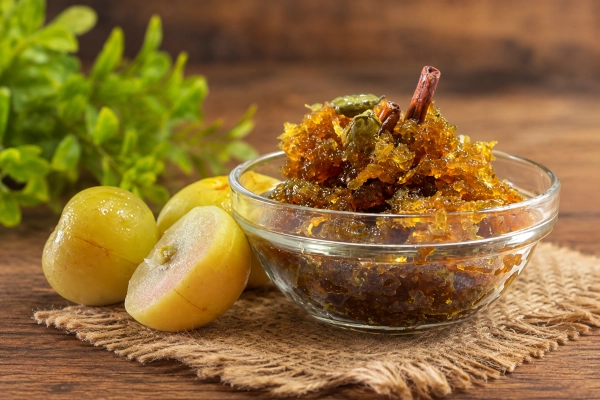
Churnodaka, commonly translated as lime water, is a clear alkaline liquid traditionally used in Ayurvedic pharmacy and food preparation. It is obtained by mixing a controlled quantity of burnt lime or slaked lime with water, allowing the undissolved material to settle and carefully separating the clear liquid above it.
In chemical terms, properly prepared lime water is a dilute aqueous solution of calcium hydroxide. Ayurveda employs it mainly as a processing medium rather than as an ordinary drink. It may be used for soaking, washing, detoxifying, firming or modifying selected fruits, vegetables and medicinal substances before they enter a formulation.
Churnodaka must not be confused with lemon water, citrus juice or concentrated lime paste. It is an alkaline preparation that requires careful measurement, settling, filtration and subsequent washing of the treated ingredient.
Meaning of the Name
The Sanskrit expression can be understood through two components:
Churna: powder or powdered substance
Udaka: water
In this context, churna refers to lime material dispersed in water. After settling and clarification, the liquid portion is used for the prescribed pharmaceutical or culinary procedure.
The name describes the method of preparation rather than suggesting that visible lime powder should remain in the final liquid.
What Is Lime Water?
Burnt lime, chemically known as calcium oxide, reacts strongly with water and forms calcium hydroxide, traditionally called slaked lime. A small portion of calcium hydroxide dissolves in the water, while the excess remains suspended or settles at the bottom.
The clear upper liquid is lime water. It is alkaline and therefore capable of altering the texture, acidity and surface characteristics of substances soaked in it.
For Ayurvedic food preparations, the material treated with Churnodaka is normally removed and washed thoroughly with clean water before further cooking. The purpose is pharmaceutical processing, not the retention of concentrated lime in the finished food.
Traditional Place in Ayurveda
Ayurvedic pharmaceutics uses several liquid media to transform raw ingredients before they are consumed. Water, milk, buttermilk, herbal decoctions, sour liquids, oils and alkaline solutions may each be selected according to the substance being processed and the desired result.
Churnodaka belongs to this wider group of processing liquids. Depending on the formulation, it may help:
- maintain the firmness of fruit during prolonged cooking;
- moderate excessive softness or disintegration;
- support the removal of selected undesirable components;
- alter acidity or astringency;
- assist purification procedures;
- improve the physical suitability of an ingredient for preservation;
- prepare a raw substance for subsequent washing, boiling or incorporation into a formulation.
Its purpose cannot be separated from the individual recipe. The same lime water should not be applied indiscriminately to unrelated herbs or foods.
Ayurvedic Understanding of Its Qualities
Because Churnodaka is alkaline, its traditional action is associated more with its Kshara-like processing character than with the Rasa–Guna profile of an ordinary herb.
It is generally understood as:
Nature: Alkaline and penetrating
Primary function: Processing, purification and alteration of texture
Effect on substances: Reduces softness, modifies sourness and changes physical structure
Method of use: External processing followed by draining or washing
Importance: Depends on concentration, duration and the material being processed
Concentrated alkaline substances may be sharp and irritating. Classical procedures therefore depend on controlled preparation rather than arbitrary quantities.
How Churnodaka Is Prepared
A general preparation method involves the following stages:
- Place the prescribed quantity of food-grade lime in a clean, non-reactive vessel.
- Add the specified quantity of potable water slowly.
- Stir carefully and allow the mixture to remain undisturbed.
- Permit all coarse and undissolved material to settle completely.
- Decant or filter only the clear upper liquid.
- Use the freshly prepared liquid according to the formulation.
- Discard the sediment safely.
The precise concentration differs according to the textual instruction. Household estimation is inappropriate because excessive calcium hydroxide can cause chemical irritation or burns.
The preparation used in the Amalaki preserve described below specifies approximately 250 milligrams of burnt lime in 60 millilitres of water. This gives the processing liquid required for soaking the fruit. Fresh Churnodaka is prepared daily during the prescribed five-day period.
Why Fruits Are Soaked in Lime Water
Fruit softens during boiling because heat, water and sugar affect its cell walls and pectin structure. When a firm whole fruit must remain intact through repeated soaking and cooking, an alkaline calcium-containing bath can help strengthen its structure.
Calcium ions can interact with pectin in plant tissues and support firmness. This explains the wider culinary use of calcium hydroxide in some traditional preserved fruits and vegetables. In the Ayurvedic procedure, the lime-water stage helps the pricked Amalaki fruits tolerate later boiling in concentrated sugar syrup without immediately collapsing.
The fruit must still be washed properly after soaking because the lime water performs a temporary processing role rather than serving as the principal ingredient of the preserve.
Churnodaka in Shodhana and Samskara
Ayurvedic pharmacy places great importance on Samskara, the transformation of a substance through processing. A raw material may change in digestibility, potency, safety, texture or therapeutic suitability after undergoing washing, heating, soaking, grinding or purification.
Shodhana is often translated as purification, although its Ayurvedic meaning can include detoxification, cleansing, reduction of undesirable properties and preparation for further pharmaceutical processing.
Churnodaka may serve as a Shodhana or Samskara medium in selected contexts. Its alkaline nature can alter surface compounds and help separate unwanted material. However, its role must be established by the authoritative formulation being followed. It should never be assumed that soaking any toxic or irritating plant in lime water makes it safe.
The Textual Sources of Amalaki Murabba
The preparation described here is cited to Ayurveda Sara Samgraha, Avaleha-Paka Prakarana, page 532, and Rasa Tantrasara Evam Siddha Prayoga Sangraha, Part I, page 405. Ayurveda Sara Samgraha is a practical Ayurvedic formulary that brings together commonly used medicines and pharmaceutical procedures. Its Avaleha-Paka section deals with cooked semisolid preparations, preserves and sugar-based formulations, explaining how ingredients are processed to obtain suitable consistency, stability and therapeutic character.
Rasa Tantrasara Evam Siddha Prayoga Sangraha is an extensive compilation of Ayurvedic pharmaceutical preparations published by Krishna Gopal Ayurveda Bhawan. The Traditional Knowledge Digital Library records separate first and second parts of the work and identifies an eighth edition published in 1990. The text is widely used as a reference for practical preparations from Rasashastra and Bhaishajya Kalpana, including herbal, mineral and compound medicines.
The inclusion of Amalaki Murabba in these practical compendia illustrates an important feature of Ayurveda: therapeutic foods and pharmaceutical preparations are not treated as entirely separate categories. A preserve may be designed to improve palatability and storage while retaining the traditional qualities of its principal ingredient.
Amalaki Murabba
Ayurvedic Gooseberry Fruit Preserve Prepared with Churnodaka
Category: Khadita—hard or chewable eatable preparation
Principal ingredient: Fresh Amalaki
Processing medium: Churnodaka
Preserving medium: Sugar syrup
Traditional properties: Pittashamaka and Balavardhaka
FSSAI’s Ayurveda Aahara product listings recognise Amalaki Murabba under the Murabba category. The notified recipe classifies it among traditional Ayurveda Aahara preparations.
Ingredients
| Ingredient | Common or botanical identity | Part used | Ratio |
|---|---|---|---|
| Sharkara | Ordinary sugar | — | 2 parts |
| Amalaki | Indian gooseberry, Phyllanthus emblica | Fresh fruit | 1 part |
| Churnodaka | Clear lime water | Processing liquid | As required |
Older Ayurvedic compilations frequently use the botanical synonym Emblica officinalis for Amalaki. The currently accepted name is commonly given as Phyllanthus emblica L.
Preparation of the Churnodaka
For the quantity indicated in the formulation:
- Take approximately 250 milligrams of burnt lime.
- Add it carefully to 60 millilitres of clean water.
- Allow the mixture to settle completely.
- Use only the clear liquid portion.
- Avoid transferring sediment or visible lime particles into the fruit-soaking vessel.
A fresh batch is prepared when the liquid is changed each day.
Because burnt lime reacts with water and can generate heat, this stage should be performed carefully with food-grade material, protective handling and accurate measurement.
Method of Preparing Amalaki Murabba
Selection and cleaning
Collect fresh, mature and undamaged Amalaki fruits. Wash them thoroughly to remove dust and surface contamination.
Pricking the fruit
Prick each fruit evenly with a clean fork or sterile pointed utensil. The small openings permit the processing liquid and later the sugar syrup to penetrate the fruit.
The fruits should remain substantially intact. Deep cuts may cause them to break apart during boiling.
Soaking in Churnodaka
Immerse the prepared fruits completely in freshly made Churnodaka.
Change the Churnodaka every day. Continue the soaking process for five days, preparing fresh lime water at each change.
This prolonged processing helps firm the fruit and prepares it for cooking in sugar syrup.
Washing
At the end of five days, remove the Amalaki fruits from the Churnodaka.
Wash them repeatedly and thoroughly in clean potable water. This is a crucial stage intended to remove residual alkalinity and surface lime.
The fruits should not proceed directly from the alkaline bath into the sugar syrup without adequate washing.
Preparing the sugar syrup
Prepare sugar syrup using the prescribed proportion of two parts sugar for one part fresh Amalaki.
Cook the syrup until it reaches approximately one-thread consistency. In the traditional culinary test, a cooled drop placed between the thumb and forefinger forms a single short thread when the fingers are gently separated.
Because hot sugar syrup can cause serious burns, this test should only be performed after cooling a small sample.
Cooking the fruits
Add the washed Amalaki fruits to the syrup and boil gently until they are properly cooked and begin absorbing the syrup.
Avoid vigorous stirring that could damage the fruits. The objective is to preserve their form while allowing the sweet medium to penetrate.
Maturation in syrup
Keep the cooked fruits immersed in the syrup for a few days. This resting period permits more uniform absorption and produces the characteristic murabba texture.
Transfer the preparation into a clean, dry and airtight food-grade container. Always use a dry utensil when removing individual fruits.
Ayurvedic Logic of the Preparation
The formulation combines three distinct elements:
Amalaki provides the principal traditional qualities. It is considered especially supportive in Pitta-related conditions and is widely valued as a Rasayana ingredient.
Sugar creates the preserving medium, reduces the intense sourness of the fresh fruit and contributes a nourishing, strengthening character.
Churnodaka performs the initial processing. It firms the fruit and prepares it to withstand cooking and preservation.
Churnodaka is therefore essential to the method but is not intended to dominate the final product. Its work is completed during soaking, after which the fruit is thoroughly washed.
Traditional Properties
Pittashamaka
Amalaki Murabba is described as Pittashamaka, meaning that it traditionally helps pacify aggravated Pitta. It is consequently associated with conditions characterised by heat, burning, excessive sourness or irritation.
Balavardhaka
The preparation is also described as Balavardhaka, or strength promoting. The preserved fruit and sugar syrup make it more nourishing and energy-dense than fresh Amalaki alone.
These descriptions represent classical Ayurvedic properties and should not be interpreted as proof that the preparation treats all modern disorders associated with similar symptoms.
Traditional Benefits
The referenced formulation associates Amalaki Murabba with the following conditions:
Daha: burning sensations
Shirahshula: headache
Pittaprakopa: aggravated Pitta
Baddhakoshtha: constipation
Arsha: piles
Rakta-vikara: bleeding-related disorders
Twak-roga: skin disorders
Prameha: conditions involving altered or excessive urination
Virya-vikara: disorders associated with reproductive or seminal function
The preserve is currently described in Ayurvedic educational material as a sugar-based Amalaki preparation in which fresh fruits are soaked in lime water before being cooked and preserved in syrup.
These indications are broad classical categories. Headache, rectal bleeding, urinary changes, persistent constipation, unexplained skin disease or reproductive symptoms require individual diagnosis rather than treatment with a preserve alone.
Nutritional Perspective
Amalaki naturally contains vitamin C, polyphenols, tannins and other plant compounds. Processing, heating and storage can alter the concentration and availability of some of these constituents.
Murabba also contains a high proportion of added sugar. It should therefore be regarded as a sweet preserve rather than as a sugar-free form of Amalaki.
The sugar contributes energy and extends preservation, but it also changes the nutritional profile considerably. A person cannot assume that consuming large portions produces greater therapeutic benefit.
Churnodaka Is Not a Daily Alkaline Drink
The use of lime water in this formulation does not support drinking homemade calcium hydroxide solution for acidity, calcium deficiency or general detoxification.
Concentrated or improperly prepared lime water can irritate or burn the:
- mouth;
- throat;
- oesophagus;
- stomach;
- eyes;
- skin.
Safe use depends on food-grade material, a prescribed dilution, clear separation from sediment, limited soaking time and thorough washing of the treated food.
Industrial lime, construction lime, whitewash material and unidentified market powders should never be used in food or medicine.
Precautions for Amalaki Murabba
The classical preparation specifically notes that it is not recommended in diabetes because sugar forms the largest ingredient by proportion. Contemporary Ayurvedic information likewise cautions that the preparation is generally unsuitable for people who need to control blood glucose.
Additional care is appropriate for people with:
- insulin resistance or prediabetes;
- obesity requiring calorie restriction;
- high triglycerides;
- dental decay;
- fructose intolerance;
- medically prescribed low-sugar diets.
The preparation should be discarded if it develops mould, fermentation, gas, an unpleasant odour or unusual discoloration.
Pregnant people, children, older adults and those with chronic illness should obtain professional advice before using it for therapeutic purposes.
Safe Handling of Churnodaka
Anyone preparing Churnodaka should observe basic safeguards:
- Use only food-grade or pharmaceutically authenticated lime.
- Measure the lime accurately.
- Add it to water slowly and carefully.
- Avoid inhaling dust.
- Protect the eyes and skin.
- Allow complete settling.
- use only the clear upper liquid.
- Keep it away from children.
- Wash the processed fruit repeatedly.
- Discard leftover liquid rather than storing it casually.
If lime material enters the eyes or causes a chemical burn, rinse continuously with clean water and seek medical assistance.
Conclusion
Churnodaka is a specialised alkaline processing liquid used in Ayurvedic pharmaceutics and selected traditional foods. Its value lies in what it does to another ingredient—firming, cleansing or preparing it for the next stage—rather than in routine direct consumption.
The preparation of Amalaki Murabba demonstrates its role clearly. Fresh gooseberries are pricked, soaked for five days in lime water that is replaced daily, washed thoroughly and then cooked in one-thread sugar syrup. Churnodaka helps the fruit retain its structure, while sugar converts it into a stable, palatable preserve.
This procedure also shows the precision of traditional Ayurvedic food processing. The usefulness of an ingredient depends not only on its identity but also on quantity, duration, sequence, washing and final combination. Churnodaka can be valuable within such a controlled method, yet potentially harmful when concentrated, incorrectly prepared or casually consumed.
References
- Ayurveda Sara Samgraha. Avaleha-Paka Prakarana. Amalaki Murabba, p. 532.
- Rasa Tantrasara Evam Siddha Prayoga Sangraha. Part I. Amalaki Murabba, p. 405. Krishna Gopal Ayurveda Bhawan.
- Food Safety and Standards Authority of India. Food Safety and Standards (Ayurveda Aahara) Regulations, 2022 and notified category-wise Ayurveda Aahara recipes.
- Food Safety and Standards Authority of India, FoSCoS. Ayurveda Aahara Category A, Murabba 21.1: Amalaki Murabba.
- Traditional Knowledge Digital Library. List of Ayurveda books: Rasatantrasara Evam Siddhaprayogasangraha, Parts I and II.
- Government of India, Ministry of AYUSH. Ayurvedic Pharmacopoeia of India: Amalaki monograph.
- Bhavaprakasha Nighantu. Classical description of Amalaki.
- Charaka Samhita. Classical references to Amalaki as a Rasayana and Pitta-supporting fruit.
Health and safety disclaimer: This article documents traditional Ayurvedic knowledge for educational purposes. Churnodaka is an alkaline processing liquid and should not be consumed directly or prepared casually. Use authenticated food-grade materials, precise measurements and professional guidance. Amalaki Murabba contains substantial added sugar and is generally unsuitable for diabetes unless specifically approved by a treating clinician.
You may also like
-
Ayurveda on Cold Foods and Iced Drinks: Why Food Temperature Matters for Digestion
-
Serum Institute of India-Manufactured Ebola Vaccine Enters Clinical Trial in Uganda
-
Ayurveda and Hydration: How Much Water Should We Really Drink?
-
Warm Water in Ayurveda: When and Why It Is Recommended
-
Women Make Up 43% of India’s Ayush Workforce as Sector Supports 17.6 Lakh Livelihoods
