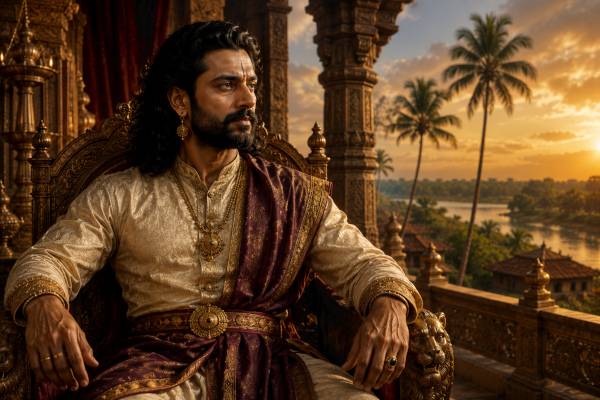
Udaya Varma Kolathiri occupies a special place in the history of North Malabar. He belongs to the Kolathiri line, the royal house that ruled Kolathunadu, the historic kingdom of northern Kerala. His name survives with particular respect because of his association with Cherusseri Namboothiri and the creation of Krishnagatha, one of the landmark works in Malayalam literary history.
Kolathunadu was one of the great political and cultural regions of medieval Kerala. It covered the northern Malabar world around present-day Kannur, Kasaragod and adjoining areas. Its older memory goes back to the Mushika rulers of Ezhimala. Over time, this ancient lineage developed into the Kola Swaroopam, whose rulers came to be known as the Kolathiris. The Kolathiri house held authority through a Kerala-style political system built around royal households, temples, Brahmin settlements, martial chiefs, trade centres and sacred legitimacy.
Udaya Varma Kolathiri must be understood inside this world. He was not merely a palace figure. He represented a royal tradition that stood at the meeting point of politics, literature, religion and regional identity. Kolathunadu had ports, temples, hill country, fertile settlements and martial families. The Arabian Sea connected it to maritime trade. The inland landscape connected it to temples, agriculture and local chieftaincies. A king in this region needed military authority, ritual legitimacy, diplomatic wisdom and cultural refinement.
The Kolathiri title itself carried deep prestige. The rulers of this line were remembered as northern lords of Kerala, linked by tradition to the older Mushika heritage. Their power was shaped by the matrilineal system of succession followed in many Kerala royal houses. Authority passed through the senior line of the royal family, and the ruler stood as the visible head of a larger swaroopam. This made the Kolathiri king both a political leader and the symbolic centre of a royal household.
Udaya Varma’s period is usually placed in the 15th century. Literary tradition connects him with the years after Kerala Varma Kolathiri. His reign is remembered more through culture than through battlefield accounts. This itself makes him important. Many kings are remembered for conquest. Udaya Varma is remembered for patronage, language and the shaping of Malayalam’s literary future.
His greatest historical association is with Cherusseri Namboothiri, the celebrated poet of Krishnagatha. Cherusseri is believed to have been a court poet under Udaya Varma Kolathiri. According to literary tradition, the king encouraged or instructed the poet to compose the work. This royal encouragement gave Malayalam one of its most beloved devotional poems.
Krishnagatha tells the story of Lord Krishna, especially the tender and devotional episodes connected with his childhood. Its greatness lies in its language. Cherusseri used a form of Malayalam that moved close to the spoken idiom of the people. This gave the poem warmth, sweetness and reach. It could be recited in homes, temples and gatherings. It carried bhakti into the everyday tongue of Kerala.
Udaya Varma’s role in this literary moment is central. A king who supports such a work is doing more than helping a poet. He is giving prestige to a language. He is allowing the speech of the people to enter the courtly and sacred world. He is helping a regional literary culture gain confidence. In that sense, Udaya Varma Kolathiri stands as a cultural ruler whose patronage helped Malayalam move closer to its later classical strength.
The relationship between king and poet was a powerful part of Indian civilisation. Courts were not only centres of administration. They were also centres of memory. Poets shaped how kingdoms were remembered. Kings shaped the environment in which poets could create. Udaya Varma’s court became part of Malayalam history because it gave space to a poet whose work outlived many political events.
Krishnagatha became a turning point because it joined devotion, poetry and language. It did not remain trapped inside elite expression. It spoke to ordinary devotees. Mothers could hear Krishna’s childhood in it. Worshippers could recite it as prayer. Malayalam speakers could recognise their own emotional world in its lines. This made the work a cultural bridge between temple, home and literature.
Through this association, Udaya Varma Kolathiri became linked to the rise of Malayalam as a literary vehicle of devotion. Before this period, Malayalam literature had already passed through important stages, including older poetic and Manipravalam traditions. Cherusseri’s work gave a new fullness to native Malayalam expression. Udaya Varma’s court therefore became part of the long journey that later reached the age of Ezhuthachan, Poonthanam and other major figures.
The king’s importance also lies in the cultural confidence of North Malabar. Kerala’s literary history is often narrated through central and southern regions, but Kolathunadu had its own strong identity. It had ancient rulers, temple networks, Theyyam traditions, ports, martial lineages and learned households. Udaya Varma stands as a reminder that North Malabar was also a major contributor to Kerala’s intellectual and devotional life.
The Kolathiri realm was deeply tied to temple culture. Temples were centres of land, ritual, art and social order. Royal authority often moved through temple patronage and sacred legitimacy. The king’s honour was connected with the honour of the deities, Brahmin settlements, local chiefs and ritual institutions. Udaya Varma’s reign belongs to this larger temple-centred world, where literature and devotion strengthened royal prestige.
A ruler like Udaya Varma also had to manage a layered society. Kolathunadu contained royal branches, Namboothiri settlements, warrior households, merchant communities, artisans, temple servants and local chiefs. Governance in such a region required balance. The king’s power rested on alliance, recognition and ritual order. His court had to project dignity, stability and learning.
The literary memory of Udaya Varma suggests that his court valued scholarship. Cherusseri’s presence points to a cultivated royal atmosphere. A king who could recognise poetic ability and encourage a major devotional composition had a refined understanding of cultural power. Such patronage gave the kingdom a prestige that military success alone could not create.
Udaya Varma Kolathiri also belongs to the history of Kerala’s soft power. Krishnagatha became a work of devotion, beauty and language. It carried the cultural influence of his court across generations. The poem continued to be read, recited and remembered. Through it, the king’s name travelled beyond palace walls and entered the memory of Malayalam literature.
This is the mark of a lasting ruler. Stone forts can fall. Political boundaries can shift. Palace authority can fade. A great work of literature can preserve a name for centuries. Udaya Varma’s legacy shows how cultural patronage can become a form of immortality.
The Kolathiri line later passed through many political changes. North Malabar saw the arrival of European powers, the growth of coastal trade conflicts, the rise of regional rivalries and later colonial interventions. Yet the memory of earlier Kolathiri rulers remained alive through temples, local traditions, family histories and literature. Udaya Varma’s place in that memory is gentle but powerful.
He is best remembered as the king under whose patronage Cherusseri’s genius flowered. This makes him one of Kerala’s important literary patrons. His contribution was not in writing the poem himself. His contribution was in creating the royal space that allowed such a poem to be born, honoured and transmitted.
In the history of Kerala, Udaya Varma Kolathiri represents a beautiful model of kingship. He shows that a ruler’s greatness can come through support for language, devotion and learning. He belongs to a time when political authority and cultural responsibility stood together. His court became the setting for a work that helped Malayalam speak with sweetness, intimacy and confidence.
Udaya Varma Kolathiri’s name deserves remembrance because he stands behind one of the great literary moments of Kerala. Through Cherusseri and Krishnagatha, his reign became part of the emotional life of Malayalam speakers. He was a Kolathiri king of North Malabar, a patron of poetry, a guardian of royal culture and a silent force behind a devotional masterpiece.
His legacy is simple and profound. He gave shelter to poetry. Poetry gave him history.
You may also like
-
Tamralipta — The Maritime Gateway of the Lower Ganga
-
Suhma — The River-and-Forest Country of Southwestern Bengal
-
Gauda — The Western Bengal Country of the Bhagirathi and the Rise of Karnasuvarna
-
Pundra — The Northern Bengal Kingdom of the Karatoya and the Ancient City of Pundranagara
-
Vanga — The River Kingdom of the Bengal Delta and the Eastern Sea
