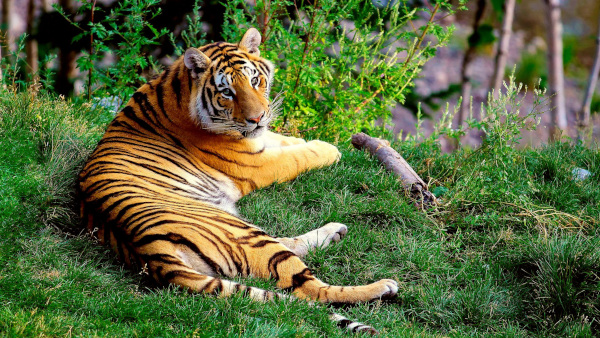
A male tiger has been confirmed in the rocky forest landscape around Anegundi, Sanapur and Basapur in Karnataka’s Koppal district, marking a remarkable return of the apex predator to a region where confirmed tiger records have been absent for decades.
The animal has been recorded repeatedly through surveillance cameras deployed by the Karnataka Forest Department after villagers reported pugmarks, livestock losses and possible tiger movement in the Gangavathi region. Forest officials have since intensified monitoring across the landscape and deployed personnel around villages where the tiger has been moving.
The sighting is particularly significant because the landscape is better known today for its spectacular granite hills, agricultural fields and association with Hampi than as established tiger habitat. Yet Koppal still contains patches of dry deciduous forest, scrubland and rocky terrain capable of supporting a surprising variety of wildlife.
Reports from the region indicate that around 50 camera traps were deployed across parts of the Sanapur-Basapur and adjoining landscape after indications of a large carnivore began emerging. The tiger was subsequently photographed on multiple occasions, confirming that the reports were not simply the result of an animal passing unnoticed on a single night.
Forest authorities are now attempting to determine how long the tiger has been present and where it originated. A technical assessment is examining its movements and possible dispersal route. Until that work is completed, claims that the animal travelled from any particular tiger reserve or forest system remain speculative.
The tiger is believed to be an adult male, with some field estimates placing its age at around six years. Its movements have reportedly been detected around Basapur, Anegundi, Sanapur, Jangamarampur, Rangapur and Temba, bringing it periodically close to agricultural areas and human settlements.
The animal’s presence has therefore created both excitement and a significant wildlife-management challenge. Reports of livestock predation have prompted the Forest Department to strengthen surveillance and conduct awareness programmes in nearby villages. Residents have been advised to avoid moving alone through forested areas after dark, keep livestock secure and immediately report fresh signs of tiger movement.
Senior forest and district officials have also reviewed the situation as teams work to prevent conflict between the animal and surrounding communities. The immediate priority is to protect residents while ensuring that the tiger is handled safely.
What makes the development particularly remarkable is its location in the Anegundi-Kishkindha landscape, one of Karnataka’s most culturally significant regions.
Anegundi lies across the Tungabhadra from Hampi and is traditionally identified with Kishkindha of the Ramayana, the kingdom associated with Sugriva, Hanuman and the Vanara forces. Karnataka Tourism itself describes Anegundi as the landscape traditionally believed to be Kishkindha, while nearby Anjanadri Hill is revered as the birthplace of Hanuman.
The modern return of a tiger to this ancient landscape therefore gives the event an unusual combination of ecological and cultural significance. The rugged hills around Anegundi and Sanapur, familiar to generations through their association with the Ramayana and Vijayanagara history, are now drawing attention for another reason — the unexpected movement of one of India’s largest predators through the same terrain.
Historical accounts add another dimension to the sighting. Wildlife reports from Karnataka indicate that tigers were photographed in the wider region during the 1970s by noted wildlife photographer and former Karnataka minister M. Y. Ghorpade. The latest camera-trap images are therefore being described as the first confirmed tiger records from this landscape in more than five decades.
The tiger’s appearance does not necessarily mean that Koppal has once again developed a resident breeding tiger population. Male tigers, particularly younger or displaced individuals, can travel considerable distances while searching for territory. A single dispersing tiger can consequently appear far beyond a recognised tiger reserve.
Nevertheless, such movements are ecologically important. They demonstrate that wildlife does not remain confined within the administrative boundaries of national parks and tiger reserves. Tigers depend on wider networks of forests, scrublands, river systems and transitional habitats when dispersing between territories.
That makes landscapes such as Koppal increasingly relevant to India’s conservation strategy. Even relatively dry or fragmented habitats can function as temporary refuges or movement routes for large mammals. Protecting these areas therefore contributes to maintaining connectivity between larger wildlife populations.
The event also underlines the importance of camera traps and rapid field monitoring. Without systematic surveillance, an animal moving through scrub forests and rocky terrain could remain unconfirmed for weeks. Camera imagery allows officials to verify species, study movement patterns and distinguish individual animals before making management decisions.
For now, the focus remains firmly on managing the tiger safely and preventing escalation of human-wildlife conflict. Its continued proximity to villages and livestock means authorities cannot treat the sighting simply as a conservation celebration. Any decision regarding capture, relocation or allowing the animal to move naturally will have to take account of both public safety and the tiger’s welfare.
Yet the larger significance is difficult to ignore. More than five decades after tigers were last documented in this part of Karnataka, an adult male is once again moving through the hills and scrub forests surrounding Anegundi and Sanapur.
In a landscape remembered as Kishkindha, where mythology, history and nature have overlapped for centuries, the return of the tiger is a striking reminder that even heavily transformed landscapes can retain ecological connections capable of bringing India’s great predators back into places from which they had seemingly disappeared.
You may also like
-
Kashmir Markhor Population Rises to 227 as Kazinag Conservation Efforts Show Results
-
ICAR-CIFRI Pushes Conservation of Indigenous Himalayan Fish for Biodiversity and Livelihood Security
-
Indian-Born Cheetah KJP21 Gives Birth to Five Cubs at Kuno, India’s Cheetah Population Reaches 60
-
ZSI and Mahatma Gandhi University Discover New Earthworm Species in Western Ghats
-
ZSI Scientists Identify New Fish Species Bathymyrus perplexus From the Bay of Bengal
