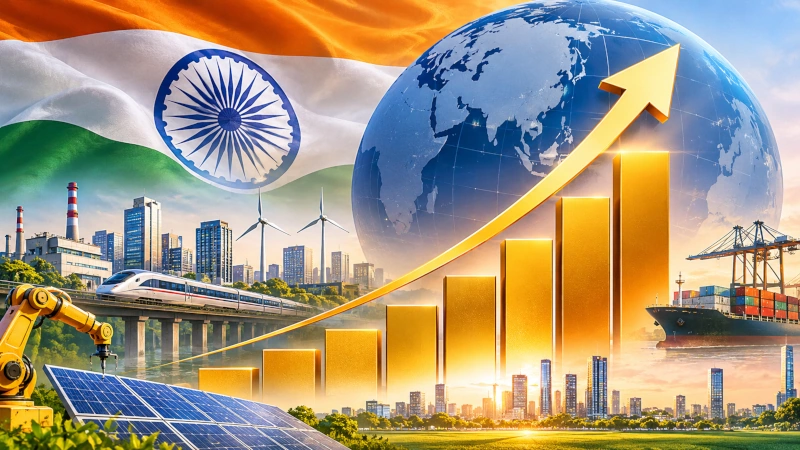
India has secured the highest position in a comparative assessment of macroeconomic resilience among the world’s ten largest economies, with a score of 71 out of 100 for the 2026–2030 period. According to a report released by the Associated Chambers of Commerce and Industry of India (ASSOCHAM) on 12 November 2026, India ranks ahead of China, Japan, Germany, Russia and the United States in its projected ability to sustain economic growth while managing key macroeconomic challenges.
The report, titled India’s Economic Edge in the Top Ten Economies, evaluates major economies using ten economic indicators drawn from the International Monetary Fund’s World Economic Outlook database. India leads the projected rankings with 71 points, followed by China with 66 points, Japan and Russia with 60 points each, and Germany with 59 points. The United States ranks tenth with 36 points.
India’s leading position is primarily supported by its strong economic growth prospects, high levels of savings and investment, improving public debt trajectory and expanding export potential. The assessment also identifies fiscal deficits, current account pressures and dependence on imported energy as areas requiring continued policy attention.
India Leads Global Macroeconomic Resilience Rankings
ASSOCHAM’s Comparative Macroeconomic Resilience Score evaluates economic performance across ten indicators covering growth, savings, investment, exports, government debt and fiscal and external balances. The study examines the historical period from 2021 to 2025 alongside projections for 2026 to 2030, allowing comparisons between recent economic performance and anticipated medium-term trends.
Under the methodology, the ten economies are ranked separately on each indicator. These rankings are converted into numerical scores and combined to produce a composite assessment out of 100, with equal weight assigned to each indicator.
India’s projected score of 71 represents an improvement from 66 during 2021–2025, when the country ranked third behind Russia and China. The improvement places India at the top of the comparative rankings for the forthcoming five-year period.
The report’s projected rankings place China second with 66 points, Japan and Russia jointly third with 60 points, Germany fifth with 59 points, Italy and Brazil jointly sixth with 53 points, the United Kingdom eighth with 52 points, France ninth with 40 points and the United States tenth with 36 points.
The assessment measures relative macroeconomic performance across the selected indicators rather than the absolute size of national economies. Consequently, India’s first-place position reflects its comparative growth and economic indicators within the study’s framework.
India Projected to Maintain Highest GDP Growth Among Major Economies
Economic growth is the strongest contributor to India’s leading position in the ASSOCHAM assessment. The report projects India’s real Gross Domestic Product to expand at an average annual rate of 6.9% during 2026–2030, the highest among the ten economies examined.
India recorded average real GDP growth of 7.9% during 2021–2025, according to the report. Although the projected rate for the subsequent five years is lower, India is expected to retain its growth advantage over the other major economies included in the comparison.
The country also ranks first in projected real GDP per capita growth, indicating that economic output per person is expected to increase at a comparatively strong pace after adjusting for inflation.
India’s growth outlook is supported by domestic consumption, investment, infrastructure development and expanding economic activity across manufacturing and services. The continued development of productive capacity and domestic markets forms an important component of the country’s medium-term economic prospects.
The projected growth advantage also reflects the differences between India’s economic structure and those of other large economies, several of which face slower growth, demographic pressures and more mature domestic markets.
High Savings and Investment Strengthen India’s Economic Position
India ranks second among the ten economies in both gross national savings and gross capital formation during the 2026–2030 projection period, with China occupying the first position on both indicators.
According to ASSOCHAM, India’s gross national savings are projected to average 35.3% of GDP over the five-year period. Gross capital formation, which measures investment in productive assets and additions to inventories, is projected to average 36.7% of GDP.
The high investment ratio reflects the importance of capital formation in India’s economic expansion. Investment in infrastructure, industrial facilities, machinery, transport networks and other productive assets contributes to the development of long-term economic capacity.
Domestic savings also provide an important source of financing for investment, reducing the extent to which economic expansion depends on external capital.
The report’s projections place India among the leading major economies in its ability to mobilise savings and direct resources towards capital formation. The combination of comparatively high growth and investment rates represents a significant strength in the country’s medium-term economic outlook.
Public Debt Ratio Projected to Decline Towards 2030
India’s projected public debt trajectory contributes positively to its macroeconomic resilience ranking, with ASSOCHAM anticipating a gradual decline in the general government debt-to-GDP ratio during the assessment period.
The report projects India’s general government debt to average approximately 79.9% of GDP during 2026–2030, compared with an average of 84.8% during 2021–2025.
The projections indicate that the debt ratio could decline from 83.1% in 2026 to approximately 77% by 2030.
The general government debt measure includes liabilities of both the Union and State Governments, providing a broader assessment of public indebtedness than central government debt alone.
A declining debt-to-GDP ratio indicates an improvement in the relationship between the size of public liabilities and national economic output. India’s projected trajectory reflects the anticipated combination of economic expansion and fiscal management over the medium term.
India ranks third among the ten economies on the debt-to-GDP indicator in the ASSOCHAM assessment.
Fiscal Consolidation Remains a Key Economic Priority
Despite India’s strong overall ranking, the report identifies the fiscal deficit as one of the country’s principal macroeconomic challenges.
India’s general government fiscal deficit averaged approximately 8.5% of GDP during 2021–2025. ASSOCHAM projects the deficit to narrow to an average of 7.1% during 2026–2030, indicating an improvement in the fiscal position while also reflecting continued borrowing requirements.
India ranks eighth among the ten economies in the overall fiscal balance indicator for the projection period. Its relatively weaker position on this measure contrasts with its leading performance in GDP growth, savings and investment.
ASSOCHAM Secretary General Saurabh Sanyal identified fiscal consolidation as an important area requiring continued attention. He noted that India’s general government deficit was the largest among the ten economies during 2021–2025 but is projected to narrow over the subsequent five years.
The report highlights the importance of improving fiscal balances alongside sustained economic growth. Reducing government borrowing requirements while maintaining productive public investment remains a significant element of India’s medium-term economic management.
India’s Export Growth Expected to Remain Competitive
India ranks third among the ten economies in projected export volume growth during 2026–2030, with ASSOCHAM estimating average growth of 4.5% over the period.
The assessment identifies manufacturing, higher-value services, digital industries and expanding international trade relationships as important components of India’s export potential.
India’s growing network of free trade agreements is also identified as a factor supporting greater access to international markets. However, the report emphasises that preferential market access must be accompanied by improvements in competitiveness, production efficiency and logistics.
The country’s digital economy is another area highlighted in the assessment. According to the report, digital economic activity contributes approximately 13% of India’s GDP, with the potential to approach 20% by 2030.
The expansion of digital services, technology-intensive industries and manufacturing capabilities forms part of India’s broader economic development strategy.
ASSOCHAM Chief Economist Dr S. P. Sharma emphasised the need to reduce the cost of doing business, particularly for Micro, Small and Medium Enterprises. He identified the cost of capital, power, compliance, logistics and labour as important factors influencing the competitiveness of Indian enterprises.
Current Account Deficit and Energy Imports Remain Challenges
India’s external sector presents another area of concern in the ASSOCHAM assessment, particularly because of the country’s dependence on imported crude oil.
The report projects India’s current account deficit to average approximately 1.4% of GDP during 2026–2030, compared with 1.1% during 2021–2025. The deficit is projected to reach approximately 1.7% of GDP by 2030.
India ranks seventh among the ten economies on the current account balance indicator.
The current account measures transactions involving trade in goods and services, primary income and transfers between a country and the rest of the world. A deficit indicates that payments to the rest of the world exceed corresponding receipts during the period.
India’s substantial requirement for imported crude oil exposes its external accounts to fluctuations in international energy prices. Higher oil prices can increase import expenditure and affect the current account balance.
The report identifies energy diversification and renewable energy development as important measures for reducing vulnerabilities associated with dependence on imported fuels.
India Secures Strong Positions Across Major Economic Indicators
The ASSOCHAM assessment places India first in real GDP growth and real GDP per capita growth, demonstrating the country’s projected advantage in economic expansion.
India occupies the second position in gross national savings and gross capital formation, while ranking third in export volume growth and the general government debt-to-GDP indicator.
The country ranks fifth in the primary fiscal balance, seventh in both the current account balance and structural fiscal balance, and eighth in the overall fiscal balance.
These rankings illustrate the differences between India’s strengths in growth and capital formation and the challenges associated with public finances and external balances.
The report’s composite score combines these indicators to provide a comparative assessment of the ten economies. Its conclusions therefore reflect performance across multiple dimensions rather than growth rates alone.
India’s Medium-Term Economic Outlook Strengthened by Growth and Investment
The ASSOCHAM report places India in the leading position among the world’s ten largest economies for projected macroeconomic resilience during 2026–2030, reflecting its growth prospects, high investment ratio and anticipated improvement in public debt indicators.
India’s score of 71 out of 100, compared with China’s 66 and the United States’ 36, highlights the country’s relative position under the report’s ten-indicator assessment framework.
The findings also underscore the importance of continued fiscal consolidation, external sector stability, energy diversification and improvements in industrial competitiveness.
While the rankings are based on projections and relative performance rather than guaranteed economic outcomes, the assessment identifies sustained growth, domestic savings and capital formation as India’s principal economic advantages.
The report presents a favourable medium-term assessment of India’s macroeconomic fundamentals while recognising that maintaining this position will require continued attention to fiscal discipline, export competitiveness and external economic vulnerabilities.
You may also like
-
India Targets First Made-in-India Civil Aircraft Within Two Years as Indigenous Aviation Manufacturing Gains Momentum
-
BITS Pilani Develops ₹2,500 System to Convert Food Waste into Animal Feed
-
Sikkim Large Cardamom: The GI-Tagged Heritage of the Eastern Himalayas’ Aromatic Black Spice
-
Indian HealthTech Startup EkaCare Selected to Build Multilingual AI Medical Documentation System for NHA
-
Ashoka Buildcon Secures $58.9 Million Contract to Develop 120 MW Solar Power Plant in Bhutan
