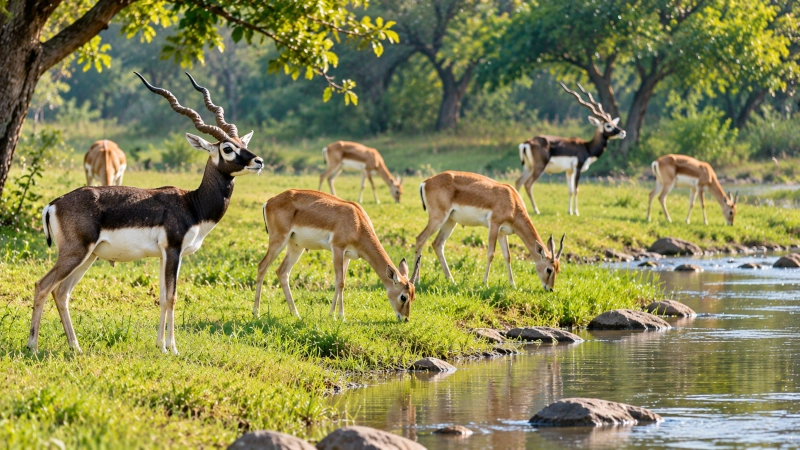
The Chhattisgarh government has approved a wildlife conservation initiative to reintroduce 50 blackbucks into Gomarda Wildlife Sanctuary in Sarangarh-Bilaigarh district, marking an important effort to restore a species that disappeared from the region more than five decades ago. The animals will be transferred from Barnawapara Wildlife Sanctuary, where an earlier conservation programme has successfully established a growing blackbuck population through scientific translocation, habitat management and sustained monitoring.
The proposal, approved by the standing committee of the Chhattisgarh State Wildlife Board, forms part of a broader effort to restore native wildlife populations to suitable habitats. The initiative follows the recovery of blackbucks at Barnawapara, where the population has increased to more than 150 animals since the introduction of an initial group in 2017–18. Forest officials have identified Gomarda’s grasslands, water resources and suitable terrain as favourable conditions for establishing a new population of the protected antelope.
Restoring a Species That Disappeared Five Decades Ago
The blackbuck (Antilope cervicapra) was historically found across grassland and open woodland landscapes in the region that now forms Chhattisgarh. However, hunting, poaching, habitat encroachment and development-related pressures contributed to a sustained decline in its population. By the 1970s, blackbucks had disappeared from the Gomarda landscape, leaving the species locally extinct for more than 50 years.
The planned reintroduction seeks to reverse this historical loss by establishing a breeding population within a protected habitat. Gomarda Wildlife Sanctuary contains dry deciduous forests, open grasslands and water resources that provide conditions suitable for blackbucks. Its landscape also supports several other wildlife species, including deer, wild boar, sloth bears and carnivores.
According to forest officials quoted by The Indian Express, Gomarda and Barnawapara are separated by approximately 70 kilometres and belong to the same broader landscape. Principal Chief Conservator of Forests O. P. Yadav highlighted Gomarda’s grasslands and water availability as important factors supporting the proposed translocation.
Restoring blackbucks to their former habitat could contribute to the recovery of native grassland biodiversity while expanding the geographical distribution of the species within Chhattisgarh.
Barnawapara’s Conservation Success Provides the Foundation
The proposed reintroduction builds upon an earlier programme undertaken at Barnawapara Wildlife Sanctuary in Baloda Bazar district. During 2017–18, the Chhattisgarh State Wildlife Board facilitated the translocation of 77 blackbucks into the sanctuary as part of an effort to restore the species to suitable habitats.
Of these animals, 50 were brought from the National Zoological Park in New Delhi, while another 27 were transferred from Kanan Pendari Zoological Garden in Bilaspur. The animals were initially maintained under controlled conditions to allow them to acclimatise before their gradual release into suitable natural habitats.
The programme combined habitat management, protection and monitoring with measures to support the animals’ adaptation to their new surroundings. Over subsequent years, breeding within the managed population helped increase the number of blackbucks at Barnawapara to more than 150.
Krishanu Chandrakar, Superintendent of Barnawapara Wildlife Sanctuary, explained that the animals required time to adapt and were therefore released gradually from their enclosures. Some animals continue to be maintained within protected facilities while others have been introduced into the sanctuary’s open habitats.
The recovery at Barnawapara has provided Chhattisgarh with practical experience in managing blackbuck populations and conducting conservation translocations. The proposed transfer to Gomarda represents the next stage of this programme, extending species restoration efforts to another suitable protected landscape.
Scientific Translocation and Habitat Management
Wildlife translocation involves the deliberate movement of animals from one location to another for conservation or management purposes. When used to restore a species to an area where it previously occurred, the process is known as reintroduction. Such programmes require careful consideration of habitat suitability, animal health, ecological conditions and the ability of the receiving landscape to sustain a breeding population.
Blackbucks are particularly associated with open grasslands and relatively dry habitats where they can graze, detect predators and move across unobstructed terrain. Their adaptation to these environments makes habitat structure an important consideration when selecting locations for reintroduction.
At Gomarda, forest authorities have identified favourable grassland conditions and water availability as important advantages. Habitat preparation and management will be relevant to supporting the animals during their initial adaptation period, particularly because blackbucks can be sensitive to unfamiliar surroundings and disturbances.
The experience gained at Barnawapara provides a useful model for the programme. Gradual acclimatisation, veterinary supervision, suitable feeding conditions and continued monitoring can help transplanted animals adapt to a new landscape before they are released into the wild.
Long-term habitat management is equally important for establishing a viable population. Maintaining suitable grasslands, controlling invasive vegetation and protecting animals from poaching and other threats can support breeding and population growth.
Blackbuck Conservation and India’s Grassland Biodiversity
The blackbuck is one of India’s most recognisable native antelope species and is distinguished by its slender build, exceptional running speed and the long, spiralling horns of adult males. Mature males typically develop dark brown to black upperparts, while females and younger animals generally have lighter coats.
The species is native to the Indian subcontinent and inhabits grasslands, scrublands and open plains. Blackbucks are herbivorous animals that feed primarily on grasses and other vegetation, making them important components of the ecosystems they occupy.
Through their grazing activities, blackbucks can influence vegetation structure and contribute to ecological processes within grassland habitats. Their presence also forms part of the broader food web, supporting the ecological relationships between herbivores, vegetation and predators.
Despite its widespread recognition, the species has experienced substantial local declines because of hunting, habitat conversion, fragmentation and expanding human activities. Although the International Union for Conservation of Nature classifies the blackbuck as Least Concern globally, the species receives the highest level of legal protection under Schedule I of India’s Wildlife (Protection) Act, 1972.
This distinction reflects the importance of protecting wildlife even when a species is not classified as globally threatened. Local extinction can eliminate an animal from landscapes where it historically played an ecological role, making carefully planned reintroduction programmes valuable conservation interventions.
New Opportunities for Wildlife Conservation and Local Communities
The proposed reintroduction could strengthen Gomarda Wildlife Sanctuary’s biodiversity while creating opportunities for conservation-oriented nature tourism and local participation in wildlife protection.
Forest officials have indicated that the restoration of blackbucks may encourage additional wildlife tourism in the sanctuary, potentially generating livelihood opportunities for communities associated with the protected landscape. Such benefits would be linked to the development of responsible tourism practices that protect habitats and minimise disturbance to wildlife.
Community participation is particularly important for the conservation of grassland species because their habitats often occur near agricultural areas, grazing lands and settlements. Awareness programmes, habitat protection and cooperation between forest authorities and local residents can contribute to maintaining suitable conditions for reintroduced animals.
The initiative also provides an opportunity to expand conservation monitoring and scientific observations of blackbuck behaviour, habitat use and breeding within the Gomarda landscape. Such information can improve understanding of species restoration and guide similar programmes in other suitable habitats.
A New Chapter in Chhattisgarh’s Wildlife Restoration Efforts
Chhattisgarh’s plan to reintroduce 50 blackbucks into Gomarda Wildlife Sanctuary represents an important extension of the state’s wildlife recovery programme. The initiative builds upon the population growth achieved at Barnawapara and seeks to restore a native antelope to a landscape where it disappeared more than five decades ago.
The programme demonstrates how scientific translocation, habitat management and sustained conservation efforts can create opportunities to reverse local wildlife losses. The recovery of blackbucks at Barnawapara has established a foundation for expanding these efforts, while Gomarda offers an opportunity to develop another protected population within the state.
By restoring an important grassland species to its historical habitat, Chhattisgarh is advancing an approach to wildlife conservation that combines species recovery with the protection of native ecosystems. The planned reintroduction adds to India’s growing experience in conservation-led wildlife restoration and highlights the potential of carefully managed protected landscapes to support the return of locally extinct species.
You may also like
-
Zoological Survey of India Plays Major Role in Landmark Global Coral Reef Assessment
-
National Zoological Park Records 46 Bird Species During 67th Foundation Day Celebrations
-
Scientists Discover New Microscopic Land Snail Species in Maharashtra’s Western Ghats
-
Thousands of Butterflies Migrate Across Tamil Nadu as Northeast Monsoon Arrives
-
Indian Researcher Surveys Over 3,000 Western Ghats Frogs to Track Deadly Amphibian Fungus
