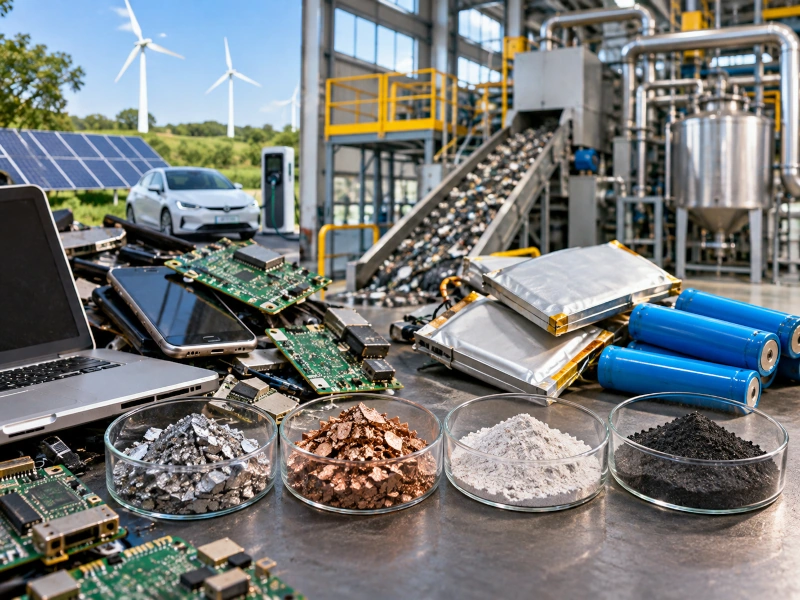
The Technology Development Board (TDB), under the Department of Science and Technology (DST), Government of India, has signed an agreement with Hyderabad-based Neo Seekermetals Private Limited to support the development and commercialisation of indigenous technology for recovering critical metals from electronic waste and used lithium-ion batteries. The agreement, announced on November 16, 2026, forms part of the government’s Research, Development and Innovation (RDI) Fund initiative to strengthen India’s domestic technological capabilities in strategically important sectors.
The project, titled Extraction of Critical Metals by Recycling of E-Waste and Lithium-Ion Battery Waste, involves a total investment of ₹20 crore, of which ₹10 crore has been approved as financial assistance under the RDI Fund. The support will be provided through Optionally Convertible Debt (OCD), enabling the company to advance its recycling technology towards commercial-scale deployment.
Indigenous Technology for Critical Minerals Recovery
Neo Seekermetals has developed an integrated and patented recycling process designed to recover valuable metals and battery materials from electronic waste and end-of-life lithium-ion batteries. The technology addresses two important challenges facing India’s industrial ecosystem: the growing requirement for critical minerals and the increasing accumulation of electronic and battery waste.
Critical minerals are essential inputs for electric vehicles, renewable energy systems, electronic equipment and advanced manufacturing technologies. As India expands its capabilities in these sectors, developing domestic sources of strategically important materials has become an increasingly significant technological and industrial priority.
The company’s recycling process is designed to extract valuable materials from complex waste streams and return them to productive industrial use. By recovering metals and battery materials that would otherwise be discarded, the technology seeks to reduce material losses while supporting more efficient utilisation of existing resources.
The integrated approach is particularly relevant because electronic waste and lithium-ion batteries contain different combinations of recoverable materials. Developing an indigenous process capable of handling both waste streams provides an opportunity to establish domestic resource recovery capabilities within India’s expanding recycling industry.
Advancing Technology from TRL-5 to TRL-9
A major objective of the TDB-supported project is to advance Neo Seekermetals’ recycling technology from Technology Readiness Level (TRL)-5 to TRL-9.
TRL-5 represents a stage at which a technology has undergone validation in a relevant environment, while TRL-9 indicates a fully demonstrated system operating under real-world conditions. The progression therefore involves substantial technological development, system integration, validation and operational demonstration.
Under the project, Neo Seekermetals will work towards developing its existing recycling process into a commercially deployable technology capable of recovering critical metals and valuable battery materials.
The programme is intended to bridge the gap between technology development and industrial application, an important requirement for scaling indigenous innovations into commercially viable manufacturing and recycling operations.
Strengthening India’s Critical Minerals Ecosystem
India’s expanding electric mobility, clean energy, electronics and advanced manufacturing sectors have increased the strategic importance of securing reliable access to critical minerals.
Recovering these materials from discarded electronics and used batteries offers an additional domestic source of valuable industrial inputs. Such recycling technologies can complement conventional mineral extraction and processing while helping address the environmental challenges associated with electronic waste.
The development of indigenous recycling capabilities also aligns with India’s broader efforts to strengthen resource security, encourage domestic technological innovation and establish a circular economy in which valuable materials remain within productive use for longer periods.
The Neo Seekermetals project represents an effort to develop Indian technological expertise in critical materials recovery rather than relying exclusively on externally developed recycling processes.
TDB Highlights Importance of Sustainable Resource Recovery
Rajesh Kumar Pathak, Secretary of the Technology Development Board, emphasised the importance of developing domestic capabilities for recovering critical minerals from waste materials.
He stated that India’s transition towards clean energy and advanced technologies would require secure and sustainable access to critical minerals. Developing indigenous technologies to recover these resources from electronic waste and end-of-life batteries would form an important component of this effort.
Pathak further observed that the RDI Fund was supporting technologies combining innovation with strategic relevance, helping transform waste streams into valuable resources while strengthening the foundations of a circular economy.
An authorised representative of Neo Seekermetals welcomed the financial support, stating that the partnership would help the company advance its technology towards commercial deployment. The company reiterated its focus on developing efficient and sustainable processes for recovering critical and valuable materials from electronic waste and lithium-ion batteries.
Supporting Indigenous Innovation and Commercialisation
The agreement reflects the Technology Development Board’s role in supporting Indian enterprises working to translate research and technological innovations into industrial applications.
By providing ₹10 crore in financial assistance for a ₹20 crore project, TDB is supporting the progression of an indigenous critical metals recovery technology from its existing validation stage towards commercial readiness.
The project also demonstrates the growing importance of Indian companies developing specialised technologies for sectors connecting advanced manufacturing, environmental sustainability and strategic resource security.
Through the RDI Fund, the partnership between TDB and Neo Seekermetals brings together government-backed innovation financing and private-sector technological development. The initiative represents another step towards strengthening India’s indigenous critical minerals recovery capabilities and building a more resource-efficient industrial economy.
You may also like
-
Waigaon Turmeric – The Golden Heritage of Maharashtra’s Vidarbha Region
-
Mankind Pharma Signs Exclusive Licensing Agreement with Betta Pharmaceuticals for Lung Cancer Drug Ensartinib
-
DG Propulsion Successfully Tests Automatic Relight Capability of Indigenous J100 Turbojet Engine
-
IISc-Incubated Thinking Balloon Successfully Tests Autonomous Tethered Aerostat Near Bengaluru
-
CUMI’s Indigenous Ceramic Vehicle Armour Achieves NATO STANAG Level 4 Qualification
