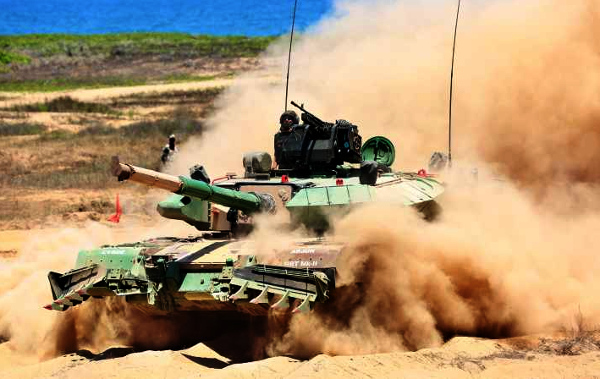
For much of the history of the tank, protection was understood primarily as a question of armour: if an enemy developed a more powerful gun, designers responded by adding thicker steel. Modern warfare has made that approach increasingly inadequate. Tanks today face anti-tank guided missiles, tandem shaped-charge warheads, kinetic-energy penetrators, top-attack weapons, mines, improvised explosive devices, loitering munitions and inexpensive FPV drones capable of striking areas that were traditionally lightly protected.
As a result, the modern tank is no longer protected by armour alone. Survivability increasingly depends on a layered protection system combining passive armour, reactive armour, signature management, electronic countermeasures, sensors, warning receivers and Active Protection Systems.
The objective is straightforward: stop the enemy from detecting the tank if possible; prevent him from achieving an accurate firing solution if detection occurs; disrupt the weapon after launch; intercept it before impact; and finally rely on physical armour and internal crew-protection measures if all the earlier defensive layers fail.
Passive Armour Remains the Foundation
Despite the growth of sophisticated electronics, passive armour remains the final physical foundation of tank protection.
Early tanks relied primarily on rolled homogeneous steel armour. Modern main battle tanks employ much more sophisticated arrangements involving combinations of high-strength steel, ceramics, composite materials, spaced armour and other specialised materials.
Different materials perform different functions. Ceramic layers can disrupt shaped-charge jets and damage penetrators, while metallic backing structures absorb and distribute the remaining energy. Composite arrangements allow designers to obtain greater protection without simply increasing steel thickness indefinitely.
The frontal arc of a main battle tank normally receives the greatest protection because it is statistically the area most likely to face enemy tank guns and anti-armour weapons during conventional engagements. The turret front and glacis therefore tend to have considerably greater protection than the sides, rear and roof.
This unequal distribution creates vulnerabilities that modern anti-tank weapons increasingly attempt to exploit.
Why Tanks Cannot Simply Keep Adding Armour
The obvious solution to a new threat might appear to be adding more armour, but tank design is constrained by weight.
Every additional tonne affects mobility, fuel consumption, suspension, transmission life, bridge-crossing capability and strategic transportation. Excessive weight can also restrict where a tank can operate.
This creates a continuing competition between protection, mobility and firepower.
Modern protection systems attempt to break this relationship by stopping threats before they physically strike the vehicle. That principle is one of the main reasons Active Protection Systems have attracted so much attention.
Explosive Reactive Armour
One of the most visible forms of tank protection is Explosive Reactive Armour, or ERA.
ERA typically consists of armour modules containing explosive material sandwiched between metal plates. When a shaped-charge warhead strikes the module, the explosive layer reacts and moves the plates across the path of the penetrating jet. This movement disrupts the jet and reduces its ability to penetrate the tank’s main armour.
ERA became particularly valuable against rocket-propelled grenades and anti-tank guided missiles using shaped-charge warheads.
Modern ERA has become considerably more sophisticated. Some systems are designed to provide protection not only against shaped charges but also to reduce the effectiveness of certain kinetic-energy penetrators.
India, for example, has developed ERA Mk-II for the T-90, and the Department of Defence Production states that trials included designated HEAT and kinetic-energy ammunition. The Indian Army subsequently granted Bulk Production Clearance for the system.
ERA nevertheless has limitations. Once an individual module has functioned, that particular area has lost a significant part of its reactive protection until the module is replaced. The explosive reaction can also complicate operations with infantry close to the vehicle.
Tandem Warheads Changed the Equation
Anti-tank weapon designers responded to ERA by developing tandem shaped-charge warheads.
A tandem weapon typically uses a precursor charge to activate or disrupt the reactive armour. A second, larger charge then strikes the underlying armour milliseconds later.
This created another cycle of armour and counter-armour development. More advanced reactive armour attempted to deal with tandem warheads, while missile designers developed increasingly sophisticated attack profiles and warhead arrangements.
The result is one reason tanks now require several defensive layers rather than depending on a single type of armour.
Non-Explosive Reactive and Composite Protection
Not every reactive armour system depends on explosives.
Non-Explosive Reactive Armour, or NERA, uses layers designed to move or deform when struck, disturbing a shaped-charge jet without an explosive reaction. Composite and hybrid protection modules can combine several techniques within the same armour package.
These systems may be particularly useful where minimising secondary explosive effects is desirable.
Modular armour also allows protection to be tailored to a mission. Additional modules can be fitted to vulnerable sections of a vehicle before deployment and replaced when damaged.
Cage and Slat Armour
The appearance of metal cages around tanks and other armoured vehicles has become increasingly familiar during recent conflicts.
Often called slat, bar or cage armour, these structures are primarily intended to interfere with certain shaped-charge weapons before their warheads function normally against the vehicle.
Their effectiveness varies significantly depending on weapon design, impact geometry and the distance between the screen and the underlying armour. They should therefore not be viewed as an impenetrable shield.
Their principal attraction is simplicity. A relatively lightweight external structure can provide another defensive layer without requiring major redesign of the vehicle.
Modern anti-drone cages have expanded this concept considerably, particularly over tank roofs.
The Roof Has Become a Critical Vulnerability
Traditional tank armour was designed around the assumption that the greatest threats would arrive horizontally from enemy tanks, anti-tank guns and infantry weapons.
Consequently, the roof has generally been considerably thinner than the frontal armour.
Modern weapons deliberately exploit this weakness.
Top-attack anti-tank missiles can approach from above or fly over a vehicle before attacking downward. Loitering munitions and FPV drones have made the threat even more pronounced because they can manoeuvre toward hatches, turret roofs, engine compartments and other vulnerable areas.
This has forced armies to reconsider the concept of tank protection.
Roof armour, electronic warfare systems, anti-drone sensors, remote weapon stations and APS coverage are increasingly becoming part of the same survivability problem.
Soft-Kill Active Protection
Before physically destroying an incoming weapon, a tank may attempt to prevent it from reaching the vehicle at all.
This is the role of a soft-kill Active Protection System.
Soft-kill systems attempt to confuse, obscure or disrupt the guidance chain of an incoming weapon rather than physically intercepting it.
A tank may use laser warning receivers to detect when a hostile rangefinder or laser designator illuminates the vehicle. Once warned, the protection system can automatically deploy smoke or other obscurants.
Modern multispectral smoke is designed not merely to block visible light but potentially to interfere with thermal and other electro-optical sensors.
Electronic and electro-optical countermeasures may also attempt to disrupt certain missile guidance systems.
The effectiveness of soft-kill protection depends heavily on the threat. A countermeasure capable of defeating one type of guidance system may have little effect against another.
For this reason, soft-kill systems are most effective as one component of a layered defensive architecture.
Hard-Kill Active Protection Systems
Hard-kill APS represents one of the biggest technological changes in armoured vehicle protection.
Instead of trying to confuse the weapon, a hard-kill system attempts to physically neutralise it before impact.
The basic process happens extremely quickly. Sensors detect an incoming projectile. A computer determines its trajectory and decides whether it will hit the vehicle. If it is considered a threat, the APS calculates an interception solution and activates a countermeasure.
The entire sequence can occur within fractions of a second.
Rheinmetall describes its StrikeShield system as a hard-kill system in which incoming threats are detected and neutralised immediately before reaching the vehicle, while combining active and passive protection within a modular architecture.
Elbit Systems’ Iron Fist similarly combines sensors, a control computer and interceptors. The company says the system uses radar and optical sensing to detect and classify threats before calculating the interception point.
Trophy and the Rise of Operational APS
One of the best-known hard-kill systems is Rafael’s Trophy.
Trophy uses sensors to detect and track incoming anti-armour weapons before launching a countermeasure intended to defeat the threat before impact. Rafael describes the system as designed for platforms ranging from main battle tanks to lighter armoured vehicles.
The United States Army has integrated Trophy with the M1 Abrams. US Department of Defense operational testing has examined Trophy-equipped Abrams tanks against representative incoming threats, illustrating how APS has moved from experimental technology toward an operational component of heavy armour protection.
This transition is significant because it changes the role of the armour itself. Instead of every incoming missile inevitably reaching the vehicle, the tank gains an opportunity to defeat the weapon several metres away.
APS Does Not Make a Tank Invulnerable
Active Protection Systems are sometimes portrayed as creating an invisible shield around a tank. That description is misleading.
Every APS has limitations.
The system must detect the threat early enough to respond. Sensors can potentially be damaged or obscured. Countermeasures are finite. Very short-range engagements can reduce reaction time, while several weapons arriving almost simultaneously can create a saturation challenge.
Coverage geometry also matters. A system providing excellent horizontal protection may require additional sensors or effectors to defend effectively against steep top-attack trajectories.
Friendly troops operating close to the vehicle must also be considered because an interceptor and fragments from the defeated weapon can create hazards.
Weight, electrical power consumption, cost, electromagnetic signature and integration with the existing turret architecture are additional engineering challenges.
The strongest design therefore remains one in which APS works with armour rather than replacing it.
Can APS Stop a Tank Gun Round?
This is considerably more difficult than intercepting an anti-tank missile.
Many ATGMs and RPGs rely on shaped-charge warheads and travel relatively slowly compared with a modern tank’s armour-piercing fin-stabilised discarding sabot projectile.
An APFSDS kinetic-energy penetrator travels at extremely high velocity and relies primarily on mass and speed rather than an explosive shaped-charge effect.
Intercepting such a threat gives the APS far less reaction time and requires the defensive system to impart enough force to significantly disturb, damage or deflect the penetrator.
Some modern systems claim capabilities against certain kinetic-energy threats. Elbit, for example, lists HEAT and kinetic-energy tank ammunition among the threats addressed by heavier Iron Fist configurations.
However, protection against high-velocity kinetic-energy penetrators remains a much more demanding problem than defeating many missile and rocket threats. Physical armour consequently remains particularly important against tank gun ammunition.
Sensors Are Becoming Part of the Armour
The protection system of a modern tank increasingly begins with awareness.
Laser warning receivers can tell a crew that the vehicle is being ranged or designated. Radar sensors can detect incoming missiles. Electro-optical cameras provide all-round surveillance. Acoustic systems can help identify firing directions in some applications.
The information generated by protection sensors can also become useful for offensive action.
For example, an APS that detects an incoming missile may be able to estimate the direction from which it was launched. That information can be passed to the crew, battle-management network or another weapon system, potentially allowing the tank or accompanying forces to engage the attacker.
Iron Fist’s manufacturer specifically describes hostile-fire source-location and integration with battle-management and fire-control systems as part of the system’s broader functionality.
Thus, the boundary between protection and situational awareness is increasingly disappearing.
Electronic Warfare Is Becoming Tank Armour
The rapid growth of drones has introduced another defensive layer: electronic warfare.
FPV drones can be comparatively inexpensive while carrying warheads capable of damaging extremely expensive armoured vehicles. Unlike conventional anti-tank missiles, they can circle obstacles, approach from unusual angles and deliberately target exposed equipment or weak armour.
Armies are therefore experimenting with vehicle-mounted jammers and other counter-UAS systems intended to disrupt control links, navigation or other elements of the drone’s guidance chain.
But electronic warfare cannot provide complete protection. Autonomous drones, hardened communications and alternative navigation methods can reduce the effectiveness of jamming.
Future tank survivability is consequently likely to combine electronic countermeasures with physical counter-drone interception.
The Emerging Counter-Drone APS
The distinction between an anti-missile APS and an anti-drone system is beginning to blur.
Modern protection systems are increasingly expected to detect not only RPGs and ATGMs but also unmanned aerial systems and loitering munitions.
Elbit now lists UAS and loitering munitions among the threats addressed by Iron Fist configurations.
This could become one of the most important developments in tank protection.
A future armoured vehicle may use a common sensor network to detect incoming missiles, drones and other threats before choosing from multiple responses: electronic jamming, smoke, a hard-kill interceptor, a remote weapon station or another defensive effector.
Signature Management: Avoid Being Targeted in the First Place
The best-protected tank is still safer if the enemy cannot locate it.
Modern survivability therefore includes signature management.
A tank creates signatures in several parts of the electromagnetic spectrum. Its engine and exhaust produce heat, its surfaces reflect radar energy, electronic equipment produces radio-frequency emissions and its movement creates visible dust, noise and vibration.
Camouflage is consequently no longer limited to paint.
Thermal-signature reduction, exhaust management, multispectral camouflage and careful control of electronic emissions can all make detection and classification more difficult.
Rheinmetall’s broader vehicle-protection portfolio, for example, explicitly treats signature protection as part of multilayer survivability rather than as a separate issue.
Reducing detection range can be just as important as adding another physical armour plate.
Mine and IED Protection
Not every threat approaches through the air.
Mines and improvised explosive devices attack the underside and running gear of a tank, exploiting another area that cannot carry unlimited armour.
Tank protection against mines can include reinforced belly armour, energy-absorbing seating, internal structural measures and systems intended to reduce the transmission of blast forces to the crew.
Tracks and suspension components may still be damaged even when the crew compartment survives. Therefore, mine protection often focuses not only on preserving the vehicle but on keeping the crew alive even when mobility is lost.
Internal Protection Is Equally Important
A projectile does not necessarily need to completely destroy a tank to kill its crew.
Penetration can produce high-velocity fragments inside the fighting compartment. Fuel or hydraulic fluid can ignite. Ammunition can detonate.
Modern survivability engineering therefore includes measures such as spall liners, automatic fire suppression, protected ammunition storage and compartmentalisation.
Some tank designs isolate ammunition from the crew and incorporate blow-off panels intended to direct the energy of an ammunition explosion away from the fighting compartment.
Crew survivability has consequently become a distinct engineering objective rather than merely a by-product of armour thickness.
Mobility Is Also Protection
A tank that constantly changes position is harder to target than one that remains stationary.
Mobility therefore acts as another defensive layer.
Acceleration, reverse speed, cross-country performance and the ability to rapidly move between firing positions can reduce exposure to enemy observation and precision weapons.
This becomes particularly important in an era when drones can transmit a tank’s coordinates to artillery or loitering munitions within minutes.
Modern tank protection must therefore be understood as part of a wider battlefield system involving reconnaissance, air defence, electronic warfare, infantry, artillery and tactical movement.
No armour package can compensate for a tank operating in isolation while being continuously observed from the air.
India Is Moving Toward Layered Tank Protection
India’s armoured forces are also moving toward this approach.
The Indian Army has previously pursued an Armoured Fighting Vehicle Protection and Counter Measure System for the T-90S/SK, covering both soft-kill and hard-kill protection. Government documentation for that programme envisaged development under the Make-II framework and a procurement phase for 818 systems under Buy (Indian-IDDM) with at least 50% indigenous content.
The requirement is strategically important because government documentation describes the T-90 as a mainstay of India’s mechanised forces and anticipates the platform remaining in service beyond 2050.
India has since taken another major step. On July 3, 2026, the Defence Acquisition Council granted Acceptance of Necessity for the procurement of Active Protection Systems for tanks. The Ministry of Defence stated that the system would strengthen tank defences and improve survivability.
This sits alongside indigenous work on ERA, sensors, fire-control equipment and other T-90 subsystems and reflects the broader transition from protecting the tank purely through armour to creating an integrated defensive architecture around the vehicle.
The Tank Is Becoming a Self-Defending Combat System
The fundamental purpose of tank protection has not changed: keep the crew alive and keep the vehicle fighting.
What has changed is how that objective is achieved.
The traditional image of a tank protected principally by massive steel armour is giving way to a vehicle surrounded by sensors, warning receivers, electronic countermeasures and active interceptors, with advanced armour waiting underneath as the final defensive barrier.
Future tank protection will almost certainly become even more integrated. APS sensors will feed battlefield networks. Counter-drone systems will become part of vehicle architecture. Artificial intelligence may assist in classifying threats and selecting defensive responses. Protection systems will have to deal simultaneously with missiles arriving from the side, drones descending from above and conventional tank ammunition travelling at extremely high velocity.
The result will not be an invulnerable tank. Such a vehicle is unlikely ever to exist.
Instead, the goal is to make every attack progressively more difficult: harder to find the tank, harder to target it, harder to guide a weapon toward it, harder to reach it, harder to penetrate it and harder to kill its crew even after penetration.
That layered philosophy has become the defining principle of modern tank protection—and will increasingly determine which armoured vehicles can survive on the battlefields of the future.
You may also like
-
Rajnath Singh to Lead Indian Delegation at ASEAN Defence Summit in Philippines, Strengthening Indo-Pacific Security Cooperation
-
Bengaluru Startup Paar Autonomy Develops AI-Powered Drone Systems for GPS-Denied Environments
-
Sigma Advanced Systems Secures Fresh ₹973 Crore NATO Artillery Ammunition Order
-
India Advances Indigenous Defence and Space Technologies Through Naval Innovation, Drones and Advanced Electronics
-
Thales Seeks Indian Partnerships for Next-Generation Missiles, Radars and Electronic Warfare Systems
