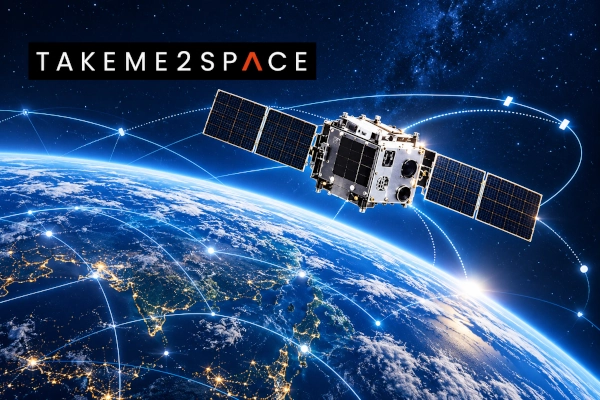
Indian space technology startup TakeMe2Space is preparing to launch MOI-1A, a new orbital computing satellite designed to process Earth-observation data directly in space rather than transmitting large volumes of raw information to ground stations. The mission represents an important step in India’s emerging private space ecosystem because it combines satellite imaging, artificial intelligence and edge computing within a single low-Earth-orbit platform.
TakeMe2Space describes MOI-1A as the first operational node in a planned constellation of orbital computing satellites. The company’s broader objective is to create programmable spacecraft capable of running customer-defined artificial intelligence models in orbit, processing selected information onboard and transmitting only the resulting intelligence back to Earth.
MOI-1A Will Process Satellite Data Directly in Orbit
Traditional Earth-observation satellites usually collect imagery, store it onboard and wait for a suitable ground-station pass before transmitting the data for analysis. As modern imaging payloads generate increasingly large datasets, this model can create a bottleneck because satellite downlink capacity remains limited.
MOI-1A is intended to address this problem by shifting part of the processing workload into orbit. TakeMe2Space says customers will be able to upload artificial intelligence models through its OrbitLab platform and execute them aboard the satellite during passes over selected geographic areas. Instead of downloading an entire image, users could receive only the information identified by the onboard model, substantially reducing the amount of data that must be transmitted to Earth.
For suitable applications, TakeMe2Space says this approach could reduce transmission requirements by as much as 85 percent. The potential advantage is particularly significant for missions that require rapid identification of specific objects, environmental changes or other features within large imagery datasets.
Satellite Carries High-Performance Onboard Computing
MOI-1A has been designed with significantly more computing capability than a conventional small Earth-observation satellite. The spacecraft is expected to use Nvidia-based edge computing hardware capable of delivering approximately 117 trillion operations per second, supported by 16 GB of onboard memory.
This level of processing capacity allows the satellite to execute machine-learning and computer-vision workloads in low-Earth orbit instead of functioning only as a platform for collecting and relaying data. Artificial intelligence models could therefore classify terrain, detect objects, identify changes between successive images or filter irrelevant information before any data is transmitted to users on the ground.
The architecture reflects a wider trend in space technology in which satellites are gradually becoming software-defined computing platforms. More onboard processing can reduce dependence on continuous communications with Earth while allowing operators to modify applications during the operational life of a spacecraft.
Nine-Band Multispectral Imaging Expands Earth-Observation Capability
MOI-1A is also equipped with a nine-band multispectral imaging payload designed to observe Earth across several wavelength ranges. Multispectral imaging provides information beyond conventional visible-light photography and can reveal differences in vegetation, soil, water, minerals and other surface features.
Combining such imagery with artificial intelligence could support applications across agriculture, environmental monitoring, mining, infrastructure assessment and land-use analysis. An onboard algorithm, for example, could analyse agricultural areas during an orbital pass and transmit only information associated with crop stress or changes in vegetation conditions instead of returning every raw image collected by the sensor.
This integration of sensing and computation is central to the company’s orbital computing model. The satellite is intended not merely to capture information but also to perform part of the interpretation process before that information leaves the spacecraft.
MOI-1A Builds on Earlier In-Orbit Technology Demonstrations
TakeMe2Space has already tested elements of its orbital computing architecture through an earlier technology demonstration mission. The company launched an initial MOI technology demonstrator in December 2024 to validate artificial intelligence inference, sensor fusion and high-speed data handling in space.
According to TakeMe2Space, the mission completed a 14-day orbital campaign and carried out more than 20 experiments in low-Earth orbit. These tests provided an opportunity to assess whether applications could be uploaded to a spacecraft, executed in the orbital environment and used to process sensor data before returning results to Earth.
The experience gained during that mission has been incorporated into subsequent versions of the platform, with MOI-1A intended to move the concept closer to regular commercial operation.
MOI-1A Follows Loss of Earlier MOI-1 Mission
TakeMe2Space attempted to launch another spacecraft, MOI-1, aboard India’s PSLV-C62 mission on January 12, 2026. The satellite was lost after the launch vehicle suffered an anomaly during its third-stage flight.
The company stated that MOI-1 itself remained nominal until the launch vehicle failure resulted in loss of the mission. MOI-1A therefore represents the company’s next opportunity to place a more operational orbital computing system into service and continue development of its planned space-based computing network.
The new mission carries added significance because it follows both the successful earlier technology demonstration and the subsequent loss of MOI-1, giving TakeMe2Space a chance to resume the transition from experimental in-orbit computing towards a commercially usable platform.
Six-Satellite Orbital Computing Constellation Planned
TakeMe2Space plans to expand beyond a single spacecraft by developing an initial constellation of six orbital computing satellites. The proposed network is intended to provide more frequent access to computing and Earth-observation services while reducing the time between satellite passes over areas of interest.
A multi-satellite architecture would allow computing tasks and imaging assignments to be distributed across several spacecraft rather than depending on one orbital platform. The company expects this to improve revisit frequency and enable more consistent delivery of processed information to customers.
TakeMe2Space has indicated that it is targeting completion of the initial six-satellite constellation by the fourth quarter of 2027. Later generations could carry greater computing capability as processors, onboard storage and spacecraft power systems continue to improve.
Orbital Computing Could Ease the Satellite Downlink Bottleneck
One of the most important challenges facing modern Earth-observation systems is the increasing imbalance between the amount of information collected by advanced sensors and the amount that can be transmitted during ground-station contact.
Higher-resolution cameras and multispectral sensors can generate enormous volumes of data during every orbit. A spacecraft, however, has limited transmission windows, limited power and restricted communications bandwidth, which means valuable information may remain stored onboard until a suitable ground link becomes available.
Orbital computing changes this model by allowing data to be filtered or analysed at its source. If a user is searching for a particular event or feature, the satellite can theoretically identify it onboard and transmit only the relevant result. This could reduce communications requirements while improving the speed at which useful intelligence reaches decision-makers.
Applications Extend From Agriculture to Infrastructure
TakeMe2Space is positioning MOI-1A as a general-purpose orbital computing platform rather than a satellite dedicated to one sector. Customers could potentially deploy different artificial intelligence models depending on the data they require.
Agricultural applications could include crop monitoring, vegetation classification and detection of abnormal plant conditions. Mining and geological applications could use multispectral information for surface analysis, while infrastructure operators could monitor transport corridors, industrial sites and other large assets.
Environmental agencies could also use orbital processing to detect changes in forests, water bodies or land cover. By running customised models aboard the spacecraft, different users could potentially extract different information from the same underlying satellite platform.
Defence and Secure Data Applications Could Emerge Later
Orbital computing could also have relevance for defence, disaster response and other time-sensitive applications because reducing dependence on raw-data downlinks can shorten the delay between observation and analysis.
A spacecraft capable of identifying selected objects or changes before contacting a ground station could potentially deliver more concise intelligence during shorter communication windows. Space-based computing and storage may also offer future possibilities for distributed or resilient information infrastructure.
TakeMe2Space has indicated that defence and secure-data applications are among the longer-term opportunities it sees for the technology, although MOI-1A itself is being positioned as a broader commercial orbital computing platform serving multiple sectors.
Radiation Protection Is Critical for Commercial Computing Hardware
Using high-performance commercial processors in orbit creates an additional engineering challenge because electronic components are exposed to radiation that can produce data errors or gradually damage semiconductor devices.
TakeMe2Space has developed a proprietary radiation-protection technology called RadShield to improve the survivability of commercial electronic components in space. The company says the technology was validated during its earlier orbital demonstration and remained functional through exposure to multiple solar-flare events.
If such protection performs reliably over longer missions, it could reduce the cost of orbital computing by allowing satellites to use powerful commercial processors rather than relying exclusively on specialised radiation-hardened electronics. This approach could make it easier to increase computing performance while keeping spacecraft size and development costs under control.
Indian Space Startups Are Moving Into Advanced Space Services
MOI-1A reflects a broader evolution within India’s private space sector. Indian startups are increasingly moving beyond conventional satellite manufacturing and launch services into specialised areas including propulsion, Earth observation, artificial intelligence, space communications, in-orbit computing and satellite-based data services.
The emergence of orbital computing is particularly important because it changes the role of a satellite from that of a remote sensor into a programmable digital platform. Instead of launching spacecraft with narrowly fixed applications, operators can increasingly design satellites whose software workloads can be modified after launch.
This capability could make future satellite networks more flexible and commercially useful, particularly as customers demand faster access to processed information rather than large volumes of unfiltered imagery.
From Satellite Imagery to Intelligence in Orbit
MOI-1A represents an attempt to move part of the satellite intelligence chain away from Earth and into space itself. By combining multispectral imaging with onboard artificial intelligence and high-performance computing, TakeMe2Space is seeking to shorten the path between observing an event and delivering useful information about it.
The success of the mission will depend on demonstrating that commercially powerful processors can operate reliably in orbit while executing customer-defined workloads and managing the limitations of spacecraft power, radiation exposure and communications.
With MOI-1A serving as the first operational node of a planned six-satellite network, TakeMe2Space is positioning an Indian startup at the intersection of space technology, artificial intelligence and distributed computing. The programme also illustrates how India’s private space ecosystem is beginning to move beyond building satellites towards developing new classes of services that process and interpret information directly in orbit.
References
TakeMe2Space — Official Website
TakeMe2Space — Missions
https://www.tm2.space/missions
TakeMe2Space — MOI Orbital Computing Platform
You may also like
-
India to Track Challenges Faced by Women Entrepreneurs in New National Business Survey
-
India Updates Vehicle Rules to Strengthen E85 and E100 Flex-Fuel Technology
-
Bengaluru Startup Paar Autonomy Develops AI-Powered Drone Systems for GPS-Denied Environments
-
Adani Green Energy Expands Battery Storage to 6.63 GWh at Khavda, Strengthening India’s Renewable Power Infrastructure
-
Sigma Advanced Systems Secures Fresh ₹973 Crore NATO Artillery Ammunition Order
