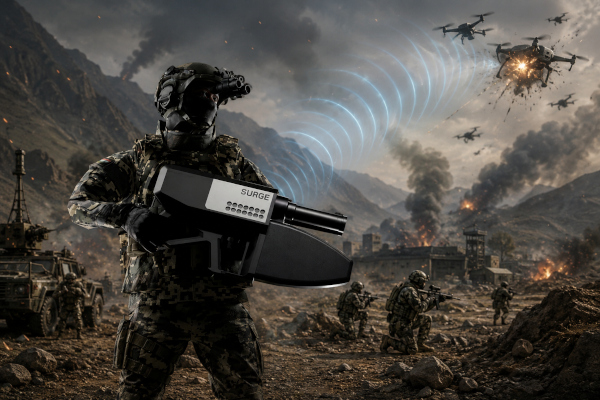
The modern battlefield has changed shape. Threats now arrive through the low sky, carried by small drones that can scout, guide artillery, drop explosives, carry contraband, film military movement and attack high-value targets. These machines are cheap, mobile and easy to modify. They place pressure on soldiers, border guards, convoy commanders, air bases, ammunition depots and critical infrastructure. India’s answer to this new class of threat is emerging through indigenous counter-drone systems, and Armory’s SURGE drone jammer gun stands out as a serious example of this new defence direction.
SURGE is built as a Counter-Unmanned Aerial System. Its purpose is to detect, track and neutralise unauthorised drones before they can complete their mission. The handheld jammer gun is the soldier-facing part of a larger system. In a manpack configuration, the operator carries the core system and uses the jammer gun as a directional electronic weapon. The soldier points the gun toward the hostile drone and activates the response. The weapon then attacks the drone’s control and navigation links through electronic disruption.
This is called a soft-kill method. A soft kill defeats the drone without physically blasting it out of the sky. The jammer interferes with the communication between the drone and its operator, disrupts navigation signals and can force the drone to lose control, drift, return, land or become useless for the mission. This matters in crowded areas, border posts, airports, military camps and public events where explosive interception can create secondary danger. A drone jammer gives the defender a clean and fast response.
The strength of SURGE lies in its modular design. Armory has presented the system in handheld, tripod and vehicle-mounted forms. This gives commanders flexibility. A handheld or manpack version can move with soldiers in difficult terrain. A tripod version can protect gates, checkpoints, camps and perimeters. A vehicle-mounted version can move with convoys and patrol columns. This modular approach is important for India because drone threats appear across deserts, mountains, plains, coastal zones, cities and border belts.
Armory’s official product details show that SURGE is designed for both detection and jamming. It can detect unauthorised drones within seconds, provide real-time intelligence to operators and jam threats across the spectrum. The system is also described as library-independent, meaning it is intended to detect unknown and novel threats instead of depending only on a fixed list of known drone signatures. This is a major battlefield advantage because hostile groups often modify commercial drones, change communication patterns and use improvised systems.
The system’s Samaritan OS gives SURGE its intelligence layer. It scans the radio-frequency environment, identifies suspicious RF movement, builds system logs and helps operators understand the threat picture. Direction finding and geolocation allow the system to give the operator information about the drone’s location, direction, azimuth and elevation. This turns the jammer gun from a simple signal blocker into part of a larger battlefield intelligence system.
The drone jammer gun has a clear infantry value. A soldier on the ground needs a fast tool against a fast threat. A hostile quadcopter may appear above a post, hover near a convoy or approach an ammunition storage area with very little warning. Traditional air-defence systems are designed for larger aerial threats. A rifle is unreliable against a small moving drone. A missile is too expensive for a cheap quadcopter. A jammer gun fills this tactical gap by giving local units an immediate counter-drone weapon.
For India, this capability has special importance along the borders. Drones have been used for surveillance, arms drops, narcotics smuggling and infiltration support. A manpack jammer gives troops the ability to deny hostile low-altitude movement without waiting for larger assets. It creates a local electronic shield around patrols, forward posts and temporary military positions. In mountain terrain, where radar coverage and vehicle movement can be difficult, a portable counter-drone system becomes even more valuable.
The SURGE system also fits into India’s larger defence self-reliance push. Armory is a Gurugram-based defence-tech startup, and the system has been described as indigenous from the ground up. This is important because counter-drone warfare changes quickly. Imported systems can become outdated if they are not adapted to local threats. An Indian system can be updated through feedback from Indian soldiers, tested in Indian terrain and manufactured through Indian supply chains. This gives the armed forces faster improvement cycles and stronger control over sensitive technology.
The reported ₹100 crore Ministry of Defence order for SURGE gives this system greater significance. It shows that India’s defence procurement is opening space for agile private companies that can build battlefield-ready technology at speed. Counter-drone warfare is no longer a niche requirement. It has become a frontline necessity. The selection of a startup-built system after field evaluations indicates a shift toward performance, adaptability and rapid deployment.
SURGE also reflects the future direction of counter-drone warfare. The next phase will depend on layered protection. A jammer gun alone is useful, but its power increases when connected with sensors, command systems, AI analysis, geolocation and hard-kill options. A strong counter-drone grid needs early warning, accurate classification, electronic attack and physical interception when required. Armory has already indicated that its C-UAS portfolio is expanding, including hard-kill solutions in future development.
The strategic value of the SURGE drone jammer gun lies in its simplicity at the point of use and sophistication inside the system. The soldier sees a hostile drone, aims the system and activates the response. Behind that action, software, antennas, RF analysis and electronic warfare logic work together. This combination of field usability and advanced intelligence makes the system suitable for modern military conditions.
India’s future wars will involve drones in large numbers. Some will be used for reconnaissance, some for attacks, some for smuggling and some for swarm-style saturation. The country that controls the low sky will protect its troops, bases and supply lines. Armory’s SURGE drone jammer gun is part of that low-sky shield. It gives Indian forces a portable, indigenous and intelligent way to defeat the small machines that now shape modern conflict.
SURGE is therefore more than a drone jammer. It is a sign of India’s defence industry moving into the age of electronic warfare, AI-enabled sensing and rapid battlefield innovation. In a world where a cheap drone can threaten a costly asset, a fast indigenous counter-drone system becomes a strategic necessity. Armory’s SURGE gives India one more tool to secure its borders, protect its forces and command the invisible battlespace above the ground.
References:
- Armory — SURGE C-UAS Product Page
https://www.armory.in/product - Armory — SURGE Handheld / Portable C-UAS
https://www.armory.in/product/handheld - ET Manufacturing — Armory Secures ₹100 Crore MoD Contract for Advanced AI-Powered Counter-Drone System
https://manufacturing.economictimes.indiatimes.com/news/aerospace-defence/armory-secures-100-crore-mod-contract-for-advanced-ai-powered-counter-drone-system/130821415 - Drone Federation India — Armory Secures Rs 100 Crore MoD Contract for SURGE
https://www.dronefederation.in/media-hub/armory-secure-rs-100-crore-mod-contract - Business Standard — Defence-tech startup Armory gets ₹100 crore order from Ministry of Defence
https://www.business-standard.com/companies/start-ups/defence-tech-startup-armory-gets-100-cr-order-from-ministry-of-defence-126050401375_1.html - Inc42 — Armory Gets ₹100 Cr Defence Ministry Order For Counter-Drone Systems
https://inc42.com/buzz/armory-gets-%E2%82%B9100-cr-defence-ministry-order-for-counter-drone-systems/
You may also like
-
India Moves Towards Five-Year Assured Orders for Defence Startups Under New Procurement Reforms
-
Zen Technologies Introduces Indigenous Hyper-Strike Falcon AI-Guided Counter-Drone Interceptor
-
L&T and Germany’s SCHOTTEL Expand Partnership for Controllable Pitch Propeller Systems in Indian Shipbuilding
-
India to Train 60,000 Civil Defence Volunteers Across 12 States and UTs with Indian Army Support
-
Indian Army’s Northern Command Opens 75-Day Defence Technology Internship Programme for Young Innovators
