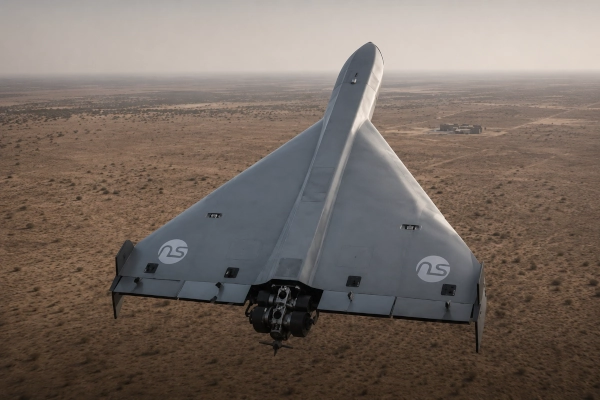
India’s rapidly expanding unmanned-warfare ecosystem is producing a new category of weapon that sits between the conventional loitering munition and the cruise missile. One of the most ambitious examples is Sheshnaag-150, a long-range collaborative attack drone being developed by Bengaluru-based NewSpace Research and Technologies, with a claimed strike reach exceeding 1,000 kilometres, endurance of more than five hours and the ability to operate cooperatively as part of an intelligent swarm.
What makes Sheshnaag-150 particularly significant is that NewSpace is not presenting it simply as another one-way attack drone. The company envisages multiple Sheshnaag aircraft operating as coordinated autonomous agents under a common software architecture, distributing tasks among themselves and attempting to penetrate or saturate increasingly dense air-defence networks. This transforms the concept from an individual expendable weapon into what could eventually become a distributed deep-strike system.
The programme has also moved beyond computer graphics and exhibition models. NewSpace publicly unveiled Sheshnaag-150 at Aero India 2025, stating at the time that flight testing had commenced. The system subsequently received an international showcase at the World Defense Show 2026 in Riyadh, where a full-scale airframe was displayed. Nevertheless, no publicly available Ministry of Defence announcement establishes that Sheshnaag-150 has yet been ordered or inducted by the Indian Armed Forces. It should therefore be regarded as an advanced indigenous system under development and testing rather than an operationally inducted weapon.
The Sheshnaag Family
Sheshnaag-150 forms part of a broader family of collaborative unmanned attack systems being developed by NewSpace under what the company calls its Fused Teaming with Uncrewed Rapid Effects, or FUTURE, initiative.
The family includes shorter-range systems such as SN-20 and SN-50, while the SN-150 occupies the deep-strike end of the spectrum. NewSpace describes SN-20 as a roughly 20-km-class collaborative system, SN-50 as a 50-km-class system and SN-150 as the weapon designed to extend collaborative unmanned strike operations to approximately 1,000 kilometres.
The name itself is deliberate. NewSpace says it drew inspiration from Sheshnaag, the multi-headed serpent of Indian tradition, using the multiple heads as an analogy for numerous unmanned aircraft acting independently while remaining coordinated by a common intelligence layer.
It is an appropriate metaphor for the system’s central philosophy. Instead of launching one highly expensive weapon against one target, a commander could theoretically release a group of comparatively inexpensive autonomous aircraft that exchange information, divide targets and approach a defended area simultaneously from different directions.
More Than 1,000 Kilometres of Reach
NewSpace’s publicly stated target for Sheshnaag-150 is an operational range exceeding 1,000 kilometres with endurance of more than five hours. The company says this endurance allows the aircraft not only to travel deep into hostile territory but also to remain airborne around the target area, conduct surveillance and wait for an appropriate engagement opportunity.
Independent reporting has placed its speed in approximately the 290-322 km/h range and its warhead or payload capacity at approximately 25-40 kg. These figures remain manufacturer- and media-reported specifications rather than Ministry of Defence-certified performance numbers.
A warhead in this category gives the aircraft a different target set from the small tactical loitering munitions now becoming common at battalion and brigade level. Rather than concentrating primarily on individual soldiers, light vehicles or exposed positions, a 25-40 kg payload could potentially be configured against targets such as radars, communications nodes, command facilities, parked aircraft, fuel infrastructure, artillery systems and other operationally important installations, depending upon the warhead fitted and the accuracy ultimately demonstrated.
The crucial difference, however, is not simply destructive power. It is the combination of warhead, endurance and range. A weapon capable of travelling roughly 1,000 kilometres can threaten military infrastructure far beyond the immediate tactical battlefield without requiring a crewed strike aircraft to enter hostile airspace.
Long Range, But Still Able to Loiter
Sheshnaag-150 also occupies an interesting position between a conventional cruise missile and a smaller battlefield loitering munition.
A cruise missile is normally assigned a target and flies towards it along a programmed route. A loitering munition can remain in an area, search or wait for a target and attack when conditions are suitable.
Sheshnaag attempts to combine aspects of both concepts.
With more than five hours of claimed endurance, the aircraft could theoretically be launched against a target area rather than merely a fixed coordinate. Once there, its sensors and autonomy architecture could allow it to continue searching, receive updated target information or cooperate with other members of the swarm before committing to the terminal attack. NewSpace describes the aircraft as capable of supporting both real-time surveillance and precision attack functions.
That persistence becomes particularly useful against targets that move or operate intermittently.
A radar may remain silent for long periods before transmitting. A mobile command vehicle may relocate frequently. An air-defence system may disperse its components after detecting an incoming strike.
A weapon that can remain in the battlespace rather than immediately attacking a predetermined coordinate potentially gives commanders more opportunities to locate such targets when they reveal themselves.
MOSAIC: The Real Centre of the Sheshnaag Concept
The airframe may be the most visible element of Sheshnaag-150, but NewSpace places considerable emphasis on its MOSAIC intelligent software suite.
The company says MOSAIC will provide the common autonomy layer through which multiple Sheshnaag vehicles cooperate.
This is critical because genuine swarm warfare requires far more than launching several drones simultaneously.
A simple mass drone attack can consist of dozens of aircraft following independently programmed routes. A collaborative swarm, by contrast, requires the individual vehicles to exchange information and modify their behaviour according to what other members of the group are detecting or doing.
One aircraft may detect an emitter while another approaches from a different direction. Some drones could potentially function as sensors or decoys, while others retain their warheads for the actual strike. If one flight path becomes heavily defended, surviving aircraft could theoretically alter their approach.
NewSpace describes the Sheshnaag family as creating both kinetic and non-kinetic saturation effects through decentralised collaboration, while still operating under a common autonomy architecture.
If successfully matured, this aspect would make Sheshnaag substantially more sophisticated than a simple long-range kamikaze drone.
Saturating Air Defences Instead of Defeating Them One by One
The economics of modern air defence increasingly favour the attacker when large numbers of inexpensive unmanned aircraft are involved.
A sophisticated surface-to-air missile interceptor can be vastly more expensive than the drone it destroys. Even where cheaper guns and short-range air-defence systems are available, they have finite ammunition, limited engagement channels and restricted radar coverage.
A sufficiently large coordinated attack can therefore attempt to create several problems simultaneously.
Some aircraft can force radars to activate. Others can approach from different bearings and altitudes. Decoys can consume interceptors while strike vehicles continue towards their targets. Repeated attacks can place pressure on the defending force’s missile inventory and crew endurance.
NewSpace explicitly describes Sheshnaag-150 as being designed for coordinated swarm attacks capable of overwhelming and saturating enemy defences.
This is one of the clearest lessons to emerge from contemporary conflicts. Iran’s Shahed family and the Russian Geran derivatives have demonstrated how large numbers of relatively inexpensive one-way attack systems can impose disproportionately high defensive costs. The United States has subsequently pursued its own low-cost long-range attack systems, including LUCAS. NewSpace itself has cited both the Shahed and LUCAS class as evidence of the relevance of the Sheshnaag concept.
Sheshnaag’s proposed advantage is that it seeks to add collaborative autonomy to this low-cost deep-strike model.
GPS-Denied Navigation Will Be Critical
There is little value in developing a 1,000-km unmanned weapon if an adversary can defeat it simply by interfering with satellite navigation.
Modern battlefields increasingly feature powerful GNSS jamming and spoofing. An autonomous strike aircraft must therefore be able to continue navigating even when GPS or another satellite-navigation constellation becomes unreliable.
Reporting on Sheshnaag indicates that the programme is moving towards visual-navigation capability, allowing the aircraft to compare terrain or imagery with onboard data rather than depending exclusively on satellite coordinates. Business Standard reported that this capability is intended to enable future operations when satellite navigation is jammed or unavailable.
This remains an area where the final demonstrated capability will matter far more than the theoretical specification.
Navigating hundreds of kilometres without dependable GNSS requires an integrated combination of inertial navigation, terrain or visual matching, onboard computing and sophisticated algorithms. Maintaining acceptable positional accuracy after several hours of flight is considerably more difficult than demonstrating autonomous navigation over a short tactical distance.
It is therefore one of the technological areas that should be watched closely as Sheshnaag progresses through testing.
Flight Testing Has Already Begun
NewSpace stated when Sheshnaag-150 was unveiled at Aero India 2025 that flight testing had commenced, making clear that the programme had progressed beyond an exhibition concept.
NDTV subsequently reported in March 2026 that Sheshnaag-150 was in an advanced stage of testing and that its first flight had taken place roughly a year earlier.
There have also been reports of a much longer test during 2026 in which a Sheshnaag-150 reportedly flew approximately 700-720 kilometres before reaching its target area at Pokhran. These details have appeared in specialist defence reporting but have not, as of August 12, 2026, been confirmed through a corresponding Ministry of Defence or NewSpace technical release giving the full test data. They should therefore be treated as reported test results rather than independently certified performance.
The more important confirmed point is that the platform is flying and its developer is attempting to mature both the aircraft and the collaborative autonomy system.
A Remarkable Match With the Indian Army’s New 1,000-km Requirement
Sheshnaag-150 has become particularly interesting because the Indian Army has now formally initiated a Long Range Loiter Munition, or LRLM, Make-II project.
The Government’s Make in India Defence portal identifies the Army as the sponsoring service and gives an Approval-in-Principle date of July 28, 2025. An industry questionnaire was uploaded on February 16, 2026, and the Defence Production Department subsequently extended the period for responses to the programme until July 20, 2026.
The reported Army requirement is strikingly close to several Sheshnaag characteristics.
According to the industry questionnaire reviewed by India Defence Wire, the Army wants a long-range loitering munition capable of striking a target at 1,000 kilometres, or as close to that distance as technically achievable, but in no case below 500 kilometres. It seeks a minimum 25-kg warhead, GPS-denied navigation and a complete system including the launcher, ground-control equipment and associated support infrastructure.
On range and payload alone, the publicly stated Sheshnaag-150 specification fits remarkably well: 1,000+ kilometres and a 25-40 kg payload class.
However, there is an important potential gap.
The Army questionnaire reportedly specifies a desired minimum speed of 400 km/h, while published Sheshnaag figures place the aircraft around 290-322 km/h. If both figures accurately represent the final configurations, Sheshnaag would require performance improvement or the Army would have to accept a different trade-off.
There is currently no public evidence establishing that Sheshnaag-150 has been selected for the Army LRLM project, or even officially confirming NewSpace as one of the competing vendors.
The overlap is nevertheless difficult to ignore. The system already being developed by NewSpace falls directly into the category of weapon the Army is now formally seeking.
The IAF Is Looking at the Same Class of Weapon
The relevance of Sheshnaag may eventually extend beyond the Army.
On August 12, 2026, The Economic Times reported that the Indian Air Force plans a major industry demonstration at Pokhran in the third week of September 2026, focused on indigenous unmanned systems. The systems expected to be evaluated include one-way attack drones, long-range loitering munitions and swarm drones. Importantly, the IAF is reported to be interested in systems with ranges exceeding 1,000 kilometres, including platforms capable of supplying live video feedback to operators.
The report does not identify Sheshnaag-150 as a confirmed participant.
Nevertheless, an Indian-developed platform advertised with more than 1,000 km range, long endurance and swarm capability clearly occupies the same technological space the IAF intends to examine.
This points towards a larger requirement emerging across the Indian military rather than a single Army procurement.
Sheshnaag Is Not a Cruise Missile Replacement
It would be incorrect to interpret Sheshnaag-150 as a replacement for systems such as BrahMos or future Indian long-range cruise missiles.
The two classes of weapon solve different problems.
A high-performance cruise missile provides speed, penetration capability, large destructive effect and a relatively short time-to-target. Such weapons remain critical against hardened, heavily defended and time-sensitive targets.
A piston-powered or otherwise relatively slow one-way attack UAV offers something different: cost-efficient mass, persistence and expendability.
A commander may be reluctant to expend a very expensive cruise missile against a radar truck, fuel installation or temporary command post. A significantly cheaper long-range attack drone becomes much more attractive against these classes of target, particularly if dozens can be launched at once.
The systems are therefore complementary.
Cruise missiles provide quality and speed. Long-range collaborative loitering munitions provide mass and persistence.
A sophisticated strike package could eventually employ both.
A New Layer in India’s Deep-Strike Architecture
For decades, long-range precision attack was largely the domain of crewed combat aircraft and expensive missiles.
Systems such as Sheshnaag could create another layer.
An artillery commander or higher formation equipped with 1,000-km-class unmanned weapons could potentially threaten command centres, radars, logistics installations and other operational infrastructure without waiting for an air-force strike package or expending a large ballistic or cruise missile.
The aircraft can also be dispersed.
Instead of concentrating valuable launchers at a handful of missile bases, relatively compact unmanned systems could potentially operate from mobile launch vehicles spread across a large geographic area.
That complicates an adversary’s targeting problem while increasing the number of potential launch points.
When combined with reconnaissance satellites, UAVs, electronic intelligence, ground-based sensors and battlefield networks, long-range loitering munitions could eventually become the final kinetic element in a much larger sensor-to-shooter chain.
The Challenge Will Be Producing Sheshnaag in Mass
The real measure of Sheshnaag’s strategic value will not ultimately be whether NewSpace can build one exceptionally capable aircraft.
It will be whether India can manufacture such weapons in large numbers and at a cost that makes mass employment practical.
A swarm weapon that costs almost as much as a cruise missile loses much of its purpose.
The airframe, propulsion system, navigation electronics, electro-optical sensors, communications equipment and onboard processors therefore have to be designed not merely for performance but for repeatable industrial production.
That means India’s private defence supply chain becomes as important as the software.
Hundreds or thousands of autonomous strike aircraft require engines, actuators, electronics, composites, sensors and warheads at a scale very different from a developmental UAV programme.
This is one reason the Army’s LRLM effort is being pursued under Make-II, which is structured around industry-funded development and requires significant indigenous content.
If Sheshnaag eventually enters such a procurement competition, price, indigenous component content and manufacturing capacity may prove almost as important as its maximum range.
What Is Confirmed and What Is Still Claimed
Sheshnaag-150 has attracted considerable attention, making it important to distinguish established facts from developmental claims.
Confirmed publicly: NewSpace Research and Technologies is developing the Sheshnaag family; Sheshnaag-150 was unveiled at Aero India 2025; the company states that flight testing has begun; it was displayed at World Defense Show 2026; NewSpace gives the aircraft a design range exceeding 1,000 km and endurance exceeding five hours; and the company is developing it around a collaborative swarm architecture using its MOSAIC software.
Reported but requiring continued verification: detailed speed figures, exact production configuration, terminal accuracy figures and some of the longer-range test results published during 2026.
Not confirmed: an Indian Army or Indian Air Force procurement order for Sheshnaag-150.
That distinction is important because an advanced prototype and an inducted military weapon are not the same thing.
From Drone to Collaborative Weapon System
The most interesting element of Sheshnaag-150 may ultimately not be its 1,000-km range.
India is already developing missiles capable of reaching similar or considerably greater distances.
The more important technological step is the attempt to create a long-range autonomous weapon that fights collectively rather than individually.
If NewSpace can mature MOSAIC sufficiently for numerous unmanned aircraft to share targeting information, reassign objectives, adapt routes and continue functioning despite jamming or the loss of individual members, Sheshnaag would represent a genuine progression beyond the traditional one-way attack drone.
A swarm of such systems could be used to expose air-defence radars, exhaust interceptors, locate electronic emitters and then direct surviving strike vehicles against the highest-value targets.
That is much closer to an autonomous distributed strike network than to the popular image of a “suicide drone.”
Sheshnaag-150 Could Fill an Important Gap in India’s Arsenal
India already possesses highly capable precision weapons at the upper end of the strike spectrum and an expanding family of tactical loitering munitions at shorter ranges.
What has been comparatively limited is an affordable indigenous weapon occupying the vast space between them: something that can travel several hundred kilometres, remain in the target area, operate despite electronic warfare and be purchased in sufficiently large numbers for saturation attacks.
Sheshnaag-150 is an attempt to occupy precisely that space.
Its claimed 1,000+ km reach, more than five hours of endurance, 25-40 kg payload and collaborative swarm architecture place it in a class with major implications for India’s future deep-strike doctrine.
The emergence of an official Indian Army LRLM requirement seeking roughly the same range and warhead class makes the programme even more relevant, while the IAF’s planned September 2026 examination of 1,000-km-class indigenous unmanned systems suggests that demand for this type of capability is spreading across the services.
Sheshnaag-150 still has important milestones ahead. Its maximum claimed range, autonomous navigation, electronic-warfare resistance, terminal accuracy and true multi-aircraft swarm behaviour will all have to survive realistic military testing. Equally important will be the ability to manufacture it cheaply and in quantity.
But the direction of travel is significant.
Sheshnaag-150 represents India’s attempt to move from possessing drones as individual platforms to employing unmanned aircraft as collaborative weapons of massed precision strike. If the programme matures successfully, the result could give the Indian Armed Forces something distinctly different from another missile or another UAV: an indigenous, expendable and scalable deep-strike network designed for the increasingly saturated and electronically contested battlefield of the future.
References
- NewSpace Research & Technologies – Sheshnaag-150 unveiled at Aero India 2025; 1,000+ km range, 5+ hours endurance and collaborative swarm concept
https://www.linkedin.com/posts/newspacert_sheshnaag150-aeroindia2025-intelligent-activity-7296706868654002176-Dbqf - NewSpace Research & Technologies – Sheshnaag family and FUTURE collaborative unmanned warfare concept
https://www.linkedin.com/posts/newspacert_india-quietly-works-on-homegrown-sheshnaag-activity-7434861296593981440-6swW - NewSpace Research & Technologies – Sheshnaag-150 and indigenous long-range strike-drone development
https://www.linkedin.com/posts/newspacert_sheshnag150-atmanirbharbharat-makeinindia-activity-7436439167120654336-zsgY - Government of India – Make in India Defence: Long Range Loiter Munition project for the Indian Army
https://makeinindiadefence.gov.in/make1-project-list
You may also like
-
India and Russia Hold Seventh Strategic Security Dialogue on Pakistan and Afghanistan
-
Rolls-Royce and Reliance Advance Indigenous 120 kN AMCA Engine Plans with Focus on Indian Design and Manufacturing
-
Indian Coast Guard and Korea Coast Guard Strengthen Maritime Cooperation at 14th High-Level Meeting in Incheon
-
Ministry of Defence Signs ₹4,106 Crore Contracts for GSAT-7C Satellite and Varunastra Torpedoes
-
AVNL, Indian Army and Russian Delegation Explore Modernisation of Armoured Vehicles
