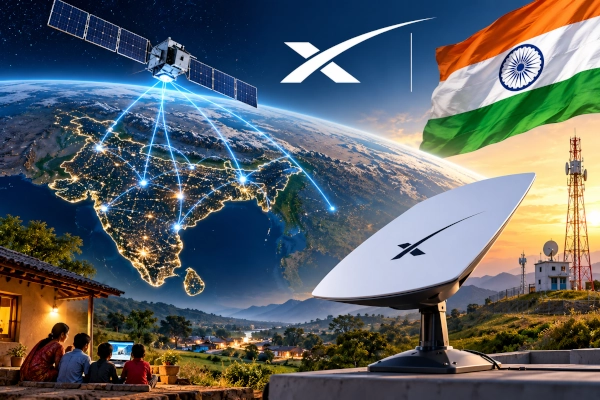
Starlink says it has built its India operations around the country’s security and regulatory requirements and is ready to begin services once the remaining government clearances are completed.
Speaking at India Mobile Congress 2026 in New Delhi on October 7, Lauren Dreyer, Vice President of Starlink Business Operations at SpaceX, said the company had spent several years working with Indian regulators, telecom operators and industry stakeholders to prepare its network for the country.
According to Dreyer, Starlink has established India-specific security controls, built local ground infrastructure and arranged for Indian user data to remain within the country.
Starlink Has Built 20 Gateway Sites in India
One of the most significant elements of Starlink’s India preparations is the construction of 20 gateway sites, comprising hundreds of antennas.
These gateways form the terrestrial link between Starlink’s low-Earth-orbit satellite constellation and India’s communications networks. They are particularly important because India’s regulatory framework requires satellite service providers to comply with local security, interception and gateway requirements.
Dreyer said Starlink had designed its India operations specifically around these requirements, including controls at multiple network layers.
Indian User Data to Remain Within India
Starlink has also said that data generated by users in India will remain within India.
This addresses one of the most important security concerns surrounding foreign satellite communication systems, where traffic can potentially be routed through infrastructure outside the country.
India has placed increasing emphasis on sovereign control over critical communications infrastructure, particularly satellite networks that may serve remote, strategic and border areas.
The Department of Telecommunications has established authorisation requirements for satellite earth-station gateway providers, including eligibility, network and compliance obligations. eServices
Starlink Already Holds Key Telecom Licences
Starlink Satellite Communication Private Limited has already secured important telecom authorisations in India.
Official Department of Telecommunications records list Starlink among companies holding authorisations for Global Mobile Personal Communication by Satellite, or GMPCS, as well as VSAT and internet services.
GMPCS authorisation allows satellite-based connectivity across the licensed area, particularly for rural, remote and underserved regions.
However, holding a licence does not by itself mean commercial services can begin immediately. Additional technical, spectrum and security conditions must still be satisfied before operations commence.
Commercial Launch Still Awaits Final Approval
Starlink has not yet begun commercial satellite broadband services in India.
Dreyer said the company is ready to start once the Government of India completes the remaining approval process.
Her remarks underline an important distinction: Starlink has moved significantly beyond the licensing stage and has already invested in local infrastructure, but the final commercial launch remains subject to regulatory clearance.
This cautious approach reflects the strategic nature of satellite communications, where security approval is as important as spectrum availability or commercial licensing.
Security Is Central to India’s Satellite Internet Policy
India treats satellite communications as part of its critical digital infrastructure.
The government has repeatedly stressed that satellite networks must comply with national-security requirements, lawful interception provisions and domestic gateway arrangements before commercial deployment.
That concern extends beyond telecom regulation. In February 2026, CERT-In and SIA-India released joint space cyber-security guidelines covering satellite communication systems and other space-based assets. The government noted that such systems support remote connectivity, disaster response, navigation, broadcasting and national-security operations.
Starlink’s decision to localise gateways and user data therefore aligns with a wider Indian policy direction focused on securing space-enabled communications.
Partnerships With Airtel and Jio
Starlink has also been preparing for commercial deployment through partnerships with Indian telecom operators.
The company has signed agreements with Bharti Airtel and Reliance Jio to explore distribution and connectivity opportunities in India once regulatory approvals are completed.
These partnerships could help Starlink reach users through established telecom distribution networks while complementing terrestrial broadband and mobile coverage.
Satellite connectivity is likely to be most relevant in regions where fibre or conventional mobile infrastructure remains difficult or expensive to deploy.
Rural and Remote Connectivity Remains the Main Opportunity
Starlink has positioned its service primarily around closing gaps in last-mile connectivity.
Low-Earth-orbit satellite systems can provide broadband to places where laying fibre or building conventional telecom infrastructure is difficult because of geography, distance or low population density.
For India, this could include remote villages, islands, mountainous regions, border areas and locations requiring rapid temporary connectivity.
Unlike geostationary satellite systems, low-Earth-orbit constellations operate much closer to Earth, reducing latency and making applications such as video calls, streaming and cloud services more practical.
India Could Become a Major Starlink Market
India represents one of the world’s largest potential satellite broadband markets because of its vast geography and uneven distribution of fixed-line infrastructure.
At the same time, the country has made it clear that access to this market must come with strict compliance on security, licensing and network control.
Starlink’s 20 gateway sites, localised data arrangements and India-specific security architecture suggest that the company has adapted its global system to meet those expectations.
The next step now depends on final government approval.
Once that clearance arrives, Starlink could add a new layer to India’s communications network—not as a replacement for fibre or 5G, but as a complementary system capable of extending high-speed connectivity into areas where conventional infrastructure remains difficult to build.
References
- Department of Telecommunications, Government of India — Official GMPCS service and licence records.
- Department of Telecommunications — Official Unified Licence records listing Starlink Satellite Communication Private Limited.
- Department of Telecommunications — Satellite Earth Station Gateway Provider Authorisation framework, 2026.
- India Mobile Congress 2026 — Remarks by Lauren Dreyer, Vice President, Starlink Business Operations, SpaceX, October 7, 2026.
- CERT-In and SIA-India — Space Cyber Security Guidelines, February 26, 2026.
- Press Information Bureau, Government of India — Official release on cyber security for India’s space and satellite communication ecosystem.
You may also like
-
India’s Services Activity Rises to Three-Month High in September as Domestic Demand Strengthens
-
India Enters Top 10 Emerging Markets for AI Readiness as Private Investment More Than Triples
-
India’s EV Retail Sales Hit Record 3.33 Lakh Units in September 2026, FADA Says
-
Google Brings Gemini Auto Browse to Chrome in India, Expands AI Assistant to Android
-
Ericsson Expands Make in India Push as India-Made Antennas Begin Reaching Global Markets
