GI Produce of India | Karnataka | Spices and Agricultural Heritage
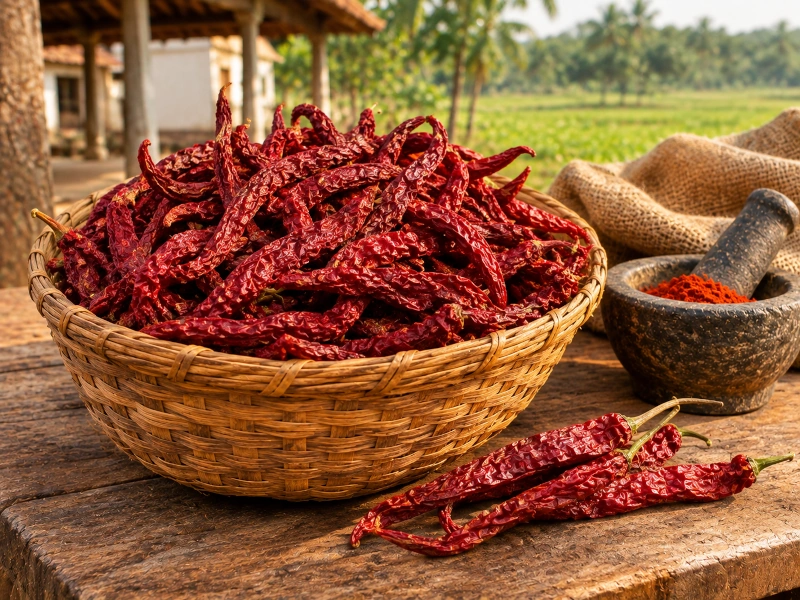
Byadagi Chilli, one of Karnataka’s most distinctive agricultural products, represents the traditional farming knowledge, culinary heritage, and spice-trading culture of northern Karnataka. Recognised for its deep-red colour, characteristic wrinkled appearance, rich aroma, and comparatively mild pungency, this celebrated chilli has established a special place in Indian kitchens and the country’s spice-processing industry. Its unique qualities have made it an important agricultural commodity, particularly for manufacturers seeking natural colouring ingredients and traditional spice products.
Named after Byadgi, a town in Karnataka’s Haveri district, the chilli is cultivated across the agricultural regions of Haveri, Dharwad, Gadag, and surrounding areas. Unlike chilli varieties primarily valued for intense pungency, Byadagi Chilli is particularly appreciated for imparting a rich red colour and characteristic flavour without overwhelming food preparations with excessive heat. These qualities have established its commercial reputation across India’s domestic spice markets and food-processing industries.
Recognising its geographical identity, distinctive characteristics, and established agricultural reputation, the Government of India granted Byadagi Chilli Geographical Indication protection. The registration certificate was issued on 27 January 2011, formally recognising the relationship between the product and its traditional cultivation region.
Historical Origins and the Agricultural Heritage of Byadgi
The history of Byadagi Chilli is closely connected with the development of chilli cultivation across the Deccan region. Chillies originated in the Americas and were introduced into India through maritime trading networks during the early modern period. Over subsequent centuries, the crop became firmly established in Indian agriculture, with different regions developing distinctive chilli varieties suited to local climatic conditions, soil characteristics, and culinary preferences.
Northern Karnataka gradually emerged as an important chilli-producing region because of its agricultural landscape, seasonal climatic conditions, and established farming traditions. Farmers developed considerable expertise in cultivating chilli varieties that produced desirable colouring characteristics, aroma, and flavour. Through successive generations, varieties associated with the Byadgi region acquired a distinctive reputation for their deep-red colour, wrinkled appearance, and comparatively mild pungency.
The town of Byadgi became an important commercial centre for dried red chillies, connecting farmers from surrounding agricultural districts with merchants, spice processors, and buyers from different parts of India. The development of local agricultural markets encouraged greater specialisation in cultivation, harvesting, drying, grading, and trading. As commercial demand increased, Byadagi Chilli emerged as a recognised agricultural product with a distinct identity within India’s spice industry.
The history of Byadagi Chilli illustrates the ability of Indian farming communities to adapt an introduced crop to local agricultural conditions and transform it into an important element of regional heritage. Although chilli cultivation was not indigenous to ancient India, generations of farmers in Karnataka developed the agricultural knowledge and processing traditions that established Byadagi Chilli’s distinctive reputation.
Geographical Origin and the Agricultural Landscape of North Karnataka
Byadagi Chilli is principally associated with the agricultural belt extending across Haveri, Dharwad, Gadag, and neighbouring areas of northern Karnataka. The region experiences a predominantly tropical climate, with warm temperatures, seasonal monsoon rainfall, and relatively dry conditions during important stages of crop maturity and harvesting. These conditions, together with established agricultural practices, provide a suitable environment for cultivating the distinctive chilli varieties associated with Byadgi.
The agricultural landscape includes areas of black and red soils, both of which support chilli cultivation when appropriate soil moisture, drainage, and nutrient conditions are maintained. Black soils, common across parts of northern Karnataka, possess considerable moisture-retention capacity, while well-drained red soils can also provide suitable growing conditions. Farmers traditionally adapt their cultivation practices to the characteristics of local soils and the availability of seasonal rainfall.
The region’s agricultural economy has historically depended on a combination of rainfed and irrigated farming. Seasonal rainfall influences planting decisions, while dry weather during harvesting and post-harvest processing supports the traditional preparation of dried chillies. The accumulated experience of local farmers in managing these conditions has contributed to the distinctive agricultural identity of Byadagi Chilli.
The geographical reputation of the product is therefore associated not merely with climate and soil but also with the knowledge, cultivation practices, and commercial traditions developed by farming communities over generations. This relationship between geographical conditions and agricultural expertise forms an important foundation of its Geographical Indication recognition.
What Makes Byadagi Chilli Unique?
The most recognisable characteristic of Byadagi Chilli is its deep-red colour, accompanied by a prominently wrinkled outer surface. The dried fruits are generally elongated and slender, with surface folds that become particularly noticeable after harvesting and drying. Depending on the cultivated type, the chillies commonly measure approximately 10–17 centimetres in length, although individual fruit dimensions vary according to variety and growing conditions.
Byadagi Chilli belongs to the species Capsicum annuum, which includes several commercially important chilli varieties cultivated worldwide. Its distinctive appearance differentiates it from smooth-skinned chilli types, while its combination of colour intensity, aroma, and comparatively mild pungency gives it a particular advantage in culinary and industrial applications.
The chilli is especially valued for its high extractable colour content. Its red pigmentation is primarily associated with naturally occurring carotenoids, including capsanthin and capsorubin, which contribute to the characteristic colour of mature red chilli fruits. In the spice industry, colour intensity is commonly assessed using ASTA measurements, which help determine the suitability of chilli products for processing and colour extraction.
Another distinguishing characteristic is its relatively low pungency compared with varieties cultivated primarily for intense heat. Pungency is associated with capsaicinoids, particularly capsaicin, and can vary among Byadagi types according to genetic characteristics, cultivation conditions, and processing methods. The combination of strong colouring properties and moderate heat makes Byadagi Chilli especially suitable for spice powders, traditional masalas, and natural colour extraction.
These distinctive characteristics have established Byadagi Chilli as a commercially valuable agricultural product whose importance extends beyond the conventional market for dried red chillies.
Traditional Varieties of Byadagi Chilli
The Byadagi chilli-growing region is associated with several traditional types, among which Byadagi Kaddi and Byadagi Dabbi are particularly well known. These varieties have developed distinct commercial identities based on their fruit characteristics, colouring properties, and suitability for different processing applications. Their continued cultivation reflects the diversity of local agricultural knowledge and the importance of preserving traditional planting material.
Byadagi Kaddi is generally recognised by its long, relatively slender fruits, which develop a deep-red colour and characteristic wrinkled appearance when dried. The variety is valued for its colouring properties and comparatively mild pungency, making it suitable for traditional spice preparations and commercial processing. Its physical characteristics have made it one of the commonly recognised forms of Byadagi Chilli in agricultural markets.
Byadagi Dabbi is traditionally associated with comparatively broader fruits and pronounced surface wrinkling. It is particularly valued for its colour characteristics and is used in spice processing and oleoresin production. Differences in fruit size, shape, colour intensity, and other agricultural characteristics distinguish Dabbi from Kaddi, although both contribute to the wider commercial reputation of Byadagi Chilli.
Other locally recognised types, including Dyavanoor, are also associated with the region’s chilli-growing traditions. The preservation of this diversity is important because locally adapted varieties provide farmers with planting material suited to particular cultivation conditions and market requirements. Maintaining these traditional characteristics while improving agricultural productivity remains an important consideration for the region.
Traditional Cultivation and Farming Practices
Byadagi Chilli cultivation begins with the selection of suitable planting material and the preparation of agricultural land. Farmers traditionally raise chilli seedlings in nurseries before transplanting them into prepared fields, where appropriate spacing supports plant growth and facilitates irrigation, weeding, and crop management. The quality of planting material plays an important role in establishing healthy crops and maintaining the desired characteristics of the cultivated variety.
The crop requires sufficient sunlight, suitable soil moisture, and balanced plant nutrition throughout its growing period. In rainfed cultivation, farmers depend heavily on the timing and distribution of seasonal rainfall, making local knowledge of weather patterns particularly important. Irrigated cultivation provides greater opportunities to manage soil moisture, although excessive watering and poor drainage can adversely affect plant growth and productivity.
Traditional farming practices include field preparation, manual weeding, nutrient management, and regular observation of crop conditions. Farmers must also protect the crop against pests and diseases, including thrips, mites, fruit borers, and viral infections that can affect chilli plants. Effective management is particularly important because damage during flowering and fruit development can influence both yield and commercial quality.
Modern agricultural practices increasingly incorporate improved seed selection, soil testing, efficient irrigation, balanced fertilisation, and integrated pest management. Agricultural research institutions and extension services support farmers by providing technical guidance intended to improve crop productivity while maintaining the distinctive characteristics of traditional Byadagi varieties.
Harvesting, Sun-Drying, and Traditional Processing
Harvesting is an important stage in determining the quality and commercial value of Byadagi Chilli. Farmers generally collect the fruits after they have reached maturity and developed their characteristic red colour. The timing of harvesting influences fruit appearance, colouring properties, and suitability for processing, making careful observation of crop maturity an essential part of traditional cultivation.
The principal harvesting period generally falls during the dry months following the main growing season, commonly extending from January to March, although actual schedules vary according to planting dates, rainfall, and local agricultural conditions. Harvesting may be carried out in several rounds because individual chilli fruits do not always mature simultaneously.
After harvesting, the chillies undergo drying to reduce moisture and prepare them for storage, transportation, and commercial processing. Traditional sun-drying has long been practised in northern Karnataka, with harvested chillies spread across suitable drying surfaces and exposed to sunlight. During this process, the fruits gradually lose moisture and develop the characteristic wrinkled appearance associated with dried Byadagi Chilli.
Careful drying is essential to preserve colour, aroma, and overall quality. Excessive moisture can encourage fungal growth and deterioration, while unsuitable handling or prolonged exposure to unfavourable conditions can affect appearance and market value. Farmers and processors therefore pay particular attention to drying conditions, handling practices, and protection against contamination.
Modern post-harvest practices increasingly emphasise hygienic drying surfaces, controlled moisture levels, scientific storage, and improved sorting methods. Once adequately dried, the chillies are graded according to their appearance, colour, variety, and quality before being transported to agricultural markets and processing centres.
Culinary Importance in Karnataka and Indian Cuisine
Byadagi Chilli occupies an important place in Karnataka’s culinary traditions, particularly in dishes requiring rich colour, distinctive aroma, and balanced pungency. Its ability to impart a deep-red appearance without excessive heat makes it suitable for a wide variety of traditional preparations, including curries, chutneys, pickles, spice powders, and masala mixtures.
The chilli is widely associated with the culinary traditions of northern Karnataka, where dried red chillies are used in household cooking and regional spice preparations. Its characteristic flavour complements ingredients such as garlic, tamarind, coconut, coriander, and other spices commonly used in Karnataka’s traditional cuisine.
Byadagi Chilli is also particularly valued in coastal Karnataka, including Mangalorean culinary traditions. It is used in the preparation of spice pastes and masalas that contribute the characteristic red appearance of several regional dishes. Its comparatively mild pungency allows cooks to achieve a rich colour while maintaining a balanced flavour profile.
The chilli’s importance extends beyond Karnataka because its distinctive colouring characteristics make it useful in commercial masala powders, spice blends, pickles, and processed foods. Manufacturers seeking consistent red colouring and traditional chilli flavour often incorporate Byadagi varieties into their formulations.
Its culinary reputation therefore connects local agricultural production with wider Indian food traditions, illustrating how a geographically distinctive crop can influence cooking practices across different regions.
Natural Colour and the Industrial Importance of Byadagi Chilli
One of the most important commercial characteristics of Byadagi Chilli is its suitability for producing natural red colouring extracts. The chilli contains carotenoid pigments, particularly capsanthin and capsorubin, which contribute to the deep-red colour of mature fruits. These naturally occurring compounds have applications in food processing, where manufacturers require colouring ingredients obtained from agricultural sources.
Byadagi Chilli is an important raw material for producing paprika-type oleoresins and related spice extracts. Oleoresins are concentrated preparations obtained through industrial extraction processes that recover colouring, flavouring, and other desirable compounds from agricultural products. These extracts can be incorporated into processed foods to provide more consistent colour and flavour characteristics.
The relatively mild pungency of Byadagi Chilli makes it commercially attractive for applications in which strong red colouring is desirable without excessive heat. This distinguishes it from chilli varieties cultivated primarily for high capsaicin content and intense pungency.
The development of spice extraction and processing industries creates opportunities for greater agricultural value addition. Instead of depending exclusively on the sale of whole dried chillies, the regional economy can benefit from processing activities that produce powders, extracts, and specialised food ingredients.
Byadagi Chilli consequently occupies an important position at the intersection of traditional agriculture, culinary heritage, and modern food-processing technology.
Geographical Indication Recognition and the GI Tag Journey
Byadagi Chilli received formal recognition under India’s Geographical Indications framework to protect its distinctive geographical identity and established reputation. The application was filed by the Spices Board, functioning under the Ministry of Commerce and Industry, Government of India, on 1 August 2008. The application was registered under Class 30, which covers relevant food and spice products.
Following examination and the prescribed registration process, the application was published in Geographical Indications Journal No. 36, dated 23 September 2010. The Geographical Indications Registry subsequently issued Certificate No. 147 on 27 January 2011, formally recognising Byadagi Chilli as a registered geographical indication.
The registration acknowledges the established association between Byadagi Chilli and its traditional production region in Karnataka. It also provides a legal framework for protecting the geographical name against unauthorised commercial use and misrepresentation.
The Spices Board serves as the registered proprietor of the geographical indication and supports measures intended to protect its authenticity and commercial reputation. The registration helps distinguish genuine Byadagi Chilli from other chilli products that may possess similar physical characteristics but do not satisfy the prescribed geographical and product specifications.
The GI registration is recorded under Application No. 129, with its current registration term extending until 31 July 2028. Continued protection is governed by the renewal provisions of India’s Geographical Indications legislation.
Protecting Authenticity and Supporting Farmers
The geographical indication provides an important mechanism for protecting the reputation of Byadagi Chilli, but its effectiveness depends on maintaining product authenticity and appropriate quality standards. The commercial value of the chilli is closely connected with its characteristic colour, aroma, appearance, and geographical origin, making verification and traceability important considerations throughout the supply chain.
The Spices Board has established guidelines for obtaining authorised-user registration for GI-protected spices, including Byadagi Chilli. Eligible producers and producer organisations can apply for recognition under the prescribed procedures, allowing legitimate participants to use the protected geographical indication in accordance with applicable requirements.
The authorised-user framework supports greater accountability in production and marketing while helping distinguish authentic GI products from commercially similar alternatives. Proper documentation of geographical origin, cultivation practices, and product characteristics can strengthen confidence among traders, processors, and consumers.
Farmers may also benefit from better access to organised markets, improved grading systems, and stronger connections with buyers who recognise the value of authentic Byadagi Chilli. Producer organisations can play an important role in bringing small farmers together, improving market access, and encouraging quality-oriented production.
Protecting the geographical indication is therefore closely connected with the broader objective of strengthening agricultural livelihoods and preserving the reputation established by generations of farmers.
Economic Importance and the Byadgi Chilli Market
Chilli cultivation and trading form an important part of the agricultural economy of the Byadgi region. The town has developed a recognised chilli market that connects growers from surrounding agricultural districts with commission agents, traders, processors, and commercial buyers. This trading network supports economic activity across farming, transportation, storage, grading, and spice processing.
The Byadgi market is particularly associated with the trade in dried red chillies valued for their colouring properties. Buyers from different parts of India procure produce for traditional spice markets, commercial masala manufacturing, and industrial extraction. The presence of organised trading activity has contributed to the development of supporting services, including warehousing, transportation, and agricultural marketing.
The economic importance of Byadagi Chilli extends beyond direct farm income. Cultivation creates employment for agricultural labourers involved in field preparation, transplanting, crop management, harvesting, and drying. Post-harvest activities provide additional opportunities for workers engaged in sorting, grading, packaging, transportation, and processing.
However, chilli cultivation remains vulnerable to variations in seasonal rainfall, pest incidence, production costs, and market prices. Sudden increases in market arrivals or reductions in commercial demand can affect prices received by farmers. Improving market information, scientific storage facilities, and access to organised procurement systems can help agricultural producers manage these challenges.
The GI identity offers an additional opportunity to differentiate authentic Byadagi Chilli within competitive spice markets. Stronger recognition of its distinctive characteristics may help support specialised commercial channels and encourage investment in quality-oriented production.
Agricultural Research and Quality Improvement
Agricultural research plays an important role in improving the productivity, quality, and long-term sustainability of Byadagi Chilli cultivation. Institutions working in horticulture, agricultural sciences, and food technology contribute to the development of improved cultivation practices, crop protection methods, and post-harvest processing systems.
Research into traditional Byadagi varieties is particularly important because their commercial reputation depends on desirable characteristics such as colour intensity, fruit appearance, aroma, and comparatively mild pungency. Scientific evaluation can help identify suitable planting material while supporting efforts to preserve locally adapted varieties.
Soil management, efficient irrigation, balanced fertilisation, and integrated pest management are important areas for agricultural improvement. These practices can help farmers manage production costs, reduce crop losses, and maintain more consistent yields under changing agricultural conditions.
Post-harvest research is equally significant because colour preservation is central to the commercial value of Byadagi Chilli. Improvements in drying methods, moisture management, hygienic handling, and storage can reduce deterioration and help maintain product quality during transportation and marketing.
Greater availability of laboratory testing, processing facilities, and technical guidance can also strengthen the competitiveness of the chilli in domestic and international markets. Combining traditional agricultural knowledge with scientific innovation provides a practical foundation for maintaining the distinctive identity of Byadagi Chilli while improving commercial productivity.
Preserving Traditional Knowledge and Regional Agricultural Identity
The heritage of Byadagi Chilli is closely associated with generations of farmers who developed expertise in cultivating, harvesting, drying, and marketing the crop. Their understanding of local soils, seasonal weather, planting schedules, and crop maturity has contributed to the development of the chilli’s distinctive agricultural and commercial reputation.
Traditional knowledge is particularly important in selecting suitable planting material and maintaining the characteristics associated with locally cultivated varieties. Farmers have historically relied on observations of fruit appearance, plant growth, colour development, and drying behaviour to assess crop quality and determine appropriate agricultural practices.
As agricultural production systems become increasingly mechanised and commercially specialised, preserving this knowledge remains important. The replacement of traditional varieties with commercially attractive alternatives can create challenges for maintaining the characteristics associated with established regional products.
Farmer-producer organisations, agricultural universities, and extension programmes can help document and preserve traditional cultivation practices while introducing suitable improvements in productivity and quality management.
The GI framework provides a formal mechanism for recognising the relationship between the product and its geographical heritage. By encouraging authenticity and preservation of distinctive characteristics, it contributes to maintaining the agricultural identity established by generations of farming communities.
Future Prospects for Byadagi Chilli
The future of Byadagi Chilli lies in combining its established agricultural reputation with improved cultivation methods, modern processing facilities, and stronger market development. Its distinctive colouring properties create opportunities in traditional spice markets as well as industries manufacturing natural food-colouring ingredients and specialised spice extracts.
Investment in scientific drying systems, hygienic processing, modern storage facilities, and quality-testing infrastructure can help improve the commercial value of the crop. These improvements are particularly important because the appearance and colour intensity of dried chillies significantly influence their market acceptance.
Greater participation by farmer-producer organisations can strengthen the bargaining position of agricultural producers and improve their access to organised procurement systems. Technical training, market information, and access to suitable agricultural technologies can also help farmers improve productivity while maintaining the distinctive characteristics of traditional varieties.
The expansion of authorised GI-user registration and traceability systems can reinforce the authenticity of Byadagi Chilli and support its recognition in specialised markets. At the same time, preserving traditional planting material and agricultural knowledge will remain essential to protecting its geographical identity.
By integrating regional agricultural heritage with scientific research and value-added processing, Karnataka can further strengthen the role of Byadagi Chilli in India’s spice economy.
Byadagi Chilli — The Deep-Red Heritage of Karnataka
Byadagi Chilli represents the transformation of a cultivated spice into a product of regional identity, culinary significance, and industrial value. Its characteristic wrinkled appearance, deep-red colour, distinctive aroma, and comparatively mild pungency reflect the agricultural knowledge and commercial traditions developed across northern Karnataka.
The geographical indication recognises the enduring association between the chilli and its traditional production region. It also provides an opportunity to protect the product’s reputation while encouraging quality-oriented cultivation, responsible processing, and greater recognition of agricultural heritage.
For farming communities in Haveri, Dharwad, Gadag, and surrounding areas, Byadagi Chilli represents generations of agricultural expertise and participation in India’s extensive spice economy. Its importance extends from traditional household kitchens to modern food-processing industries, demonstrating how regional agricultural products can contribute to cultural continuity and economic development.
Preserving its authenticity, supporting farmers, and strengthening scientific cultivation and processing will help ensure that Byadagi Chilli continues to represent the distinctive agricultural heritage of Karnataka in Indian and international markets.
References
The principal official references for this article include the Geographical Indications Registry, Intellectual Property India, which records Byadagi Chilli under Application No. 129 and Certificate No. 147; the Spices Board, Ministry of Commerce and Industry, Government of India, which maintains information on Indian chilli varieties and guidelines for GI authorised users; and the Agricultural and Processed Food Products Export Development Authority (APEDA), which provides information on India’s registered geographical indications.
Additional technical references include the National Institute of Food Technology Entrepreneurship and Management (NIFTEM), particularly its training material on Byadgi Chilli processing, and agricultural information published by government institutions concerned with horticulture, spice production, and regional agricultural development.
You may also like
-
Coal India Receives Government Letter of Intent for 1,200-Tonne Rare Earth Magnet Manufacturing Facility
-
India’s Mounted PCB Parts Exports Surge to $2.1 Billion as Electronics Manufacturing Diversifies
-
CSIR Transfers Five Indigenous Technologies to Industry for Sustainable Infrastructure and Industrial Development
-
Guntur Sannam Chilli — Andhra Pradesh’s Fiery Red Spice and the Agricultural Heritage of Guntur
-
NALCO Partners with Russia’s RUSAL to Explore Scandium Recovery from Aluminium Industry Waste
