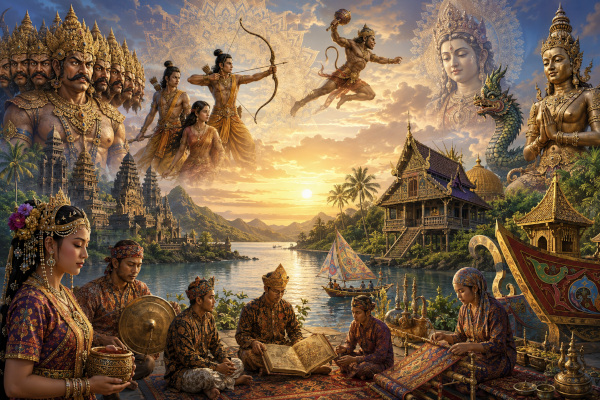
The story of the Ramayana travelled far beyond the Indian subcontinent, carried by sea routes, merchants, monks, poets, performers, and royal courts. In Southeast Asia, it entered temples, dances, shadow plays, court literature, sculpture, and folk memory. The Philippines, often left out of popular discussions on Ramayana influence, preserves one of the most fascinating localised traditions through the Maranao epic Maharadia Lawana, a Philippine Ramayana-related narrative from the Lake Lanao cultural world of Mindanao. This tradition shows how the civilisational light of Bharat reached island societies, blended with local imagination, and became part of a wider Asian cultural family.
This connection is best understood as Brihattar Bharat — the larger civilisational sphere shaped by Indian stories, dharmic ideas, maritime exchange, Sanskritic vocabulary, sacred art, and shared cultural memory. It is a cultural idea of connectedness, where India’s epics inspired neighbouring societies while allowing each land to express them in its own language, landscape, and spiritual rhythm. The Government of India has also described India’s enduring cultural and religious linkages with Southeast Asia, including the Philippines, through Hinduism, Buddhism, epics, iconography, performing arts, and maritime relations.
The Philippine Ramayana: Maharadia Lawana
The strongest Ramayana-related tradition in the Philippines is Maharadia Lawana, a Maranao epic associated with the people of Lanao in Mindanao. Scholars identify it as an indigenous Filipino epic that resembles the Indian Ramayana while also showing strong Malay-Indonesian pathways of transmission. A 2024 study describes Maharadia Lawana as a Filipino epic rooted in local Philippine culture, yet clearly connected to the Ramayana tradition and likely shaped through Indonesian and Malaysian adaptations.
In this Maranao version, the familiar Ramayana world takes on local names and cultural colours. Maharadia Lawana reflects Ravana; Radia Mangandiri corresponds to Rama; Radia Mangawarna corresponds to Lakshmana; and Tuwan Potre Malano Tihaia or Potre Malaila Ganding corresponds to Sita. Juan R. Francisco’s work on the indigenisation of the Rama story records these principal character correspondences.
The plot also carries the Ramayana’s central moral architecture: a royal household, a noble woman, abduction, conflict, heroic search, divine assistance, and the defeat of destructive power. Yet the Maranao imagination reshapes the tale through its own social world of sultans, island kingdoms, lake culture, Islamic-era vocabulary, and Southeast Asian storytelling style. Maharadia Lawana is described as a seven- or eight-headed ruler, recalling Ravana’s many-headed form, while the Hanuman-related role appears through the figure of Laksamana, showing how the epic was reinterpreted through local and regional filters.
This makes Maharadia Lawana valuable because it is both Indian and Filipino in spirit. The soul of the Ramayana remains visible, while the body of the story becomes Maranao. It is a beautiful example of how Akhand Bharat worked culturally: ideas travelled, but each society gave them a new home.
How the Ramayana Reached the Philippines
The Philippines was part of a larger maritime Asian world connected by trade routes linking India, Sri Lanka, Java, Sumatra, Borneo, the Malay world, Champa, and the islands of the Philippine archipelago. These routes carried more than goods. They carried words, titles, ritual ideas, scripts, myths, art forms, and heroic stories.
The wider evidence of Indic influence in the Philippines appears in language, archaeology, and mythology. The Laguna Copperplate Inscription, dated around 900 CE, is the earliest known written document from the Philippines; it uses Kawi script, Old Malay, and contains Sanskrit loanwords, showing the Philippines’ early cultural links with neighbouring Asian civilisations.
Another powerful symbol is the Golden Tara of Agusan, a gold image found in Mindanao. Scholars have debated whether it represents a Hindu-Buddhist goddess, a Mahayana Buddhist Tara, or a related Tantric Buddhist figure. The Cultural Center of the Philippines notes that its presence allows scholars to discuss a possible Hindu-Buddhist period in the Philippines connected with the Srivijaya and Majapahit worlds before the spread of Islam and Christianity.
Together, Maharadia Lawana, the Laguna Copperplate Inscription, Sanskrit-derived vocabulary, and the Golden Tara point to a Philippines that was culturally connected with the larger Indic-influenced world of Southeast Asia.
Ramayana Values in the Filipino Setting
The Ramayana survived across Asia because it speaks in universal moral language. In the Philippines, Maharadia Lawana carries themes familiar to the Indian epic: royal duty, courage, loyalty between brothers, the dignity of womanhood, the battle against arrogance, and the final triumph of order over destructive desire.
Rama’s dharma becomes Radia Mangandiri’s royal responsibility. Lakshmana’s devotion becomes Radia Mangawarna’s brotherly loyalty. Sita’s purity becomes the dignity of Potre Malaila Ganding. Hanuman’s service becomes transformed through the local figure of Laksamana. Ravana’s pride becomes Maharadia Lawana’s destructive kingship. The same ethical structure flows through a different cultural river.
This is the genius of the Ramayana tradition. It does not erase local identity. It gives local identity a grand moral canvas. In the Philippines, the epic became a Maranao story, but its deeper dharmic pulse remained alive.
Hindu Gods and Philippine Traditional Culture: A Cultural Comparison
Philippine traditional religion is diverse, with many ethnic groups preserving their own spiritual worlds. The Tagalog, Visayan, Bicolano, Ilocano, Maranao, Manobo, Ifugao, and other communities had their own deities, spirits, ancestor beings, and nature guardians. The comparison with Hinduism must be read as cultural resonance and historical influence, not as a claim that every Filipino deity is a direct copy of an Indian deity.
Bathala, also called Abba or Maykapal in Tagalog tradition, was described by F. Landa Jocano as the highest-ranking deity of the ancient Tagalogs. This supreme creator role gives Bathala a conceptual parallel with Hindu ideas of Ishvara, Brahma, and the supreme cosmic source who creates and sustains order.
The Filipino word diwata is especially important. It is widely linked to the Sanskrit devata, meaning deity or celestial being. In Philippine culture, diwata came to refer to divine beings, nature spirits, and guardians of mountains, forests, rivers, and fertility. This strongly recalls the Hindu world of devas and devis, where divine beings are associated with cosmic forces, natural elements, prosperity, rain, fire, earth, and protection.
Anito, the Filipino concept of ancestral or spirit beings, can be compared with the Hindu reverence for pitṛs, the ancestral spirits remembered through rites and offerings. Both traditions recognise that the living remain connected with the departed through memory, ritual, gratitude, and sacred continuity.
Mayari, the Tagalog goddess of the moon, offers a strong parallel with the Hindu lunar principle represented by Chandra and Soma, while also carrying feminine beauty and night symbolism. Jocano records Mayari as the moon goddess in Bathala’s celestial court, along with Hana, goddess of the morning, and Tala, goddess of the stars.
Tala, the star goddess, can be compared with the Hindu reverence for the nakshatras and celestial order. Hana, the morning goddess, echoes the Vedic Ushas, the goddess of dawn, who brings light, renewal, and awakening.
Ikapati, described as the goddess of cultivated land and agriculture, has a natural comparison with Bhumi Devi, Annapurna, and aspects of Lakshmi connected with fertility, food, prosperity, and abundance. Jocano records Ikapati as a benevolent giver of agriculture, food, and prosperity.
Apolaki, described in Tagalog tradition as a sun deity and patron of fighters, can be compared with Surya, the Hindu sun god, and with warrior deities such as Skanda/Kartikeya/Murugan. Jocano’s account places Apolaki within the Tagalog divine order as a solar and martial figure.
The naga motif also links the Philippines with the Indic world. Philippine tradition includes naga-like serpent or dragon beings, while Hindu and Buddhist traditions honour Nāgas as semi-divine serpent beings connected with water, fertility, protection, and hidden wisdom. The presence of such motifs across Southeast Asia reflects a shared mythic language shaped by maritime cultural exchange.
The Philippines Genius of Adaptation
The Philippines did not merely receive Indian culture passively. It transformed what it received. This is why Maharadia Lawana is important. It shows how the Maranao people absorbed a Ramayana-related story and made it their own. The epic entered a local world of sultanates, lake settlements, oral poetry, heroic memory, and Islamic-era cultural vocabulary. The result was a Ramayana that spoke in a Filipino voice.
This same pattern is seen across Southeast Asia. Thailand has the Ramakien, Cambodia has the Reamker, Indonesia has the Kakawin Ramayana, Laos has Phra Lak Phra Ram, Malaysia has Hikayat Seri Rama, and the Philippines has Maharadia Lawana. Each version carries the Indian epic’s moral seed, while blooming in its own soil.
Akhand Bharat in the Philippine Context
In the Philippine context, Akhand Bharat should be understood as a civilisational ocean, not a political border. It is the memory of a time when Bharat’s stories, scripts, sacred vocabulary, trade networks, and spiritual ideas moved across seas and found loving homes in distant cultures. The Philippines stands at the eastern edge of this memory.
Maharadia Lawana proves that the Ramayana was not limited to mainland kingdoms or temple states. It could live in an island society, in a Muslim Maranao cultural setting, among bards and storytellers, in a language and landscape far from Ayodhya, yet still connected to the same epic heartbeat.
This is the positive meaning of Akhand Bharat: a family of cultures linked by shared stories, mutual respect, and ancient civilisational exchange. India gave the Ramayana to Asia, but Asia gave the Ramayana many new lives.
Conclusion
The Ramayana influence in the Philippines is one of the most beautiful chapters of India’s cultural journey across the seas. Through Maharadia Lawana, the Maranao people preserved a localised Ramayana-related tradition that carries the memory of Rama, Sita, Lakshmana, Hanuman, and Ravana in Filipino form. Through words like diwata, through concepts such as Bathala, Mayari, Tala, Ikapati, Apolaki, anito, and naga, Philippine traditional culture also shows deep resonances with the wider Indic world.
The Philippines reminds us that the Ramayana is not only a text. It is a travelling civilisation. It crossed oceans without armies, entered hearts without force, and became local without losing its sacred origin. In that sense, Maharadia Lawana is not just a Philippine epic. It is a golden bridge between Bharat and the islands of the eastern sea.
You may also like
-
Yavana in the Mahabharata: Greek Connections, Pandava Campaigns and the Warriors of Kurukshetra
-
India and Sri Lanka Launch SAMHiTA Manuscript Digitisation Project to Preserve Ancient Buddhist Heritage
-
ASI Uses Ground-Penetrating Radar to Investigate Ancient Buddhist Stupa at Ujjain After Nearly 90 Years
-
Pahlava: The Parthian World Beyond India’s Northwestern Frontiers in the Mahabharata
-
Namami Gange in 2026: 368 Projects Completed, 4,339 MLD Sewage Treatment Capacity Created as Ganga Rejuvenation Advances
