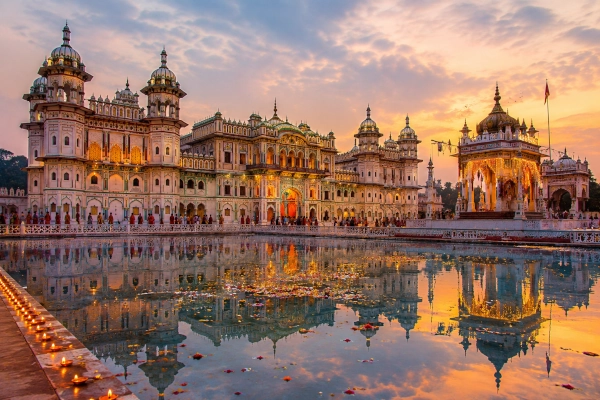
Janakpur, also revered as Janakpurdham, is among the most sacred cities connected with the Ramayana tradition. Located in the Mithila region of Nepal’s southern plains, the city is traditionally identified as the capital of King Janaka and the birthplace of Sita, whom devotees worship as Janaki, Vaidehi and Maithili. Its temples, sacred ponds, marriage rituals, Maithili language and Mithila art preserve a living cultural world centred on the union of Sita and Rama.
For generations of pilgrims from Nepal and India, Janakpur represents the maternal home of Sita. Ayodhya is remembered as the kingdom of Rama, while Janakpur is cherished as the city from which Janaki entered the royal household of Raghu. The sacred relationship between the two cities has shaped pilgrimage routes, devotional songs, wedding customs and family traditions across the Himalayan and Gangetic regions.
Janakpur in the Ramayana
The Bala Kanda of the Valmiki Ramayana describes Rama and Lakshmana travelling with Maharishi Vishvamitra to Mithila. King Janaka receives the sage and the two princes, and the events surrounding the great bow of Shiva unfold within his kingdom. Rama lifts and breaks the divine bow, fulfilling the condition associated with Sita’s marriage. The marriage of Rama and Sita is then solemnised alongside the unions of their brothers and the other princesses of Mithila.
This episode places Mithila at the centre of one of the Ramayana’s most joyful chapters. The marriage unites the Suryavamsha of Ayodhya with the royal house of Videha. It also brings together two powerful ideals of dharma: Rama as the disciplined prince devoted to righteousness, and Sita as the embodiment of courage, purity, sacrifice and spiritual strength.
Janakpur’s importance therefore extends beyond its association with a single event. The city represents the beginning of the shared earthly journey of Rama and Sita. Their marriage became an enduring model for sacred companionship, mutual duty and the spiritual responsibilities of household life.
Sita as Janaki, Vaidehi and Maithili
Sita’s names preserve her relationship with the sacred geography of Mithila. She is called Janaki as the daughter of Janaka, Vaidehi through her connection with the kingdom of Videha and Maithili as the princess of Mithila. Each name carries the memory of her homeland and connects her life permanently with Janakpur.
In the Ramayana, King Janaka explains that he found Sita while ploughing a field connected with a sacred rite. Her name is associated with the Sanskrit word sītā, meaning a furrow made by a plough. This tradition presents her as Bhumija, the daughter of the Earth, born from cultivated soil and connected with fertility, agriculture and the sustaining power of nature.
This agricultural symbolism remains especially meaningful in Mithila, a region whose civilisation grew through settled communities, fertile land, seasonal rivers and carefully preserved domestic traditions. Sita’s emergence from the earth makes her both a royal princess and a universal daughter of the land.
For many devotees, Sita represents Shakti expressed through patience, wisdom and inner endurance. Her strength appears through her choices, her commitment to dharma and her ability to preserve her spiritual dignity through every stage of the Ramayana.
King Janaka and the Vedic Heritage of Videha
King Janaka is remembered in the Ramayana as Sita’s father and the ruler of Mithila. The name Janaka also possesses a wider Vedic and Upanishadic resonance. Rulers of Videha bearing the title Janaka appear in the Brihadaranyaka Upanishad, where the royal court becomes a centre of philosophical inquiry involving sages such as Yajnavalkya. The text belongs to the Shukla Yajurveda tradition and explores some of the deepest Vedic teachings concerning the Atman, Brahman and the nature of consciousness.
This intellectual heritage gives Mithila a distinctive place in Bharatiya civilisation. Its ideal ruler supports sacred learning, invites philosophical debate and recognises wisdom as the foundation of good governance. Janaka thus became an enduring symbol of the rajarshi—a king who combines worldly responsibility with spiritual understanding.
The association of Janakpur with Janaka links the city to both the epic world of the Ramayana and the contemplative world of the Upanishads. Royal power, family duty, yajna, knowledge and liberation meet within the wider cultural memory of Videha.
Janaki Mandir: The Spiritual Heart of Janakpur
The great Janaki Mandir stands at the centre of Janakpur’s religious life. Dedicated to Goddess Sita, the monumental temple attracts pilgrims throughout the year and becomes the principal focus of celebrations during Vivah Panchami and Rama Navami.
The present structure was commissioned by Queen Vrisha Bhanu Kunwari of Tikamgarh. Official Nepal Tourism sources give differing dates for its construction, ranging from 1874 to 1910, placing the monument’s creation across the late nineteenth and early twentieth centuries. The temple is popularly known as the Naulakha Mandir, recalling the traditional account that its construction cost nine lakh rupees.
The three-storeyed complex combines regional, Rajput, Mughal and classical architectural elements. Domes, arched windows, ornamental gateways, courtyards and finely decorated walls give the building the appearance of a sacred palace prepared for the princess of Mithila. The temple contains the revered image of Janaki and numerous chambers associated with worship and pilgrimage.
The Ram Janaki Temple was submitted by Nepal’s Department of Archaeology to UNESCO’s World Heritage Tentative List in 2008. The submission recognises the temple’s religious importance, distinctive architecture and close association with the traditions of Sita, Rama and King Janaka.
The Vivah Mandap and the Marriage Tradition
Near the main Janaki shrine stands the Vivah Mandap, traditionally associated with the wedding of Rama and Sita. The mandap presents the marriage as a living sacred event, with images and decorative elements representing Rama, Sita and the members of their royal families.
The spiritual atmosphere of the complex reflects the hospitality of Mithila. Rama is welcomed as the bridegroom from Ayodhya, while Sita is honoured as the beloved daughter of Janakpur. Devotees approaching the mandap enter a ritual world where the divine marriage continues to be celebrated through prayer, song and ceremonial remembrance.
Marriage traditions across Mithila draw inspiration from this episode. Songs connected with the arrival of the bridegroom, the welcoming of the marriage party, the emotions of Sita’s family and her departure from her maternal home remain part of the region’s cultural inheritance.
Vivah Panchami: When Janakpur Becomes the City of the Divine Wedding
Vivah Panchami is Janakpur’s most celebrated Ramayana festival. Observed on the fifth lunar day of the bright fortnight of Margashirsha, usually during November or December, it commemorates the marriage of Sita and Rama.
During the festival, ceremonial processions representing Rama’s marriage party move through the city. The arrival of the bridegroom is celebrated with music, devotional chanting, decorated chariots and traditional hospitality. Representations of Rama and Sita are brought together at the Vivah Mandap, where priests conduct rituals recalling their sacred wedding.
Pilgrims arrive from different parts of Nepal and India, transforming Janakpur into a vast cultural gathering. Ramayana recitations, Maithili wedding songs, bhajans and ritual performances allow the ancient narrative to enter contemporary life. Families experience the festival as participants in Sita’s wedding rather than distant spectators.
The celebrations also reveal the emotional depth of the relationship between Janakpur and Ayodhya. Janakpur receives Rama as its son-in-law, while Sita’s journey towards Ayodhya is remembered with the affection traditionally given to a daughter leaving her maternal home.
Sacred Ponds and the Wider Pilgrimage Landscape
Janakpur’s religious geography extends beyond the Janaki Mandir. The city contains several sacred ponds connected with ritual bathing, festivals and local tradition. Ganga Sagar and Dhanush Sagar are among the best known, while other temples dedicated to Rama, Lakshmana, Hanuman and various deities form a wider pilgrimage circuit.
Dhanushadham, situated outside the central city, is traditionally associated with fragments of Shiva’s bow after Rama broke it. Parashuram Kunda recalls the encounter between Rama and Parashurama following the bow-breaking episode. Together, these places allow pilgrims to follow the marriage narrative across a sacred landscape rather than within a single temple.
Mithila Art and the Memory of Sita’s Wedding
Janakpur is also a major centre of Mithila art, commonly known as Madhubani painting. The tradition is recognised for its vivid colours, geometric borders, natural imagery and portrayals of deities, marriages, festivals and village life.
Sita and Rama’s wedding forms one of its most enduring themes. Painted walls, ceremonial chambers and marriage decorations frequently portray the royal couple, their families and the rituals of Mithila. Scholarly documentation from the Indira Gandhi National Centre for the Arts records the close relationship between Mithila painting and the cultural memory of the divine marriage.
Women have played a central role in preserving and transmitting this artistic heritage. Through household murals and ceremonial paintings, generations of artists transformed the Ramayana into a visual language woven into everyday life. Modern workshops in and around Janakpur continue this tradition through paintings on paper, cloth, pottery and other materials.
Sanskrit, Maithili and a Shared Literary World
Sanskrit provides the foundational literary language of the Valmiki Ramayana and the Upanishadic traditions connected with Videha. Maithili carries the story into the homes, songs, ceremonies and regional literature of Mithila.
The language of Janakpur therefore forms part of a continuous cultural dialogue. Sanskrit preserves the epic and philosophical framework, while Maithili expresses its emotions through folk songs, wedding verses, theatre and oral storytelling. The names Janaki, Vaidehi, Mithila and Videha continue to carry their Sanskritic meanings within Maithili devotional culture.
This interaction between classical and regional languages reflects a wider pattern across Bharat, where the Ramayana lives simultaneously in scripture, poetry, drama, music, painting and family tradition.
Janakpur and the Civilizational Vision of Akhand Bharat
Within the civilizational imagination of Akhand Bharat, Janakpur and Ayodhya belong to one sacred cultural landscape. Their relationship arose through dharma, pilgrimage, kinship, language and collective memory. Modern political boundaries exist within a much older network of temples, river routes, marriage customs and devotional traditions.
The story of Rama and Sita creates a cultural bridge between Nepal and India. Janakpur is honoured in India as the home of Janaki, while Ayodhya is revered in Nepal as the home of Rama. The bond resembles a family relationship, expressed through the enduring idea that Nepal is Sita’s maternal homeland and Ayodhya the home she entered through marriage.
India and Nepal have also promoted the Ramayana Circuit as a means of connecting places associated with Rama and Sita. Official Indian statements have described Janakpur and Ayodhya as central points within this shared pilgrimage network.
Akhand Bharat in this cultural sense represents a civilisation whose sacred stories move freely across the Himalayas, the Terai and the Gangetic plains. Janakpur demonstrates how this unity survives through devotion, art, festivals and family memory.
A Living City of Ramayana Heritage
Janakpur remains one of the finest examples of a Ramayana city whose ancient tradition continues through active worship. The bells of Janaki Mandir, the marriage songs of Vivah Panchami, the waters of sacred ponds and the painted walls of Mithila keep Sita’s presence alive.
For Nepal, the city is a major centre of national religious and cultural heritage. For the wider Bharatiya world, it is the sacred maternal home of Janaki. For every devotee who follows the journey of Rama and Sita, Janakpur represents love guided by dharma, royal life illuminated by wisdom and the enduring unity of a civilisation joined through sacred memory.
You may also like
-
Yavana in the Mahabharata: Greek Connections, Pandava Campaigns and the Warriors of Kurukshetra
-
India and Sri Lanka Launch SAMHiTA Manuscript Digitisation Project to Preserve Ancient Buddhist Heritage
-
ASI Uses Ground-Penetrating Radar to Investigate Ancient Buddhist Stupa at Ujjain After Nearly 90 Years
-
Pahlava: The Parthian World Beyond India’s Northwestern Frontiers in the Mahabharata
-
Namami Gange in 2026: 368 Projects Completed, 4,339 MLD Sewage Treatment Capacity Created as Ganga Rejuvenation Advances
