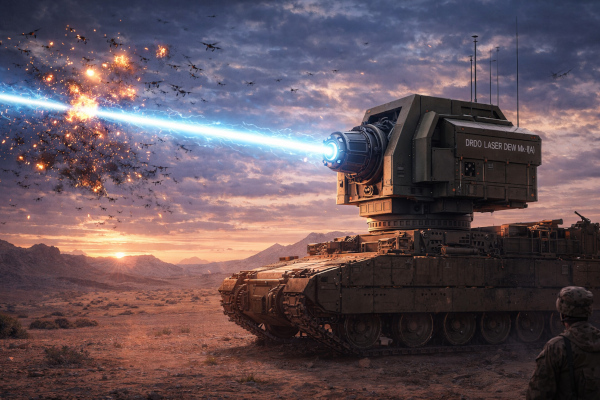
India’s successful demonstration of the Laser Directed Energy Weapon Mk-II(A) in April 2025 marked one of the most significant shifts in the country’s air-defence and counter-drone architecture in recent years. Conducted by DRDO’s Centre for High Energy Systems and Sciences (CHESS) at the National Open Air Range in Kurnool, Andhra Pradesh, the trial showcased a vehicle-mounted 30 kW laser weapon capable of engaging fixed-wing UAVs, swarm drones, and surveillance sensors. Official reporting described the trial as a full-spectrum demonstration of the system’s capability, including structural damage to drone targets and disabling of hostile sensors, placing India among a small group of countries that have demonstrated high-power laser directed-energy weapons.
What makes the Mk-II(A) important is that it represents a different economics of battlefield defence. Conventional air-defence systems use missiles or gun ammunition to defeat incoming threats; those are effective, but they are expensive and finite. A laser directed-energy weapon changes that equation by delivering engagement at the speed of light, with a much lower cost per shot once power and thermal management are available. That makes such systems especially attractive against low-cost drones, loitering munitions, and swarm attacks, where the attacker’s objective is often to saturate defences and force the defender to spend disproportionately. DRDO itself described the Mk-II(A)’s speed, precision and lethality as making it one of the most potent counter-drone systems in this category.
The system’s institutional home is also important. CHESS, Hyderabad is DRDO’s laboratory for directed-energy weapons, and this is not an isolated experiment but part of a longer programme of indigenous high-energy weapon development. A PIB listing of DRDO laboratories identifies CHESS specifically with the directed-energy weapons domain, while BEL disclosed in 2022 that it had signed a licence agreement with CHESS for the manufacture of the Multi-kW Beam Directed Optical Channel (BDOC), which BEL called the core of any laser DEW system. BEL’s description is useful because it reveals that the laser weapon is the optical channel, using a precisely stabilised combination of mirrors and lenses, is central to placing a focused high-power beam accurately on a moving target.
That optical-control problem is one of the hardest parts of laser weapon engineering. A battlefield laser is not just “a powerful beam”; it is a highly integrated system that must solve for beam generation, beam quality, target acquisition, line-of-sight stabilisation, atmospheric distortion, tracking accuracy, jitter control, dwell time, and thermal management. Even after the laser reaches the target, the kill mechanism depends on maintaining enough energy on a sufficiently small spot for long enough to heat, burn, crack, blind, or structurally degrade the target. Against drones, that can mean burning control surfaces, damaging propulsion sections, destroying electro-optical payloads, or blinding surveillance apertures. Against sensors and antennae, the objective may be degradation rather than spectacular destruction. The Kurnool trial’s emphasis on both structural damage and sensor disablement suggests the Mk-II(A) is being developed with precisely this layered utility in mind.
The 30 kW power level is a meaningful threshold. In public reporting carried in DRDO’s own press-clipping compilations, the Mk-II(A) is described as India’s first true high-powered laser weapon, following earlier lower-power developmental steps. One such report, reproduced in DRDO’s clippings, outlines a path from a 2 kW demonstrator to 12 kW and then to the 30 kW Mk-II(A), with the latter associated with engagement ranges of up to around 4 km against drones, helicopters and sensors. Because that specific range-and-evolution breakdown appears in media coverage reproduced by DRDO rather than a formal standalone DRDO technical specification sheet, it should be read as reported detail rather than a fully released official datasheet. Still, it offers a credible indication of the programme’s trajectory: India is clearly moving from proof-of-concept lasers toward tactically relevant battlefield systems.
Operationally, the Mk-II(A) is best understood first as a counter-UAS and point-defence weapon. It is particularly suited to defending fixed installations, high-value military nodes, air bases, logistics areas, radar sites, ammunition dumps and potentially mobile formations against small and medium aerial threats. A vehicle-mounted architecture gives it mobility, but the current public picture suggests it is most valuable where there is an integrated detection-and-tracking grid and where power and cooling support can be sustained. Laser weapons excel against targets that are visible, within line of sight, and not heavily hardened. They are much less magical than science fiction suggests, but within their envelope they can be devastatingly efficient.
The strategic significance lies in what comes next. DRDO Chairman Dr. Samir V Kamat described the April 2025 trial as “just the beginning of the journey” and said DRDO is also working on high-energy microwaves, electromagnetic pulse, and other high-energy systems. That comment is important because it places the Mk-II(A) inside a broader Indian directed-energy roadmap rather than presenting it as a single isolated product. In other words, the laser itself is one branch of a growing ecosystem that may eventually include sensor-kill systems, anti-swarm microwave systems, and layered directed-energy air defence.
The industrial angle matters too. BEL’s 2022 agreement to manufacture the BDOC indicates that elements of the directed-energy chain are already being moved toward industrial production. That is a meaningful step because a weapon like the Mk-II(A) will only matter strategically if it can be manufactured, ruggedised, serviced, and fielded in numbers. The shift from laboratory optics to industrially reproducible beam-directing assemblies is exactly the kind of behind-the-scenes milestone that determines whether a defence technology remains a demonstration or becomes a deployable system.
In practical combat terms, the biggest value of the Mk-II(A) may be in cost asymmetry reversal. Drone warfare has rewarded attackers because relatively cheap UAVs and swarms can threaten expensive radars, missiles, airframes and ammunition. A laser DEW offers the defender a way to answer mass with repeatable, low-marginal-cost fire, as long as the system can detect, track and dwell on targets fast enough. This does not eliminate the need for missiles and guns; rather, it adds another layer to a modern air-defence network. In the Indian context, where armed forces must think simultaneously about border surveillance, high-value static installations, and saturation attacks by low-cost unmanned systems, that extra layer could become extremely important.
The real significance of the DRDO Laser DEW Mk-II(A), then, is that it signals India’s transition from researching directed-energy concepts to demonstrating battlefield-relevant systems with credible tactical roles. Publicly available details remain limited, and that is normal for an emerging weapon system. But enough is already clear: India now has a 30 kW vehicle-mounted laser weapon, developed by CHESS under DRDO, tested successfully against fixed-wing UAVs, swarm drones and hostile sensors, with industrial support already visible in critical optical subsystems. For Indian defence technology, that is not just another trial. It is the opening move in a new category of warfare.
Reference:
News on Air — India demonstrates laser weapon capability, joins elite global club
https://www.newsonair.gov.in/india-demonstrates-laser-weapon-capability-joins-elite-global-club/
DRDO News Clippings (12–15 April 2025) — coverage of Mk-II(A) Laser Directed Energy Weapon trial
https://drdo.gov.in/drdo/sites/default/files/drdo_news/NPC12to15Apr2025.pdf
DRDO News Clippings (16 April 2025) — coverage of India’s first high-powered laser weapon
https://www.drdo.gov.in/drdo/sites/default/files/drdo_news/NPC16Apr2025.pdf
DRDO News Clippings (17 April 2025) — coverage of Mk-II(A) Laser Directed Energy Weapon
https://www.drdo.gov.in/drdo/sites/default/files/drdo_news/NPC17Apr2025.pdf
PIB — Laboratories of DRDO
https://www.pib.gov.in/newsite/PrintRelease.aspx?relid=113748
BEL — BEL signs LAToT with CHESS, DRDO
https://bel-india.in/news-bel/bel-signs-latot-with-chess-drdo/
You may also like
-
Indian Navy Vice Chief Inspects Japan’s Mogami-Class Stealth Frigate as India-Japan Shipbuilding Cooperation Expands
-
Philippine Marine Wargames Reportedly Show BrahMos Can Penetrate Chinese Destroyer Air Defences
-
Safran Signs 18 Agreements with Indian Aerospace Suppliers, Expanding Make in India Manufacturing Partnerships
-
Indian Army’s Vajra Corps Certifies First Batch of Drone Operators, Strengthens Battlefield Surveillance
-
India to Seek 35% Increase in Defence Modernisation Budget for FY 2027–28
:%20India’s%2030%20kW%20Directed-Energy%20Breakthrough%20and%20the%20Future%20of%20Counter-Drone%20Warfare)