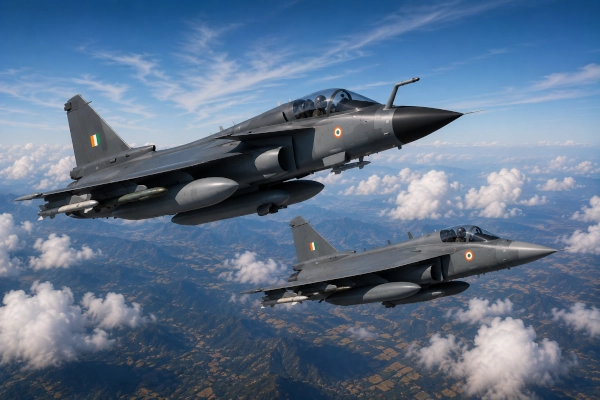
The Tejas Mk1 and Tejas Mk2 belong to the same indigenous combat-aircraft family, but they have been designed for substantially different operational requirements.
The Tejas Mk1 established India’s ability to design, test, manufacture and operate a modern supersonic fighter. It is a compact light combat aircraft intended to provide air defence, close combat, offensive air support, ground attack and maritime-strike capabilities.
The Tejas Mk2 builds on this technological foundation but moves into the medium-weight fighter category. It is being developed with a more powerful engine, a larger mission-system architecture, advanced sensors and greater capacity for fuel and weapons.
The Mk2 is therefore not simply a stretched Mk1 or a routine avionics upgrade. It represents the next stage of India’s indigenous fighter-development programme.
Tejas Mk1 Created India’s Modern Fighter Ecosystem
The Tejas programme was conceived to rebuild India’s indigenous combat-aircraft design capability after the HF-24 Marut.
The Aeronautical Development Agency serves as the programme-management agency responsible for the aircraft’s design and development, while Hindustan Aeronautics Limited is the principal design partner and production agency. The wider programme brought together DRDO laboratories, public-sector organisations, private companies, academic institutions and military certification agencies.
The first Tejas technology demonstrator flew on January 4, 2001. The fighter subsequently achieved Initial Operational Clearance in December 2013 and Final Operational Clearance in February 2019. The Indian Air Force’s No. 45 Squadron, known as the Flying Daggers, began operating the aircraft in July 2016.
By January 2026, 38 Tejas aircraft—32 fighters and six trainers—had been inducted into two Indian Air Force squadrons. The programme had also completed more than 5,600 successful flight trials.
The Mk1’s importance therefore extends beyond the number of aircraft produced. It created Indian expertise in composite airframes, digital fly-by-wire controls, glass cockpits, avionics integration, flight testing, military certification and combat-aircraft manufacturing.
Mk1 Is a Light Fighter; Mk2 Is a Medium-Weight Fighter
The most fundamental difference lies in their respective weight classes and intended roles.
The Tejas Mk1 is officially described as a lightweight, all-weather, multirole combat aircraft. It was designed to undertake offensive air support, close air combat, ground attack and maritime operations.
The Tejas Mk2 is officially classified as a Medium Weight Fighter. Moving into this category allows the aircraft to accommodate a more powerful engine, additional fuel, a broader weapon inventory and a more extensive suite of sensors and defensive equipment. The resulting platform is intended to possess greater operational reach and mission flexibility than the smaller Mk1.
The distinction is important because combat aircraft are shaped by trade-offs. A small light fighter can be agile, economical and easier to deploy in numbers, but its compact airframe limits the amount of fuel, weapons and equipment it can carry.
A medium-weight fighter provides more internal volume and payload capacity, allowing it to conduct longer and more demanding missions. The trade-off is a larger and more complex aircraft with higher development, production and operating requirements.
Basic Comparison
| Feature | Tejas Mk1 | Tejas Mk2 |
|---|---|---|
| Aircraft category | Light Combat Aircraft | Medium Weight Fighter |
| Programme position | Operational with the Indian Air Force | Under development |
| Engine | GE F404-IN20 | GE F414 family |
| Maximum take-off mass | 13,500 kg | Higher medium-weight category |
| Maximum speed | Mach 1.6 | Supersonic; final certified performance awaits flight testing |
| Service ceiling | 50,000 feet | Final certified figure awaits testing |
| External stations | Nine | Designed for a broader and heavier weapon load |
| Radar generation | Mechanically scanned radar in original Mk1 configuration | Active Electronically Scanned Array radar planned |
| Electronic warfare | Defensive systems suited to Mk1 requirements | Integrated unified electronic-warfare suite planned |
| Oxygen system | Conventional configuration, with indigenous OBOGS-related technology tested on a Tejas prototype | On-Board Oxygen Generation System planned |
| Primary advantage | Compact, operational and comparatively economical | Greater thrust, payload, fuel, sensors and mission flexibility |
| Development role | Established India’s modern fighter ecosystem | Expands that ecosystem into the medium-fighter class |
The official Tejas product specifications list the Mk1 family as 13.2 metres long and 8.2 metres wide, with a maximum take-off mass of 13,500 kilograms. It is powered by the GE F404-IN20 engine, producing 85 kilonewtons of thrust with afterburner. The aircraft has a stated maximum speed of Mach 1.6, a service ceiling of 50,000 feet and nine external stations.
Comparable final performance figures for the Mk2 will remain developmental until prototypes complete ground tests, flight-envelope expansion, weapons trials and military certification.
F404 vs F414: The Crucial Engine Difference
The engine change is one of the most important distinctions between the two aircraft.
The Tejas Mk1 uses the General Electric F404-IN20 turbofan. The engine provides sufficient power for the Mk1’s compact light-fighter airframe and has supported the aircraft through development, certification and operational service.
The Tejas Mk2 is being developed around the more powerful GE F414 engine. The Government has described this as an upgrade from the F404 used in the present Tejas to the F414 planned for the Mk2.
Additional thrust is necessary because the Mk2 must carry a larger airframe, more internal fuel, heavier mission equipment and a broader weapons load.
A more powerful engine can improve acceleration, energy recovery and performance when the aircraft carries external weapons and fuel tanks. It can also provide greater electrical and thermal capacity for modern radar, electronic-warfare and computing systems.
India has also pursued domestic manufacture of the F414 through an arrangement involving HAL and GE Aerospace. The proposed transfer of manufacturing technology is intended to strengthen India’s aero-engine production and maintenance capabilities.
Airframe and Aerodynamic Development
The Tejas Mk1 is one of the world’s smallest operational supersonic fighters. Its compact configuration was developed around a tailless delta-wing design, extensive use of composite materials and a quadruplex digital fly-by-wire flight-control system.
Because a delta-wing aircraft can be aerodynamically unstable in parts of its flight envelope, the flight-control computers continuously interpret the pilot’s commands and make rapid adjustments to the control surfaces.
The system provides controlled handling while allowing the aircraft to exploit the manoeuvring advantages of its aerodynamic design. The Mk1 also incorporates carefree manoeuvring, which helps prevent the pilot from unintentionally exceeding critical aircraft limits.
The Mk2 retains the technological lineage of Tejas but introduces a different airframe optimised for medium-weight missions.
Its larger configuration allows more internal space for fuel, sensors, avionics, cooling systems and electronic-warfare equipment. The design is also intended to provide a stronger balance between agility, endurance and weapon-carrying capability.
The Mk2 can therefore use technologies matured through the Mk1 while avoiding some of the physical limitations imposed by the earlier aircraft’s compact dimensions.
Radar and Situational Awareness
The original Tejas Mk1 entered service with a radar and avionics architecture developed according to the requirements and technologies available during its design period.
The Mk2 is intended to begin its operational life with a more advanced sensor configuration.
Official programme information has identified an Active Electronically Scanned Array radar as one of the principal systems planned for the Mk2. Unlike a conventional mechanically steered radar antenna, an AESA system can electronically direct its beam across the search area.
This supports faster target detection, simultaneous tracking of multiple contacts and more flexible operation across air-to-air and air-to-ground modes.
AESA technology can also improve resistance to hostile electronic interference and enhance the aircraft’s ability to operate in complex electromagnetic environments.
The distinction has narrowed somewhat with the arrival of the Tejas Mk1A. The Mk1A is an enhanced development of the Mk1 airframe that incorporates an AESA radar, improved avionics and an upgraded electronic-warfare suite. However, it remains in the light-fighter category and continues to use the F404 engine class.
The Mk2 combines advanced sensors with a larger airframe and more powerful propulsion, allowing it to exploit these systems across longer and heavier missions.
Electronic-Warfare Capability
Electronic warfare has become central to the survival of modern combat aircraft.
A fighter must detect hostile radar emissions, identify threats, warn the pilot and deploy suitable countermeasures. Advanced systems can also interfere with enemy radar and missile guidance.
The Tejas Mk2 is planned with a Unified Electronic Warfare Suite, integrating threat detection and defensive functions more closely with the aircraft’s mission computer and other sensors.
Sensor fusion can combine information from the radar, electronic-support systems, data links and other sources into a common tactical picture.
This reduces the need for the pilot to interpret several independent displays and can accelerate decision-making during combat.
The original Mk1 possesses defensive electronic systems, while the Mk1A introduces improved radar-warning and self-protection jamming capabilities. The Mk2 is intended to advance this further through a more deeply integrated system designed into the aircraft from the beginning.
Cockpit and Avionics
The Tejas Mk1 introduced India to a modern fighter cockpit incorporating digital displays, Hands-On Throttle and Stick controls, digital avionics and an open-architecture approach.
The aircraft’s glass cockpit presents essential flight and mission information through multifunction displays rather than relying primarily on traditional analogue instruments.
The Mk2 is expected to take this philosophy further through increased automation, more powerful mission computers and greater integration between sensors, weapons and defensive systems.
Its avionics architecture is being designed for modern networked warfare, in which a fighter may receive targeting or warning information from other aircraft, ground stations and airborne surveillance platforms.
The objective is not merely to display more information. The system must prioritise threats and present the pilot with a clear understanding of the tactical environment.
Fuel, Range and Endurance
The Tejas Mk1 was designed as a light fighter, placing natural limits on its internal fuel capacity.
External fuel tanks and aerial refuelling can extend its operating radius, but external tanks occupy stations that could otherwise carry weapons and also increase aerodynamic drag.
The Mk2’s medium-weight design is intended to provide more internal fuel and improved endurance. This should allow it to remain on station longer, reach targets farther from its operating base and conduct missions with a more useful combination of fuel and weapons.
Greater endurance is particularly important for maritime operations, air patrols and strike missions requiring the aircraft to fly around defended areas or approach from less predictable directions.
Actual combat radius always depends on altitude, speed, weapon load, external tanks, mission profile and reserve requirements. It should therefore not be reduced to a single universal figure.
Weapons and Payload
The Tejas Mk1 has nine external stations and is designed to carry air-to-air missiles, precision-guided weapons, conventional bombs, external fuel tanks and mission pods.
Its compact size, however, requires careful balancing between fuel and weapons.
The Mk2 is intended to carry a heavier and more diverse payload. Additional capacity would allow the aircraft to combine beyond-visual-range missiles, short-range air-combat weapons, precision-guided bombs, anti-radiation weapons and external fuel more effectively.
This gives the Mk2 greater multirole flexibility. A single aircraft could be configured for air defence, deep strike, battlefield interdiction, maritime attack or suppression of hostile air defences according to operational requirements.
Weapons integration remains a major part of fighter development. Every missile, bomb, pod or fuel tank must undergo structural, aerodynamic, software and separation testing before it can be cleared for operational use.
Survivability
Neither the Tejas Mk1 nor the Mk2 is designed as a fully stealthy fifth-generation fighter. Their survivability instead depends on a combination of compact size, electronic warfare, manoeuvrability, sensors, weapons and tactical employment.
The Mk1’s small physical profile can make visual detection more difficult and presents a comparatively small radar target.
The Mk2 will be larger, but its more advanced electronic-warfare architecture, radar and greater weapon-carrying capacity are intended to give it stronger defensive and offensive options.
The aircraft could engage threats from greater distances, receive information from networked platforms and use electronic countermeasures to complicate enemy targeting.
India’s dedicated stealth-fighter requirement is being addressed separately through the Advanced Medium Combat Aircraft programme.
Maintenance and Operational Availability
The Tejas Mk1 possesses the advantage of operational maturity.
Its systems have undergone thousands of test flights, the aircraft has achieved operational clearances and Indian Air Force personnel have accumulated experience in flying and maintaining it.
The Mk2 will have to build this maturity through ground testing, flight trials, certification and squadron service.
Its larger number of advanced systems could increase maintenance complexity, although modern diagnostic equipment and improved access to components can reduce servicing time.
The Tejas Mk1A has already introduced maintainability improvements over the original Mk1. Lessons from both variants can be incorporated into the Mk2’s design and support system.
Operational Status: Proven Aircraft vs Development Programme
The Tejas Mk1 is an operational combat aircraft.
Its IOC and FOC versions have been manufactured, and the platform is serving with the Indian Air Force. The original contracts covered 16 IOC fighters and four trainers, followed by 16 FOC fighters and four trainers.
The Mk2 remains under development. Official information released in January 2026 continued to list LCA Mk2 as a development programme rather than an operational or production aircraft.
This difference must be considered in any comparison.
Mk1 performance is supported by completed development testing and operational experience. Mk2 capabilities are based on approved design objectives and planned systems that must still be demonstrated through prototype testing.
The Mk2 may offer considerably greater combat potential, but the Mk1 remains the aircraft that India can operate and manufacture today.
Where Does the Tejas Mk1A Fit?
The Tejas Mk1A forms the bridge between the Mk1 and Mk2, but it should not be confused with either.
It retains the basic light-fighter airframe and F404 engine family of the Mk1 while introducing significant improvements in radar, electronic warfare, avionics and maintainability.
Officially listed Mk1A equipment includes an AESA radar, radar-warning and self-protection jamming systems, a Digital Map Generator, Smart Multifunction Displays, a Combined Interrogator and Transponder and an advanced radio altimeter.
The Mk1A allows the Indian Air Force to obtain a more capable light fighter without waiting for the larger Mk2 to complete development.
The Mk2, by contrast, changes the engine and aircraft category. Its greater internal capacity gives its designers more room to expand range, payload and mission systems.
The progression can therefore be understood as:
Tejas Mk1: Establishes the operational light-fighter platform.
Tejas Mk1A: Modernises and improves the light-fighter platform.
Tejas Mk2: Creates a new medium-weight fighter using technologies and experience developed through the earlier aircraft.
Which Aircraft Is Better?
In terms of projected combat capability, the Tejas Mk2 should be the more powerful aircraft.
Its F414 engine, medium-weight airframe, advanced radar, unified electronic-warfare suite and greater fuel and weapon capacity are intended to give it wider mission capabilities.
However, aircraft cannot be judged only by maximum capability.
The Tejas Mk1 is smaller, operationally proven and likely to remain less expensive to manufacture and operate. It is well suited to air defence, point interception, training, limited strike missions and operations where the capacity of a medium fighter is unnecessary.
The Mk2 is intended for missions demanding greater range, endurance, payload and sensor capability.
The two aircraft can therefore complement one another. A light fighter can provide numbers and economical routine operations, while a medium fighter undertakes more demanding missions.
Strategic Significance for India
The most important difference between the Mk1 and Mk2 may be what each represents in India’s aerospace development.
The Mk1 proved that India could create a modern fighter aircraft and take it from preliminary design to squadron service.
The Mk2 is intended to demonstrate that the country can scale this capability into a more powerful medium-weight platform with advanced sensors, electronic warfare and a higher-thrust engine.
Technologies developed through the Tejas family are also contributing to India’s broader combat-aircraft ecosystem. The expertise accumulated in composites, flight controls, avionics, software, testing and certification can support programmes such as the Advanced Medium Combat Aircraft and future naval fighters.
More than 100 design work centres across government laboratories, academia and industry have participated in the Tejas programme, making it an industrial and technological project extending far beyond HAL and ADA.
Conclusion
The Tejas Mk1 and Tejas Mk2 should not be viewed as direct competitors.
The Mk1 is a compact operational light fighter that established India’s modern indigenous combat-aircraft capability. It offers agility, multirole flexibility and the advantage of an existing production and operational base.
The Mk2 is a new medium-weight aircraft intended to deliver greater thrust, range, payload and sensor capability. It uses the Tejas programme’s accumulated knowledge but is being developed for a broader and more demanding set of missions.
The Mk1 represents the foundation. The Mk1A strengthens that foundation with modern sensors and electronic warfare. The Mk2 expands it into an entirely new operational category.
Its eventual success will depend on the completion of prototype construction, flight testing, weapons integration, certification and timely transition to series production.
References
Department of Defence Production, Ministry of Defence, Government of India. “LCA Tejas.” Product specifications and programme status, updated July 24, 2026.
Press Information Bureau, Government of India. “ADA’s Two-Day National Seminar ‘Aeronautics 2047’ Begins in Bengaluru.” Ministry of Defence, January 4, 2026.
Press Information Bureau, Government of India. “Prime Minister Visits HAL Facilities in Bengaluru; Appreciates Its Growing Capabilities.” Ministry of Defence, November 25, 2023.
Press Information Bureau, Government of India. “Tejas-1 and Tejas Mk2 Aircrafts.” Ministry of Defence, December 2, 2019.
Press Information Bureau, Government of India. “Schedule for Induction of Tejas Mark II Aircraft into Service.” Ministry of Defence, August 4, 2015.
Press Information Bureau, Government of India. “Background to DRDO-Developed Light Combat Aircraft Tejas.” Ministry of Defence, July 1, 2016.
You may also like
-
Indian Navy Vice Chief Inspects Japan’s Mogami-Class Stealth Frigate as India-Japan Shipbuilding Cooperation Expands
-
Philippine Marine Wargames Reportedly Show BrahMos Can Penetrate Chinese Destroyer Air Defences
-
Safran Signs 18 Agreements with Indian Aerospace Suppliers, Expanding Make in India Manufacturing Partnerships
-
Indian Army’s Vajra Corps Certifies First Batch of Drone Operators, Strengthens Battlefield Surveillance
-
India to Seek 35% Increase in Defence Modernisation Budget for FY 2027–28
