Indian defence manufacturer Paras Defence and Space Technologies Limited has clarified its technology partnership with American company Powerus Corporation following reports of the US firm’s separate defence agreement with Pakistan. The Indian company has emphasised that its arrangement is focused on technology transfer, indigenous manufacturing and strengthening India’s counter-drone capabilities.
The clarification, reported on October 8, 2026, follows concerns about Powerus establishing defence relationships with both India and Pakistan. Paras Defence stated that its agreement was signed on June 30, nearly three months before the American company’s engagement with Pakistan’s military authorities in September.
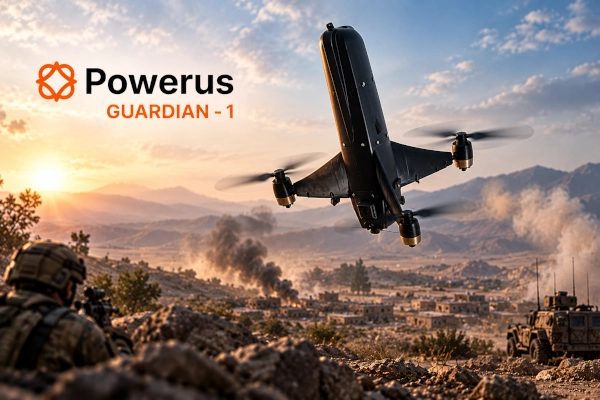
Under the agreement, Paras Defence holds an exclusive licence to manufacture and commercialise the Guardian-1 counter-drone interceptor in India. The system is a high-speed, battery-powered unmanned aircraft designed to intercept relatively inexpensive aerial threats.
The original licensing agreement was formally disclosed by Paras Defence to the Bombay Stock Exchange and National Stock Exchange on June 30, 2026. The company’s latest clarification reinforces its stated objective of developing India-specific defence capabilities through domestic manufacturing.
Paras Defence Signed Guardian-1 Licensing Agreement in June 2026
Paras Defence entered into an intellectual property licensing agreement with Tandem Defense LLC, a Georgia-based company and wholly owned subsidiary of Autonomous Power Corporation, which operates under the Powerus name.
According to the company’s official stock exchange disclosure dated June 30, the agreement grants Paras Defence exclusive rights to use the licensed Guardian interceptor technology within India for manufacturing and commercial purposes.
The licence is non-transferable and non-sublicensable, meaning Paras Defence cannot independently transfer the rights or grant sublicences outside the permitted contractual arrangements.
The agreement has an initial duration of twelve months and can be renewed through mutual consent.
Paras Defence also disclosed that it does not hold an ownership stake in Tandem Defense or its parent company. The arrangement is therefore a technology licensing partnership rather than an equity investment or joint venture.
The agreement establishes a framework for manufacturing and selling the Guardian-1 interceptor in the Indian market. It does not, by itself, represent a procurement order from the Indian Armed Forces.
Powerus Partnership with Pakistan Prompts Clarification
The Indian company’s clarification followed reports that Powerus had separately entered into a defence cooperation arrangement with Pakistan.
On September 16, 2026, representatives of Powerus met Pakistan’s military leadership in Rawalpindi to discuss cooperation in unmanned systems, defence technology and industrial development.
Powerus subsequently announced a memorandum of understanding with the Pakistan Army and an initial procurement order associated with unmanned aerial systems.
The company did not publicly disclose the value of the procurement order or the specific equipment involved, citing security and confidentiality considerations.
The development attracted attention because Powerus had already licensed its Guardian interceptor technology to Paras Defence for manufacturing and commercialisation in India.
The available disclosures establish that the Indian agreement preceded Powerus’s engagement with Pakistan. However, they do not establish that Pakistan has acquired the Guardian-1 interceptor or that identical technologies will be supplied to both countries.
The separate commercial relationships have nevertheless raised questions about technology protection, intellectual property arrangements and the role of international suppliers in sensitive defence markets.
Paras Defence Emphasises Technology Transfer and Indian Manufacturing
Responding to questions about the partnership, Paras Defence stated that its objective from the beginning had been to develop indigenous manufacturing capabilities and contribute to India’s defence preparedness.
The company explained that Powerus’s principal role under the arrangement involves technology transfer, while Paras Defence intends to establish manufacturing and commercial capabilities within India.
The Indian manufacturer also indicated that the technology and associated expertise would be adapted to the specific requirements of India’s defence ecosystem.
This distinction is important because licensed manufacturing can involve different levels of domestic participation, ranging from assembly to the development of manufacturing processes and local supply chains.
Paras Defence’s stated objective is to establish an Indian manufacturing capability around the Guardian-1 platform rather than depend entirely on imported finished equipment.
However, the publicly available agreement does not establish the percentage of indigenous content, the extent of design modifications permitted or the proportion of components that will eventually be sourced from Indian manufacturers.
These details will become relevant as the partnership progresses towards manufacturing and commercial deployment.
Guardian-1 Designed to Intercept Low-Cost Drone Threats
The Guardian-1 is a high-speed, battery-powered counter-drone interceptor developed by Powerus to address threats from hostile unmanned aerial systems.
Unlike conventional surface-to-air missiles, which rely on rocket propulsion and are generally designed for broader air-defence requirements, drone interceptors use unmanned aircraft platforms to engage airborne threats.
Such systems are attracting attention because inexpensive drones have become increasingly common in modern conflicts. Small unmanned aircraft can conduct reconnaissance, carry explosive payloads and threaten military installations or critical infrastructure.
Counter-drone interceptors offer an alternative method of engaging these threats, particularly where using expensive conventional missiles against comparatively inexpensive drones would impose significant costs.
The Guardian-1 platform is described as a high-speed interceptor intended to counter low-cost aerial threats. Powerus has also promoted the Guardian family as a potentially economical approach to defending against hostile unmanned systems.
Technical specifications reported for the Guardian-1 include a maximum speed of approximately 290–340 km/h, a working flight distance of around 15 kilometres and a maximum operating altitude of 5,000 metres.
These figures describe the manufacturer’s reported performance characteristics. They should not be interpreted as independently verified operational capabilities under Indian conditions.
India’s Counter-Drone Requirements Create Opportunities for Indigenous Industry
The increasing use of unmanned aerial systems has encouraged defence manufacturers to develop technologies capable of detecting, tracking and neutralising small airborne threats.
Counter-unmanned aircraft systems generally combine several functions, including surveillance, threat classification, tracking and interception.
Radar systems, electro-optical sensors and radio-frequency detection equipment can identify approaching drones. Command-and-control systems then help operators evaluate threats and select suitable countermeasures.
Neutralisation technologies include electronic jamming, directed-energy systems, interceptor drones and kinetic engagement systems.
Each approach has operational advantages and limitations. Electronic jamming may disrupt communication or navigation links, while kinetic interception can provide an alternative against drones that are resistant to electronic interference.
Interceptor drones are particularly relevant to the challenge of engaging small aerial targets without relying exclusively on conventional air-defence missiles.
India’s growing indigenous counter-drone industry includes companies developing surveillance radars, electronic warfare systems, interception platforms and integrated air-defence solutions.
The Guardian-1 licensing arrangement adds another technology to this developing industrial landscape.
Exclusive Indian Licence Does Not Extend to Other Countries
An important feature of the Paras Defence agreement is its territorial scope.
The June 30 stock exchange filing explicitly establishes that the licensed intellectual property may be used by Paras Defence within India for manufacturing and commercialising products.
The exclusive licence therefore provides contractual rights in the Indian market rather than worldwide ownership of the underlying technology.
Powerus remains the technology developer and retains rights subject to its contractual arrangements.
This distinction helps explain how the American company could enter separate commercial relationships outside India without necessarily violating the territorial exclusivity granted to Paras Defence.
However, territorial licensing alone does not establish the safeguards governing sensitive technical information, future product modifications or the use of related technologies in other jurisdictions.
The publicly available disclosure does not provide sufficient detail to determine whether the agreements contain restrictions concerning sales to particular countries.
The Indian partnership must therefore be understood according to its disclosed contractual terms rather than assumptions about the international activities of Powerus.
Guardian-1 Agreement Has Not Yet Become an Indian Military Order
The commercial significance of the partnership should be distinguished from confirmed military procurement.
Paras Defence’s June announcement established a technology licensing arrangement permitting manufacturing and commercialisation in India.
It did not disclose an Indian Armed Forces purchase order, an awarded procurement value or a confirmed delivery schedule for Guardian-1 interceptors.
There has also been no publicly established announcement confirming the system’s formal induction into Indian military service under this arrangement.
Before any new counter-drone platform can become part of an operational military capability, it must satisfy the applicable technical, safety and procurement requirements.
Performance evaluation, integration with existing surveillance systems, operational suitability and lifecycle support are among the considerations relevant to military acquisition.
The partnership nevertheless gives Paras Defence an opportunity to develop and offer an additional counter-drone product for India’s defence market.
Indigenous Counter-Drone Manufacturing Strengthens India’s Defence Ecosystem
Paras Defence has established capabilities across defence engineering, optics, electronics and specialised military technologies. Its participation in the Guardian-1 programme reflects the increasing involvement of Indian private companies in advanced defence systems.
Domestic production of counter-drone technologies can create opportunities for precision engineering firms, electronics manufacturers, propulsion specialists and software developers.
Local manufacturing capabilities can also support equipment maintenance, upgrades and technical support, which are important considerations for defence customers.
At the same time, international technology licensing arrangements require careful attention to intellectual property, manufacturing rights and supply-chain security.
The Guardian-1 partnership illustrates both the opportunities and complexities associated with introducing foreign-developed defence technologies into India’s indigenous manufacturing ecosystem.
Paras Defence’s October clarification establishes that its agreement with Powerus preceded the American company’s subsequent engagement with Pakistan and that the Indian manufacturer’s objective remains domestic capability development.
As India expands its counter-drone technology base, partnerships involving manufacturing rights and technology transfer can complement indigenous research programmes. The development of domestic production, testing and integration capabilities will strengthen the ability of Indian companies to supply advanced systems suited to the country’s defence requirements.
References
- Paras Defence and Space Technologies Limited, June 30, 2026. Disclosure Under Regulation 30 of SEBI Listing Regulations – Signing of IP License Agreement with Tandem Defense LLC. Official company filing submitted to the National Stock Exchange and Bombay Stock Exchange.
https://nsearchives.nseindia.com/corporate/PARAS_30062026155053_Reg30IP.pdf - National Stock Exchange of India, June 30, 2026. Paras Defence and Space Technologies Limited – Corporate Announcement Regarding Guardian Interceptor Technology Licensing Agreement.
https://www.nseindia.com/companies-listing/corporate-filings-announcements?symbol=PARAS - Paras Defence and Space Technologies Limited. Official company information and investor disclosures.
https://parasdefence.com/investors - Times of India, October 8, 2026. Indian Company Inked Agreement with Powerus 3 Months Before US Firm Signed Pact with Pakistan. Includes Paras Defence’s statement clarifying the objectives of its partnership.
https://timesofindia.indiatimes.com/defence/news/indian-company-inked-agreement-with-powerus-3-months-before-us-firm-signed-pact-with-pakistan/articleshow/134777175.cms - Reuters, September 16, 2026. US Drone Maker Powerus Signs Pakistan Army MoU, Gets Initial Order.
https://www.reuters.com/world/asia-pacific/us-drone-maker-powerus-signs-pakistan-army-mou-gets-initial-order-2026-09-16/
You may also like
-
Seven Indian SMEs Debut on Stock Exchanges as Electronics, Software and Engineering Firms Access Public Markets
-
DRDO Advances Indigenous Submarine AIP System as ₹1,990 Crore Kalvari-Class Integration Programme Progresses
-
India’s Defence Procurement Approvals Cross ₹1.62 Lakh Crore as Indigenous Manufacturing Gains Momentum
-
India Targets 10% of Global 6G Patents and Standards, Pushes Indigenous Telecom Technologies
-
India Demonstrates Maritime Rescue Capabilities at SAREX-2026 with Observers from 30 Countries
