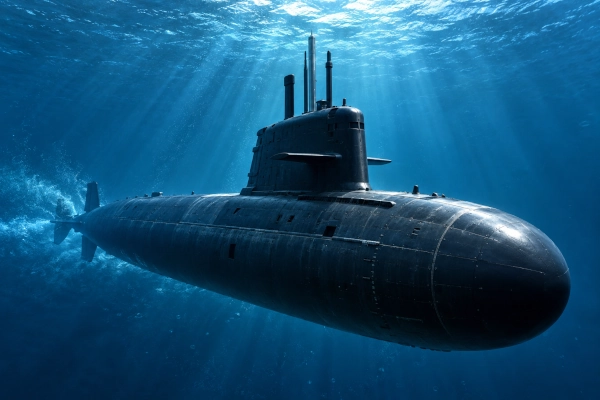
India’s Defence Research and Development Organisation (DRDO) is advancing its indigenous Air Independent Propulsion (AIP) system for conventional submarines, with engineering activities underway to integrate the technology into the Indian Navy’s Kalvari-class fleet. The programme represents an important step towards strengthening India’s underwater warfare capabilities and reducing dependence on imported submarine propulsion technologies.
Developed by DRDO’s Naval Materials Research Laboratory (NMRL), the fuel-cell-based propulsion system is designed to extend the underwater endurance of diesel-electric submarines without requiring them to surface or snorkel frequently for battery charging.
The Ministry of Defence signed a ₹1,990 crore contract with Mazagon Dock Shipbuilders Limited (MDL) on December 30, 2024, covering the construction of an AIP integration plug and its installation in Indian submarines.
According to DRDO’s published technical information, the AIP energy module and its subsystems have been designed, while work on the integration plug, technical reviews and design validation continues.
DRDO’s Indigenous AIP System Designed to Extend Submarine Endurance
Conventional diesel-electric submarines rely on batteries for underwater propulsion. These batteries must periodically be recharged using diesel generators, requiring the submarine to surface or operate a snorkel near the sea surface.
Such operations can increase the possibility of detection by enemy surveillance systems, particularly in contested maritime environments.
Air Independent Propulsion technology addresses this limitation by allowing submarines to generate additional electrical power underwater without drawing oxygen from the atmosphere.
DRDO’s indigenous system uses phosphoric acid fuel-cell technology to generate electricity through an electrochemical reaction involving hydrogen and oxygen.
The electrical energy produced by the fuel cells can supplement a submarine’s battery-powered propulsion system, enabling it to remain submerged for longer periods.
Unlike conventional diesel-generator operation, fuel cells generate electricity without combustion, offering quieter power generation that supports submarine stealth.
DRDO has identified extended underwater endurance and reduced acoustic signatures as important advantages of the technology.
India Develops Fuel-Cell Technology with Onboard Hydrogen Generation
A distinctive feature of India’s indigenous AIP system is its onboard hydrogen-generation capability.
Fuel-cell propulsion requires hydrogen and oxygen to produce electrical energy. DRDO’s system incorporates technology that generates hydrogen within the submarine instead of relying entirely on stored hydrogen supplies.
According to the Ministry of Defence, this configuration differentiates the Indian technology from several other AIP approaches developed internationally.
The system uses phosphoric acid fuel cells to convert chemical energy directly into electricity. The generated power undergoes electrical conditioning before being supplied to the submarine’s power system.
DRDO has also designed the technology around a modular architecture, enabling its configuration for different submarine requirements.
This modular approach is relevant to India’s long-term submarine development programmes because it provides a technological foundation that can potentially support future conventional submarine designs.
The successful development of the technology also strengthens domestic expertise in fuel cells, hydrogen generation, energy management and specialised naval engineering.
DRDO Successfully Demonstrated AIP Prototype in 2021
The indigenous AIP programme achieved an important technological milestone on March 8, 2021, when DRDO successfully demonstrated its land-based prototype.
The prototype underwent tests in endurance mode and maximum-power mode according to the Indian Navy’s requirements.
These tests established the system’s ability to operate under different power conditions and represented a major step in validating the fuel-cell technology.
DRDO developed the system with support from Indian industrial partners, including Larsen & Toubro and Thermax.
Following the demonstration, the Ministry of Defence stated that the technology had reached a level of maturity suitable for progressing towards installation in the intended submarine platforms.
However, successful land-based testing does not establish completion of onboard installation or sea trials. Integration into an operational submarine requires additional engineering, safety assessments and platform-specific validation.
The programme subsequently moved into the detailed design and integration stages needed to adapt the technology for the Kalvari-class submarines.
DRDO and Naval Group Collaborate on Kalvari-Class Integration
On January 23, 2023, DRDO’s Naval Materials Research Laboratory signed an agreement with France’s Naval Group to advance the detailed design of the indigenous AIP system for integration into Kalvari-class submarines.
The agreement established cooperation between Indian and French organisations responsible for developing and adapting the technology to the submarine platform.
Naval Group, which designed the Scorpene-class submarines on which India’s Kalvari class is based, undertook responsibility for design certification relating to integration.
NMRL and Indian industrial partners were assigned responsibilities involving the AIP energy module and associated technologies.
The collaboration addresses an important engineering challenge because introducing an additional propulsion module into an existing submarine design affects the vessel’s internal arrangement, structural configuration and associated onboard systems.
Integration requires detailed consideration of equipment placement, power connections, structural interfaces and the safe operation of the propulsion system.
The 2023 agreement created the technical framework for progressing from prototype development towards submarine-specific engineering.
Mazagon Dock Awarded ₹1,990 Crore Contract for AIP Integration
The Ministry of Defence took another significant step on December 30, 2024, by signing a contract worth approximately ₹1,990 crore with Mazagon Dock Shipbuilders Limited.
The contract covers construction of the specialised AIP plug and its integration into Indian submarines.
An AIP plug is a dedicated hull section designed to accommodate the propulsion module and associated equipment. Its integration requires modifications to the submarine’s structure and the incorporation of electrical, mechanical and supporting systems.
The work is particularly demanding because submarine hulls must maintain structural integrity, watertightness and operational safety under underwater pressure.
Mazagon Dock’s experience in constructing the Kalvari-class submarines provides an established industrial foundation for undertaking the integration programme.
The Ministry of Defence estimated that the project would generate approximately three lakh person-days of employment, supporting India’s domestic defence shipbuilding and engineering industries.
The programme also creates opportunities for suppliers involved in precision fabrication, mechanical systems, electrical equipment and specialised submarine components.
DRDO Confirms AIP Energy Module Development and Design Reviews
DRDO’s published project-status information confirms that work on the AIP energy modules for Project-75 submarines and the detailed design of the integration plug is progressing.
The organisation states that the energy module, including its subsystems, has already been designed. Technical reviews of the mechanical systems and assessment of the AIP design documentation are also underway.
These activities include examination of the energy module and liquid oxygen module in cooperation with the submarine designer.
Liquid oxygen is an important part of the fuel-cell propulsion system because the electrochemical process requires an oxygen supply independent of the atmosphere.
Engineering assessments must establish how the propulsion equipment will operate safely within the confined environment of a submarine.
The ongoing design reviews demonstrate progress towards platform integration, although DRDO has not publicly confirmed completion of the full integration process or operational sea trials.
Kalvari-Class Submarines to Benefit from Indigenous AIP Technology
The Indian Navy operates six Kalvari-class submarines constructed by Mazagon Dock Shipbuilders under Project-75.
The class consists of INS Kalvari, INS Khanderi, INS Karanj, INS Vela, INS Vagir and INS Vagsheer. The final submarine, INS Vagsheer, was commissioned in January 2025.
These conventional diesel-electric submarines perform important roles in maritime surveillance, anti-submarine warfare and operations against hostile surface vessels.
The addition of AIP technology is intended to improve their ability to remain submerged during extended missions.
Longer underwater endurance can provide operational advantages by reducing the frequency of snorkelling and allowing submarines to spend more time operating covertly.
This is particularly relevant to the Indian Ocean Region, where submarine operations contribute to maritime security, surveillance and sea-denial capabilities.
The integration programme is intended to enhance the capabilities of existing submarines while strengthening India’s experience in developing advanced underwater propulsion systems.
AIP Offers a Different Capability from Nuclear Submarine Propulsion
Air Independent Propulsion is an important technology for conventional submarines, but it operates differently from nuclear propulsion.
Nuclear-powered submarines use onboard reactors to generate energy, enabling extended submerged operations without the atmospheric oxygen requirements associated with conventional diesel engines.
Fuel-cell-based AIP systems generate additional electrical power through chemical reactions, extending underwater endurance while remaining dependent on finite onboard supplies of reactants.
They generally provide more limited electrical output than nuclear reactors and are especially useful for sustained, relatively low-speed submerged operations.
This makes AIP suitable for missions requiring covert surveillance, controlled movement and extended periods underwater.
Conventional submarines equipped with AIP can therefore provide important operational capabilities without the complexity and cost associated with nuclear-powered submarines.
For India, developing an indigenous AIP system strengthens the technological base of its conventional submarine fleet while complementing its separate nuclear submarine programmes.
Indigenous AIP Development Strengthens India’s Naval Technology Base
The AIP programme brings together DRDO, the Indian Navy, Mazagon Dock Shipbuilders, Indian engineering companies and France’s Naval Group.
Its development has required expertise in electrochemistry, fuel-cell engineering, hydrogen generation, structural design, electrical systems and submarine integration.
The involvement of Indian industry in developing the prototype and integration infrastructure reflects the growing participation of domestic manufacturers in advanced naval technologies.
Beyond the immediate submarine application, these capabilities can strengthen India’s broader expertise in fuel-cell systems, specialised energy technologies and marine engineering.
The ₹1,990 crore integration contract also represents a significant industrial commitment to transferring the indigenous technology from research and prototype development into a submarine-compatible system.
DRDO’s progress in fuel-cell propulsion demonstrates India’s ability to develop sophisticated underwater technologies through cooperation between research laboratories, defence shipyards and industrial partners.
With energy-module development and integration engineering continuing, the programme is advancing towards an important enhancement of India’s conventional submarine capabilities.
The indigenous AIP system represents a substantial technological achievement that will strengthen domestic naval engineering expertise and support India’s long-term objective of self-reliance in critical underwater defence technologies.
References
- Defence Research and Development Organisation (DRDO). Air Independent Propulsion (AIP) System — Official Project Status.
https://drdo.gov.in/drdo/en/offerings/products/air-independent-propulsion-aip-system - Ministry of Defence, Press Information Bureau, December 30, 2024. MoD Inks ₹1,990 Crore Contract with MDL for Construction of Air Independent Propulsion Plug for DRDO-AIP System and Its Integration.
https://www.pib.gov.in/PressReleasePage.aspx?PRID=2088874 - Ministry of Defence, Press Information Bureau, January 23, 2023. DRDO’s Fuel Cell-Based Air Independent Propulsion System to Be Fitted Onboard INS Kalvari.
https://www.pib.gov.in/PressReleasePage.aspx?PRID=1893096 - Ministry of Defence, Press Information Bureau, March 9, 2021. Fuel Cell-Based Air Independent Propulsion System Crosses Important Milestone of User-Specific Tests.
https://www.pib.gov.in/PressReleasePage.aspx?PRID=1703456 - Defence Research and Development Organisation, January 2026. DRDO’s Indigenous Naval Technologies for Combat Submarines.
https://www.pib.gov.in/PressReleasePage.aspx?PRID=2217280 - Ministry of Defence, Press Information Bureau. India’s Indigenous Submarine Development and Naval Modernisation Programmes.
https://www.pib.gov.in/PressNoteDetails.aspx?ModuleId=3&NoteId=156668&id=156668
You may also like
-
Seven Indian SMEs Debut on Stock Exchanges as Electronics, Software and Engineering Firms Access Public Markets
-
Paras Defence Clarifies Guardian-1 Counter-Drone Partnership with US Firm Powerus Amid Pakistan Deal Concerns
-
India’s Defence Procurement Approvals Cross ₹1.62 Lakh Crore as Indigenous Manufacturing Gains Momentum
-
India Targets 10% of Global 6G Patents and Standards, Pushes Indigenous Telecom Technologies
-
India Demonstrates Maritime Rescue Capabilities at SAREX-2026 with Observers from 30 Countries
