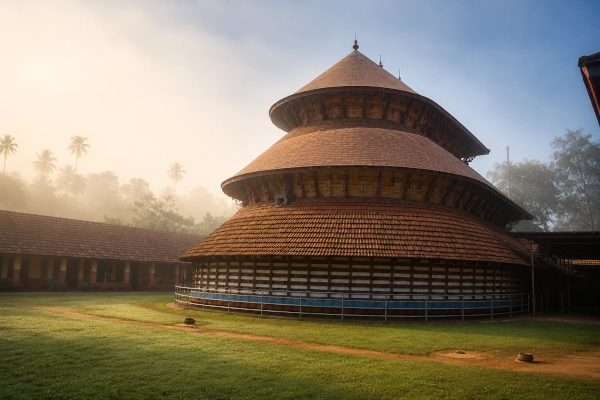
Madhur Anantheshwara Vinayaka Temple, officially known as Sree Madanantheshwara Siddhivinayaka Temple, is one of the most important pilgrimage centres in Kasaragod district. Situated beside the Madhuvahini, the local name for the Mogral River, the temple is admired for its powerful Ganapathi tradition, ancient Shiva worship and distinctive architecture shaped by the cultural heritage of northern Kerala and the neighbouring Tulu region.
The shrine lies about seven to eight kilometres east of Kasaragod town. Although it is widely known as Madhur Ganapathi Temple, the principal deity is Lord Shiva, worshipped as Madanantheshwara or Anantheshwara. Lord Siddhivinayaka, however, has become the temple’s most famous and widely revered presence.
Lord Madanantheshwara and Siddhivinayaka
The central sanctum is dedicated to Lord Shiva. Temple tradition associates the Shiva linga with a woman named Madaru, from whom the place is believed to have derived the name Madhur.
Alongside the Shiva shrine stands the celebrated image of Siddhivinayaka. Over time, devotion to Ganapathi became so prominent that the temple came to be popularly known as Madhur Ganapathi Temple or Madhur Vinayaka Temple.
Devotees approach Siddhivinayaka as the remover of obstacles and the giver of success, intelligence and prosperity. The temple is especially popular among families praying before the beginning of education, marriage, journeys, business ventures and other important undertakings.
Legend of the Growing Ganapathi Image
The best-known temple legend concerns the origin of the Siddhivinayaka image. According to local tradition, a young boy belonging to a priestly family drew an image of Ganapathi on one of the temple walls while playing.
The drawing is believed to have gradually assumed a living divine form and begun increasing in size. Tradition holds that the growing image became so large that it appeared capable of breaking through the roof. A priest then touched or restrained it with a sacred object, after which the image stopped growing vertically.
The idol is consequently believed to have continued expanding sideways. This unusual form contributes greatly to the temple’s fame and gives the Madhur Siddhivinayaka shrine a distinctive identity among the Ganapathi temples of Kerala.
The account forms part of the temple’s sacred oral tradition rather than documented architectural history, yet it remains central to the faith of devotees.
Connection With Tipu Sultan
Another widely repeated tradition links the temple with Tipu Sultan’s military campaigns in northern Kerala. According to the story, Tipu intended to damage or destroy the temple during his advance through the region.
Before entering the shrine, he drank water from the temple well. The experience is said to have changed his mind, leading him to spare the temple. A mark traditionally associated with his sword is sometimes pointed out within the temple complex.
This account survives primarily through local tradition. It demonstrates how the temple’s history has been woven together with the political memory of Kasaragod and the wider Malabar region.
Architecture of the Temple
Madhur Temple is especially admired for its unusual architectural form. Its prominent three-tiered roof rises above the temple complex and creates a striking profile against the surrounding greenery and river landscape.
The shrine combines elements of Kerala temple architecture with influences associated with the Tulu-speaking cultural region immediately north of Kasaragod. The sloping roofs, timber framework, carved pillars, enclosed courtyard and layered superstructure reflect architectural traditions adapted to the heavy monsoon climate of the western coast.
The roof is covered with copper plates, while the wooden components contain carefully executed carvings. Decorative figures, mythological scenes and traditional motifs appear across the pillars, beams and mandapams.
The temple’s architecture appears massive and fortified when viewed from outside, while its inner spaces have the intimate atmosphere characteristic of traditional Kerala shrines.
The Namaskara Mandapam
The Namaskara Mandapam is among the most notable architectural features of the temple. Its timber ceiling and structural members display intricate carvings, including episodes and figures associated with Hindu sacred tradition.
The mandapam stands before the principal sanctum and forms an important part of the temple’s ritual arrangement. The skilled woodwork illustrates the high standard of craftsmanship supported by the temple’s former patrons.
Such carved wooden halls were both sacred spaces and expressions of the artistic traditions of northern Kerala.
The Temple and the Kumbla Rulers
The temple is historically associated with the rulers of Kumbla, whose territory once extended across parts of present-day Kasaragod. These rulers are believed to have supported the construction, renovation and ritual life of the shrine.
Kasaragod historically stood at the meeting point of Kerala and coastal Karnataka. This position allowed Malayalam, Tulu, Kannada, Konkani and Sanskrit traditions to interact closely.
Madhur Temple reflects this cultural meeting. Its worship, festivals, architecture and community traditions cannot be understood solely within the boundaries of modern Kerala, since the shrine has long attracted devotees from both Kerala and Karnataka.
Appam as the Famous Offering
One of the best-known offerings at Madhur Temple is appam, a sweet preparation made using rice, jaggery and other ingredients. It is offered to Lord Siddhivinayaka and later distributed as prasadam.
The offering is closely associated with Ganapathi worship and is particularly sought by devotees visiting the temple. Families often make the offering after the fulfilment of a prayer or before beginning an important stage in life.
The temple’s appam prasadam has become one of its strongest cultural associations, much as particular foods are linked with other major pilgrimage centres of Kerala.
Udayasthamana Puja
Udayasthamana Puja is among the temple’s important offerings. The expression refers to a complete sequence of worship conducted from sunrise until sunset.
The elaborate observance includes a series of pujas and ritual offerings performed throughout the day on behalf of a devotee or family. It is generally undertaken in fulfilment of a vow, as an expression of gratitude or as a prayer for prosperity and relief from difficulties.
Because such offerings may require advance booking and are subject to the temple calendar, devotees should contact the temple administration before planning them.
Moodappam Seva
The temple is especially renowned for Moodappam Seva, a rare and elaborate offering in which the Ganapathi image is covered with a very large quantity of appam.
The ritual demands extensive preparation and community participation. Because of the scale of the offering, it is conducted only on special occasions rather than as a routine daily ceremony.
Moodappam symbolises abundance, fulfilment and complete surrender to Lord Ganapathi. It is one of the practices that distinguishes Madhur from most other Ganapathi shrines.
Major Festivals
The annual festival is one of the most important events in the temple calendar. It generally extends over several days and includes special pujas, processions, traditional music, cultural programmes and community participation.
Ganesh Chaturthi, also known regionally as Vinayaka Chaturthi, is celebrated with particular devotion because of the temple’s association with Siddhivinayaka.
Maha Shivaratri is equally significant because Lord Madanantheshwara remains the principal deity of the temple.
Other important occasions include Vishu, Navaratri and special observances connected with the Malayalam and regional temple calendars. Festival dates vary each year and should be checked through the temple’s official announcements.
The Madhuvahini Riverside Setting
The temple stands on the banks of the Mogral River, locally called the Madhuvahini. The riverside setting contributes greatly to its calm and sacred atmosphere.
The temple’s tiled roofs, copper-covered superstructure and old timber halls appear especially striking against the river, coconut trees and dense vegetation of Kasaragod.
The river has historically supported ritual activities and everyday life in Madhur village. During the monsoon, the surrounding landscape becomes particularly lush, though visitors should be prepared for heavy rain and slippery surfaces.
A Meeting Point of Kerala and Tulu Traditions
Madhur Temple represents the cultural character of Kasaragod more clearly than many other monuments in the district. Kasaragod lies at Kerala’s northern edge and has long been shaped by interaction with the Tulu Nadu region.
The shrine consequently attracts Malayalam-, Kannada- and Tulu-speaking devotees. Its architectural form, local legends, ceremonial vocabulary and traditional patronage reflect this shared cultural zone.
The temple demonstrates how sacred traditions often developed across linguistic and political boundaries rather than within them.
Temple Timings
The temple is generally open during the morning and evening, with a break around midday. Timings may change during festivals, special rituals and renovation work.
Visitors should consult the official temple timings page before travelling, particularly when planning a specific offering or arriving from a distant location.
Traditional dress and respectful conduct are expected. Photography may be restricted in the inner parts of the temple, and visitors should follow the directions of temple officials.
Best Time to Visit
The period from October to March generally provides comfortable weather for visiting Kasaragod. The post-monsoon landscape is green, while temperatures are usually more pleasant than during the peak summer months.
Ganesh Chaturthi and the annual temple festival offer an opportunity to witness the shrine at its most vibrant. Ordinary weekdays are better suited to visitors seeking quieter darshan and time to appreciate the architecture.
Early morning is particularly atmospheric, while evening visits allow devotees to experience the temple under the light of traditional lamps.
How to Reach Madhur Temple
Madhur Temple is located approximately seven to eight kilometres from Kasaragod town and is easily accessible by road.
By road: Buses, taxis and autorickshaws operate between Kasaragod and Madhur. The journey from the town centre usually takes around 20 to 30 minutes, depending on traffic and the chosen route.
By rail: Kasaragod Railway Station is the nearest major railhead. It is connected with Mangaluru, Kannur, Kozhikode, Kochi, Thiruvananthapuram and major cities elsewhere in India. Taxis and autorickshaws are available from the station.
By air: Mangaluru International Airport is the nearest major airport and lies across the Kerala–Karnataka border. Kannur International Airport is another option, particularly for travellers arriving from other parts of Kerala or from Gulf destinations.
Visitors may combine the temple journey with nearby attractions such as Ananthapura Lake Temple, Malik Deenar Mosque, Chandragiri Fort, Bekal Fort and the beaches of Kasaragod.
A Sacred Landmark of Northern Kerala
Madhur Anantheshwara Vinayaka Temple is more than a popular Ganapathi shrine. It is a major expression of Kasaragod’s religious, architectural and cultural history.
Its Shiva sanctum, growing Ganapathi legend, three-tiered roof, celebrated appam offering and riverside location give the temple a unique character. The shrine also represents the deep historical ties between northern Kerala and the Tulu-speaking coastal region.
For devotees, Madhur is a place where obstacles are placed before Siddhivinayaka and prayers are offered to Madanantheshwara. For travellers interested in heritage, it provides one of the finest introductions to the distinctive temple culture of Kerala’s northernmost district.
Reference
- Kerala Tourism, Government of Kerala.
“Madhur Anantheshwara Vinayaka Temple, Kasaragod.”
https://www.keralatourism.org/temples/kasaragod/madhur-anantheshwara-vinayaka-temple-kasaragod - Kerala Tourism, Government of Kerala.
“Madhur Temple in Kasaragod.”
https://www.keralatourism.org/malabar/destination_detailed_view/madhur-temple/158 - Kerala Tourism, Government of Kerala.
“Madhur Temple or Sree Madanantheswara Sidhivinayaka Temple.”
https://www.keralatourism.org/destination/madhur-temple-kasaragod/504/ - District Tourism Promotion Council, Kasaragod.
“Madhur Sree Madanantheshwara Siddhivinayaka Temple.”
https://www.dtpckasaragod.com/destination/madhur-temple - Sree Madanantheshwara Siddhivinayaka Temple.
Official Website.
https://madhurtemple.in/ - Sree Madanantheshwara Siddhivinayaka Temple.
“History.”
https://madhurtemple.in/history/ - Sree Madanantheshwara Siddhivinayaka Temple.
“Timings.”
https://madhurtemple.in/timings/ - Kasaragod District Administration, Government of Kerala.
“Places of Interest.”
https://kasargod.nic.in/en/places-of-interest/
You may also like
-
Kamarupa — The Historic Kingdom of the Brahmaputra Valley and the Eastern Himalayas
-
Bharat Vandana Park: Delhi’s ‘Mini India’ Brings the Nation’s Heritage Together in One Landscape
-
Pragjyotisha — Bhagadatta’s Kingdom of the Brahmaputra Valley
-
Samatata — The Low-Lying Deltaic Realm of Southeastern Bengal
-
Tamralipta — The Maritime Gateway of the Lower Ganga
