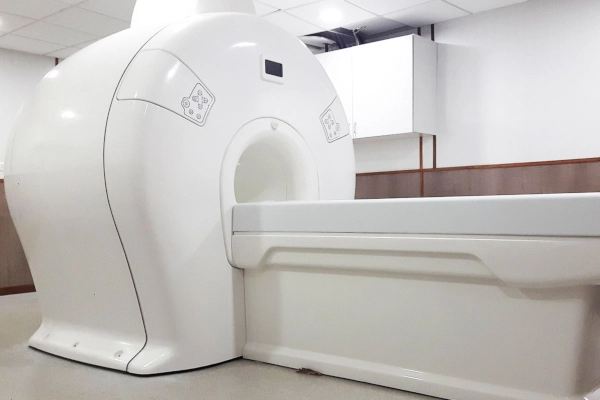
India’s effort to build advanced medical equipment domestically has achieved an important breakthrough with the development of an indigenous 1.5-Tesla magnetic resonance imaging scanner.
Developed by Bengaluru-based Voxelgrids Innovations Private Limited, the compact, full-body MRI system represents a significant step towards reducing India’s dependence on imported diagnostic-imaging equipment. The scanner has been designed for both stationary installations and mobile deployment, potentially allowing high-quality MRI services to reach hospitals and diagnostic centres outside the country’s largest cities.
Unlike simpler medical devices that can be assembled from imported components, an MRI scanner requires expertise across superconducting magnets, radio-frequency engineering, gradient coils, image reconstruction, signal processing, embedded electronics, patient-handling systems and clinical software.
The development of a home-grown MRI platform therefore marks the emergence of deeper Indian capabilities in high-precision medical technology.
India’s First Commercially Licensed Indigenous MRI Scanner
The Voxelgrids system was formally launched in New Delhi in August 2023 as India’s first indigenously developed, affordable, lightweight and high-field 1.5-Tesla MRI scanner.
According to the Department of Biotechnology, the system was also the first MRI scanner developed by an Indian company to receive a commercial sale and manufacturing licence from the Central Drugs Standard Control Organisation.
The company describes its first deployed product as a compact and lightweight full-body 1.5-Tesla scanner suitable for stationary as well as mobile configurations. It has been engineered to operate under demanding installation conditions while producing images required for clinical diagnosis.
A 1.5-Tesla magnetic field strength is widely used for routine clinical MRI examinations, including imaging of the brain, spine, joints, abdomen, blood vessels and several soft-tissue structures.
MRI provides detailed anatomical images without using the ionising radiation associated with X-rays and computed tomography. Its ability to differentiate between different types of soft tissue makes it especially valuable in neurology, orthopaedics, oncology, cardiac care and several other medical disciplines.
Government and Startup Collaboration
The scanner was developed with support from the National Biopharma Mission of the Department of Biotechnology, implemented through the Biotechnology Industry Research Assistance Council.
Approximately ₹17 crore was spent on developing the system, of which ₹12 crore was provided by the Department of Biotechnology through BIRAC. The remaining development effort involved the company, its technical partners and the broader medical-innovation ecosystem.
Voxelgrids also received incubation and development support from the Foundation for Innovation and Social Entrepreneurship of Tata Trusts.
The project demonstrates how government research funding, private engineering talent, clinical partnerships and technology incubation can be combined to produce commercially relevant medical equipment within India.
Rather than limiting support to laboratory research, the programme helped the company move through product development, engineering, testing, regulatory approval and commercialisation.
Building the Complete MRI Technology Stack
MRI systems are among the most technologically complex devices used in modern hospitals.
The scanner must generate a strong and highly stable magnetic field around the patient. Gradient coils then produce controlled variations in that field, while radio-frequency coils transmit signals into the body and receive the resulting electromagnetic responses.
Those signals must be rapidly processed and reconstructed into medically useful images.
Voxelgrids lists its areas of development as including 1.5-Tesla superconducting MRI magnets, gradient coils, high-density radio-frequency antennas, body coils, spectrometers, transmit-and-receive chains, patient-handling systems, pulse sequences, embedded software and image-reconstruction platforms.
This systems-level approach is important because genuine technological self-reliance requires control over more than the external structure of the machine.
Long-term domestic capability depends on Indian companies developing expertise in magnets, electronics, software, coils, signal-processing algorithms, cooling systems, safety architecture, testing and maintenance.
Compact Design for Difficult Locations
Traditional high-field MRI scanners are large, heavy and expensive to install.
Hospitals may require structural reinforcement, specialised electrical systems, magnetic shielding, cooling equipment and carefully designed rooms before a scanner can begin operating. These requirements can make installation difficult for smaller hospitals and medical centres.
Voxelgrids developed its scanner around a more compact and lightweight architecture. The company says the product can operate in challenging installation environments and can be configured for mobile use.
Tata Trusts stated during the development phase that the scanner was designed to consume less power and could be mounted on a vehicle, creating the possibility of taking high-field MRI services to smaller towns and remote regions. It also reported that the technology was designed to accelerate imaging compared with conventional systems.
A mobile MRI platform could be particularly valuable for regional cancer-screening programmes, neurological examinations, medical camps, disaster-response operations and hospitals that cannot immediately justify the cost of a permanently installed scanner.
Addressing India’s Dependence on Imported Equipment
India has historically depended heavily on multinational manufacturers for advanced radiology equipment.
This dependence affects not only the initial purchase price but also the cost of installation, software licences, replacement components, servicing and long-term maintenance.
Imported equipment can also expose hospitals to exchange-rate fluctuations and delays in obtaining specialised components.
The government stated at the launch of the indigenous scanner that domestic manufacturing could reduce capital expenditure, lower the cost of MRI examinations and save foreign exchange.
A locally engineered MRI platform could also provide Indian hospitals with faster access to technical support, locally produced spare parts and software adapted to domestic clinical requirements.
These advantages will ultimately depend on manufacturing scale, clinical performance, service quality, component localisation and the ability to maintain machines reliably over many years.
Potential to Make MRI Scans More Affordable
The high cost of MRI equipment is one reason the technology remains concentrated in major hospitals and urban diagnostic centres.
Smaller institutions must consider not only the scanner’s purchase price but also building modifications, electricity consumption, specialist staffing, cooling, maintenance and annual service agreements.
An affordable Indian MRI system could reduce several of these barriers.
Lower equipment and operating costs could enable more district hospitals, charitable institutions, cancer centres and independent diagnostic facilities to introduce MRI services.
Increased availability may also improve competition among diagnostic centres and reduce the distance patients must travel for advanced scans.
The government expects indigenous manufacturing to help lower the cost of MRI examinations while making the technology accessible to a wider section of the population.
A Parallel National Mission Led by SAMEER
Voxelgrids is not India’s only indigenous MRI initiative.
The Ministry of Electronics and Information Technology is supporting a separate Indigenous Magnetic Resonance Imaging National Mission led by the Society for Applied Microwave Electronics Engineering and Research.
SAMEER is working with C-DAC centres in Thiruvananthapuram and Kolkata, the Inter-University Accelerator Centre in New Delhi and the Dayananda Sagar medical-imaging research centre in Bengaluru.
The programme is developing another indigenous 1.5-Tesla MRI system, including radio-frequency amplifiers, switches, spectrometers, coils, receiver systems, control electronics, patient couches, imaging software and superconducting magnet technologies.
Animal trials had been completed by March 2025, while AIIMS New Delhi entered into an agreement with SAMEER to assist with clinical validation, artificial-intelligence-based image enhancement, accelerated imaging and future development of high- and low-field MRI systems.
The existence of multiple Indian MRI programmes is significant. Competition and collaboration between startups, research laboratories, hospitals and established manufacturers could create a broader domestic supply chain rather than dependence on a single product.
Medical-Device Manufacturing Gains Momentum
India’s MRI development is part of a wider expansion in domestic medical-device manufacturing.
The government’s Production Linked Incentive Scheme for Medical Devices has an outlay of ₹3,420 crore and covers radiology, medical imaging, cancer-care equipment, implants and several other high-value product categories.
As of July 2026, 27 applications had been approved under the programme, including 14 involving MSMEs. Approved projects had reported investments of ₹1,153.07 crore and had begun domestic production of equipment including MRI and CT systems, linear accelerators, mammography units, C-arms and ultrasound machines.
This emerging ecosystem could support the localisation of electronics, magnets, specialised metals, medical software, precision components, testing facilities and maintenance services.
It could also help Indian companies move from assembly and contract manufacturing towards ownership of complete product designs and intellectual property.
Opportunities Beyond the Indian Market
Affordable MRI equipment is required across many developing countries where access to advanced diagnostic imaging remains limited.
A compact system designed for lower power consumption, difficult installation conditions and mobile deployment could have applications across South Asia, Africa, Southeast Asia, Latin America and other regions facing similar infrastructure constraints.
The government has identified the indigenous MRI scanner as a potential “Made in India, Made for the World” product that could eventually serve countries in the Global South.
Export success, however, will require internationally recognised certifications, a strong distribution network, trained service engineers, dependable spare-parts availability and extensive evidence of clinical reliability.
A Major Step Towards Healthcare Self-Reliance
The indigenous MRI scanner represents more than the domestic production of a single hospital machine.
It demonstrates that Indian engineers and scientists can work across superconducting magnet technology, radio-frequency systems, precision electronics, imaging software and clinical integration to develop one of the most sophisticated diagnostic devices used in healthcare.
The larger challenge will be to convert this technological achievement into sustained industrial capacity.
India will need to expand production, improve component localisation, build service networks, complete extensive clinical validation and ensure that domestically manufactured scanners remain reliable throughout their operational lives.
Successful scale-up could reduce import dependence, lower the cost of advanced diagnostics and bring MRI services closer to patients in smaller cities and underserved regions.
The Made-in-India MRI scanner is therefore an important milestone in India’s transition from being primarily a buyer of sophisticated medical equipment to becoming a developer, manufacturer and potential exporter of advanced healthcare technologies.
Reference Sources
Press Information Bureau, Ministry of Science and Technology — Launch of India’s first indigenously developed 1.5-Tesla MRI scanner, August 1, 2023.
Press Information Bureau, Ministry of Electronics and Information Technology — AIIMS New Delhi and SAMEER collaboration on indigenous MRI technology, March 25, 2025.
Press Information Bureau, Department of Pharmaceuticals — High-precision medical instruments and domestic medical-device manufacturing, July 24, 2026.
Voxelgrids Innovations — Official MRI technology and product information.
Tata Trusts Foundation for Innovation and Social Entrepreneurship — Development of the compact 1.5-Tesla MRI scanner.
You may also like
-
India’s Economic Warfare Challenge: Strategic Autonomy, Energy Security and the Rise of a Global Power
-
India-US Trade Deal Stalemate: Why Washington’s Tariff Pressure Has Failed to Secure an Agreement
-
US Double Standards in Foreign Policy: 16 Recent Cases Involving India, Russia, China and Global Trade
-
India’s Arctic Energy Ambitions: Russian Oil, LNG and a New Sea Route to Indian Ports
-
India and Russia Explore Joint Icebreaker Construction as Maritime Industrial Cooperation Expands
