In a significant step toward advancing clean energy technologies, scientists have developed a new class of polymeric materials that could enhance both energy storage and the production of green hydrogen. The materials, known as Zn(DAB) and Cd(DAB), have demonstrated high efficiency, durability, and scalability, making them strong candidates for next-generation energy solutions.
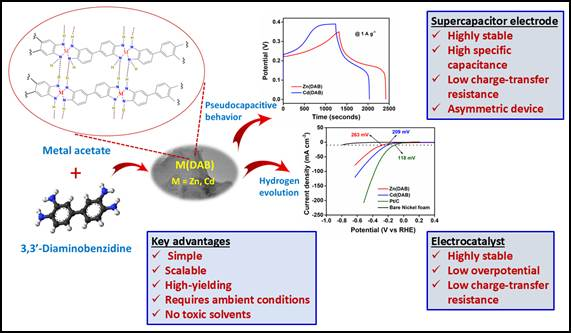
The materials are coordination polymers formed by combining zinc (Zn²⁺) or cadmium (Cd²⁺) ions with organic molecules of 3,3′-diaminobenzidine (DAB). These components naturally assemble into layered, structurally stable frameworks. One of their key advantages is ease of production — they can be synthesized in large quantities using a simple room-temperature process, without requiring complex equipment or high energy input, making them suitable for large-scale applications.
The research was carried out by a team from the Centre for Nano and Soft Matter Sciences (CeNS), an autonomous institute under the Department of Science and Technology (DST), in collaboration with CHRIST (Deemed to be University), Bengaluru. The team evaluated the materials for performance in two critical clean energy areas: energy storage and hydrogen generation.
In laboratory tests, both materials showed exceptional energy storage capacity. Zn(DAB) achieved 2091.4 F g⁻¹, while Cd(DAB) reached 1341.6 F g⁻¹ under standard testing conditions. Even in more practical configurations, such as asymmetric supercapacitors, the materials maintained strong performance, with Zn(DAB) recording 785.3 F g⁻¹ and Cd(DAB) 428.5 F g⁻¹. The materials also demonstrated durability, retaining a significant portion of their energy capacity after 5,000 charge-discharge cycles.
Beyond storage, the materials also showed strong potential in green hydrogen production through electrocatalytic water splitting. They required relatively low overpotential — 263 mV for Zn(DAB) and 209 mV for Cd(DAB) — indicating high efficiency compared to existing materials. This could make hydrogen production more energy-efficient and cost-effective, supporting broader adoption of clean fuel technologies.
Researchers highlighted that the dual functionality of these materials — combining high-performance energy storage with efficient hydrogen generation — makes them particularly promising in the transition toward sustainable energy systems. Such innovations could help bridge the gap between laboratory research and real-world clean energy deployment.
The findings, authored by Samika Anand, Abhishek Kumar, Dr. C. V. Yelamaggad, and Dr. Sunaja Devi K. R., have been published in leading scientific journals, including ACS Omega and Catalysis Science and Technology, underscoring the growing importance of coordination polymers in future energy applications.
Source: PIB
You may also like
-
Molecular Geometry Tweak Opens New Way for Smart Biomaterials
-
IISc Scientists Show How Strong Magnetic Fields Could Allow White Dwarfs to Exceed Chandrasekhar Limit
-
IIT Madras to Launch Global Mission to Map 100 Human Brains in 3D
-
3,898 Indian Scientists Feature in 2026 Global Top 2% Research Database; IISc Leads Indian Institutions
-
New Metal-free Porous Material can Help Produce Affordable Clean Energy
