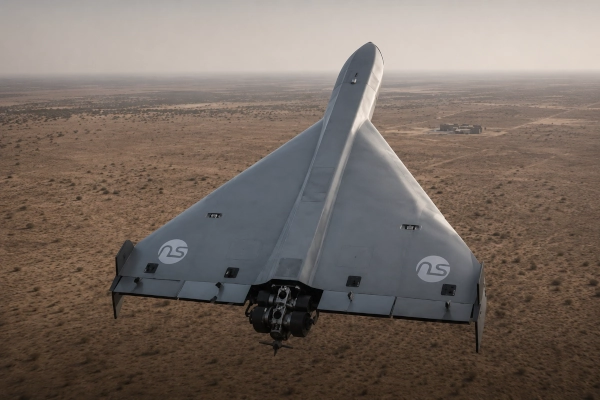
Bengaluru-based NewSpace Research and Technologies (NRT) has successfully conducted the first test trial of an indigenous Rocket-Assisted Take-Off (RATO) booster for its Sheshnag-150 long-range loitering munition, marking another technological achievement in India’s expanding unmanned aerial systems industry.
The company announced the successful demonstration in October 2026, congratulating its GryphonWorks engineering team for developing and testing the booster entirely in India. NewSpace described the achievement as a first for India’s indigenously designed and manufactured long-range one-way attack drone category.
The development represents progress towards providing the Sheshnag-150 with runway-independent launch capabilities, enabling greater flexibility in deploying indigenous long-range unmanned strike platforms.
Indigenous RATO Booster Successfully Tested
According to NewSpace Research and Technologies, its GryphonWorks team successfully completed the first test trial of a Rocket-Assisted Take-Off booster integrated with the Sheshnag-150 platform.
The company highlighted the development as an important step in the Sheshnag-150 programme, which has progressed through its maiden flight, long-range trials and now rocket-assisted launch testing.
RATO technology employs an additional rocket booster to generate thrust during the initial launch phase of an aircraft. For unmanned platforms, this approach can reduce dependence on conventional runways by providing the acceleration required to initiate flight.
NewSpace stated that the successful demonstration establishes progress towards more flexible launch arrangements for long-range one-way attack drones. The company also emphasised that the technology was designed, manufactured and tested domestically by its private-sector engineering team.
Runway-Independent Launching Expands Operational Flexibility
One of the principal advantages of rocket-assisted launching is the ability to operate unmanned aerial platforms without relying on established airfields.
Conventional runway-dependent aircraft require suitable infrastructure for take-off, which can restrict deployment options. RATO technology provides an alternative by enabling an aircraft to achieve the necessary initial acceleration using an auxiliary propulsion system.
NewSpace highlighted runway independence as a major objective of the Sheshnag-150 booster development programme. The company stated that this capability could support faster launch cycles and more flexible deployment from dispersed locations.
Such flexibility is particularly relevant to long-range unmanned aircraft intended to operate from different geographical environments. The technology can also reduce dependence on dedicated runway infrastructure while allowing developers to explore more compact launch arrangements.
The successful booster test represents an important developmental step towards these capabilities.
Sheshnag-150 Designed for Long-Range Autonomous Strike Missions
The Sheshnag-150 is an indigenous long-range one-way attack unmanned aerial vehicle developed by NewSpace Research and Technologies as part of its Sheshnag family of autonomous swarming systems.
The company unveiled the platform at Aero India 2025, introducing it as a long-range unmanned strike system designed to conduct coordinated missions using intelligent swarm technologies.
According to NewSpace’s official product announcements, the Sheshnag-150 has been designed for an operational range exceeding 1,000 kilometres and an endurance of more than five hours. These are developer-stated capabilities rather than independently verified operational performance figures.
The platform forms part of the company’s Fused Teaming with Uncrewed Rapid Effects (FUTURE) initiative, which focuses on developing coordinated unmanned aerial systems capable of operating collectively.
NewSpace has also identified its proprietary MOSAIC intelligent software suite as a key component of the Sheshnag-150 programme. The software is intended to support autonomous coordination and collaborative operations between multiple unmanned platforms.
Sheshnag-150 Programme Advances Through Flight Testing
The RATO demonstration follows earlier developmental achievements involving the Sheshnag-150.
In February 2025, NewSpace announced the maiden flight of the indigenous long-range strike UAV. According to the company, the aircraft successfully engaged a designated ground target during the terminal phase of its flight, demonstrating a reported circular error probable of five metres.
The company subsequently continued developing the platform’s long-range and autonomous capabilities as part of its broader programme for intelligent unmanned systems.
NewSpace has designed the Sheshnag family around distributed autonomy, enabling multiple aerial platforms to coordinate their activities through a common intelligent control architecture.
The latest RATO trial expands the programme’s developmental focus beyond flight performance and autonomous capabilities to include more flexible methods of launching long-range unmanned aircraft.
Swarm Technology Forms the Foundation of the Sheshnag Family
The Sheshnag-150 belongs to a wider family of indigenous unmanned aerial systems developed by NewSpace Research and Technologies.
According to the company, the Sheshnag series includes the SN-20, SN-50 and SN-150, representing different operational range categories.
The systems are being developed around autonomous coordination, allowing multiple unmanned platforms to share mission information and operate collaboratively.
NewSpace has described this approach as decentralised swarming, in which individual aerial vehicles function as coordinated elements within a larger autonomous network.
The company draws inspiration for the Sheshnag name from the multi-headed serpent associated with Indian tradition, using the concept to represent multiple autonomous platforms operating through coordinated intelligence.
The technology forms part of NewSpace’s broader work in intelligent unmanned aerial systems, advanced autonomous control and collaborative aerospace platforms.
Indigenous Defence Innovation Supports Aatmanirbhar Bharat
NewSpace Research and Technologies identified the successful RATO demonstration as an achievement aligned with India’s Aatmanirbhar Bharat and Make in India initiatives.
The company emphasised that the booster technology was developed and tested in India by an Indian private-sector engineering team, demonstrating the growing capabilities of domestic defence technology enterprises.
India’s expanding unmanned aerial systems industry is increasingly developing indigenous capabilities in autonomous navigation, propulsion, flight-control systems, intelligent coordination and specialised aerospace technologies.
The successful integration and testing of supporting technologies such as RATO boosters can strengthen the domestic development ecosystem for advanced unmanned aircraft.
For NewSpace, the achievement reflects continued investment in indigenous research and engineering aimed at developing advanced aerospace systems for India’s defence requirements.
NewSpace Advances India’s Long-Range Unmanned Aerial Capabilities
The successful RATO booster trial represents another milestone in the development of the Sheshnag-150 long-range loitering munition.
By progressing from initial flight demonstrations to long-range testing and rocket-assisted launch technology, NewSpace is expanding the technological capabilities associated with its indigenous unmanned strike platform.
The development also highlights the increasing contribution of Indian private-sector companies to advanced defence research, autonomous systems and aerospace engineering.
As NewSpace continues developing the Sheshnag family, advances in autonomous coordination, propulsion and flexible launch technologies will contribute to India’s growing indigenous unmanned aerial systems capabilities and strengthen the country’s defence technology ecosystem.
References
- NewSpace Research and Technologies — Official Company Announcement, October 2026: Successful RATO Booster Trial on Sheshnag-150 — NewSpace Official LinkedIn
- NewSpace Research and Technologies — Official Announcement, February 2025: Sheshnag-150 Maiden Flight and Precision Strike Demonstration
- NewSpace Research and Technologies — Aero India 2025: Sheshnag-150 Swarming Attack System and MOSAIC Autonomous Technology
- NewSpace Research and Technologies — Official Company Website: Indigenous Unmanned Aerospace Systems and Advanced Autonomous Technologies
- NewSpace Research and Technologies — Official Technical Overview: Sheshnag Family of Autonomous Swarming Unmanned Systems
You may also like
-
Gopalan Aerospace Hosts Czech Delegation, Signs Five MoUs to Strengthen Aerospace and Defence Cooperation
-
Picraft Technology Successfully Tests Indigenous Swarm Drones at 16,500 Feet in Ladakh
-
India’s Space Economy Set to Reach $45 Billion as Private Investment Accelerates
-
Solar Industries to Acquire Sivasakthi Industrial Explosives for ₹115 Crore, Expands Manufacturing Business
-
India and Vietnam Strengthen Counter-Terrorism and Cybersecurity Cooperation at 4th Security Dialogue in New Delhi
