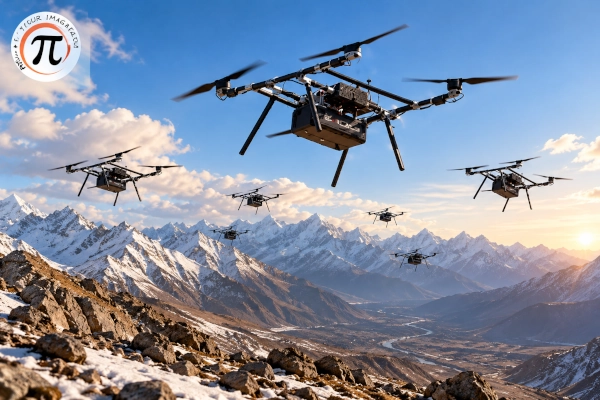
Indian defence technology startup Picraft Technology Pvt. Ltd. has reportedly completed successful trials of its indigenous swarm drone technology at an altitude of approximately 16,500 feet in Ladakh, marking progress in the development of autonomous unmanned aerial systems for challenging military environments.
The Dehradun-based company announced the high-altitude demonstration, which was reported on October 17, 2026. The trials highlight the growing capabilities of Indian defence startups in developing indigenous drone technologies capable of operating in extreme mountainous conditions.
The achievement is particularly relevant to India’s efforts to develop reliable unmanned aerial platforms for surveillance, reconnaissance and other specialised applications along its Himalayan frontiers.
Indigenous Swarm Drone Technology Tested in Ladakh
According to reports based on the company’s announcement, Picraft Technology successfully evaluated its swarm drone system during trials conducted at approximately 16,500 feet in Ladakh. The demonstration focused on the operation of coordinated unmanned aerial platforms in an environment characterised by reduced atmospheric density, low temperatures and difficult terrain.
Swarm drone technology enables multiple unmanned aerial vehicles to operate collectively through coordinated navigation, communication and control systems. Unlike conventional drones that function independently, swarm systems can share information, maintain coordinated flight patterns and perform assigned tasks as a group. Such capabilities are particularly useful for missions requiring wider surveillance coverage, distributed reconnaissance and coordinated aerial operations.
The reported trials demonstrate Picraft’s efforts to develop indigenous autonomous systems suited to India’s demanding geographical and operational requirements. They also provide an opportunity to evaluate the performance of drone technologies in conditions significantly different from those encountered at lower elevations.
Overcoming the Challenges of High-Altitude Drone Operations
Operating drones at an altitude of 16,500 feet presents considerable engineering challenges because atmospheric conditions directly affect flight performance. Lower air density reduces the lift generated by propellers, placing additional demands on propulsion systems and power management. Extremely low temperatures can also influence battery efficiency, electronic components and overall flight endurance.
Mountainous regions introduce further complications through unpredictable winds, rapidly changing weather conditions and difficult communication environments. Maintaining reliable navigation and coordination becomes especially important when several drones operate simultaneously as part of a swarm.
High-altitude trials help developers assess these challenges and refine propulsion efficiency, flight-control algorithms, communication reliability and autonomous coordination. Such evaluations are essential for developing unmanned aerial systems capable of supporting sustained operations in demanding Himalayan environments.
Picraft Technology Expands Indigenous Defence Drone Development
Picraft Technology is a Dehradun-based enterprise engaged in the development of autonomous aerial systems and advanced defence technologies. The company has been working on artificial intelligence-enabled drone platforms intended to address emerging requirements in unmanned military operations.
In April 2026, Picraft announced the successful pilot testing of an AI-powered autonomous First Person View (FPV) kamikaze drone system in collaboration with the Indian Army’s Dogra Regiment. According to the company, the demonstration evaluated autonomous target acquisition and precision terminal engagement capabilities.
The earlier FPV drone demonstration and the latest reported swarm drone trials represent separate technological developments within Picraft’s expanding unmanned aerial systems portfolio. Together, they reflect the company’s focus on autonomous navigation, coordinated operations and specialised defence applications.
The progress also illustrates the increasing role of Indian startups in developing technologies that complement the research and manufacturing capabilities of established defence organisations.
Swarm Drones Offer New Capabilities for Military Operations
Swarm drone technology is attracting increasing attention because coordinated unmanned aerial platforms can perform tasks that would otherwise require multiple independently controlled aircraft. By sharing information and coordinating their movements, these systems can improve operational flexibility and expand the area covered during reconnaissance and surveillance missions.
For military operations, swarm systems offer potential applications in battlefield observation, target identification, intelligence gathering and coordinated aerial missions. Their ability to operate as distributed networks can provide commanders with information from several locations simultaneously, improving situational awareness in complex environments.
Autonomous coordination also allows operators to supervise multiple drones without continuously controlling each aircraft individually. This capability becomes particularly valuable in mountainous regions, where difficult terrain can restrict visibility and conventional surveillance methods may face limitations.
The development of indigenous swarm technologies can therefore contribute to India’s broader efforts to strengthen unmanned reconnaissance and autonomous aerial capabilities.
High-Altitude Drone Technology Supports India’s Himalayan Defence Requirements
India’s extensive Himalayan frontiers present some of the world’s most demanding operating environments for military equipment. Troops deployed in these regions frequently encounter extreme temperatures, strong winds, difficult terrain and reduced atmospheric pressure, making reliable technological support essential.
Unmanned aerial systems designed for high-altitude operations can assist military units by improving observation capabilities and providing aerial information over areas that are difficult to access through conventional means. Coordinated drone platforms could further enhance these capabilities by covering multiple locations during a single mission.
The Indian Army has increasingly focused on evaluating indigenous unmanned aerial technologies for deployment in mountainous regions, including FPV drones and other specialised platforms. Developing systems capable of maintaining reliable performance at high elevations supports the larger objective of strengthening operational readiness through domestically developed technologies.
Picraft’s reported Ladakh trials contribute to this emerging technological ecosystem by evaluating autonomous drone capabilities under demanding environmental conditions.
Indigenous Defence Startups Strengthen Aatmanirbhar Bharat
The development of advanced unmanned aerial systems by companies such as Picraft Technology reflects the growing participation of private enterprises in India’s defence technology sector. Government initiatives promoting indigenous research, manufacturing and innovation have created opportunities for startups to develop specialised technologies for the armed forces.
Indian companies are increasingly working on autonomous navigation, artificial intelligence-based flight control, communication systems, propulsion technologies and coordinated drone operations. These capabilities are important for building a domestic supply chain capable of supporting advanced unmanned aerial platforms.
High-altitude demonstrations also provide valuable engineering experience that can help improve future designs and strengthen the technological capabilities of India’s defence industry. The combination of indigenous research, private sector innovation and operational testing is gradually expanding the country’s ability to develop specialised aerospace technologies.
India Advances Indigenous High-Altitude Drone Capabilities
Picraft Technology’s reported successful swarm drone trials at 16,500 feet in Ladakh represent another development in India’s expanding indigenous unmanned aerial systems industry. The demonstration highlights the potential of Indian startups to develop autonomous technologies for environments that present significant engineering and operational challenges.
Continued advances in swarm coordination, communication reliability, propulsion efficiency and high-altitude endurance can strengthen India’s capabilities in unmanned surveillance and other specialised defence applications.
With growing participation from domestic technology enterprises, India’s defence innovation ecosystem is steadily developing the expertise needed to support advanced autonomous systems while strengthening the country’s long-term technological self-reliance.
References
- Picraft Technology Pvt. Ltd. — Official Company Profile: Picraft Technology on LinkedIn
- AvioBlog — October 17, 2026: Picraft Validates Swarm Drone Technology at 16,500 Feet in Ladakh
- Picraft Technology — April 2026: Official Announcement of AI-Powered Autonomous FPV Drone Trials
- The Times of India — October 8, 2026: Indian Army’s Growing Focus on FPV Drones for Himalayan Operations
You may also like
-
NewSpace Successfully Tests Indigenous RATO Booster for Sheshnag-150 Long-Range Loitering Munition
-
India’s Space Economy Set to Reach $45 Billion as Private Investment Accelerates
-
Solar Industries to Acquire Sivasakthi Industrial Explosives for ₹115 Crore, Expands Manufacturing Business
-
India and Vietnam Strengthen Counter-Terrorism and Cybersecurity Cooperation at 4th Security Dialogue in New Delhi
-
GRSE Signs ₹1,032 Crore Contract with ONGC to Build Four Hybrid Platform Supply Vessels
