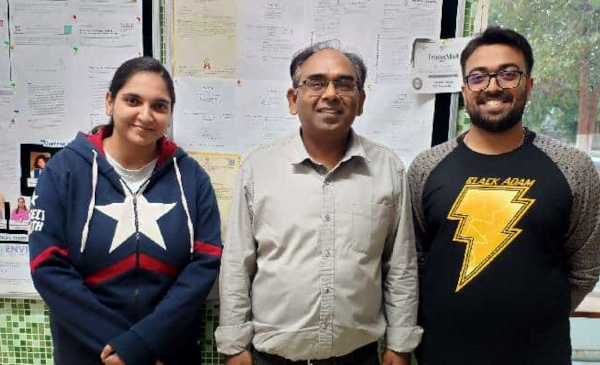
Researchers at the National Institute of Technology Rourkela have developed a novel bio-ink that could significantly advance the field of regenerative medicine. Designed for use in 3D bioprinting and tissue engineering, the innovation offers promising applications in repairing bone and cartilage, areas where natural healing is often limited. This breakthrough reflects India’s growing strength in next-generation healthcare technologies, particularly in personalised treatment and artificial tissue fabrication.
The research was led by Devendra Verma, along with research scholars Shreya Chrungoo and Tanmay Bharadwaj. The team has secured a patent for their invention, described as a high shape-fidelity protein-polysaccharide composite bio-ink. Their work addresses a key global challenge in bioprinting: the lack of materials that can combine structural strength, printability, and biological compatibility in a single system.
3D bioprinting is an emerging technology that enables scientists to create tissue-like structures layer by layer using living cells and supportive biomaterials. Unlike conventional 3D printing, which relies on plastics or metals, bioprinting attempts to replicate the architecture and function of human tissues. This opens the door to applications such as skin grafts, cartilage repair, bone scaffolds, and potentially even fully functional organs in the future. One of its most important advantages is the ability to produce patient-specific solutions, where tissues are customised based on an individual’s anatomy, improving treatment outcomes and reducing the risk of rejection.
A major bottleneck in this field has been the development of effective bio-inks. These materials must support living cells while maintaining their shape and integrity after printing. Many existing options fall short—some are easy to print but structurally weak, while others are strong but fail to support cell growth. Recognising this gap, the NIT Rourkela team engineered a new bio-ink by combining bovine serum albumin, sodium alginate, and gelatin–chitosan complexes. This formulation creates a bioactive material that not only prints with high precision but also mimics the natural environment surrounding cells, known as the extracellular matrix.
Laboratory testing has shown encouraging results. The bio-ink demonstrated strong mechanical properties, allowing printed structures to retain their shape, while also supporting high levels of cell survival—over 90% viability in certain compositions. It promotes cell attachment, growth, and overall biological activity, and shows potential for bone tissue formation and collagen production. These characteristics are crucial for creating functional tissue scaffolds that can integrate effectively within the human body.
The potential applications of this innovation are particularly significant for bone and cartilage repair. These tissues have limited capacity to heal on their own, especially in cases of severe injury, ageing, or degenerative conditions like arthritis. Bioprinted scaffolds made from advanced bio-inks can act as temporary frameworks, enabling new cells to grow and gradually regenerate natural tissue. Over time, such approaches could reduce dependence on traditional treatments like donor grafts or metal implants.
Looking ahead, the research team plans to conduct studies on animal models to further evaluate the safety and effectiveness of the bio-ink, followed by clinical trials in humans. If successful, this technology could play a transformative role in regenerative medicine and position India as a key contributor to global advances in biomedical innovation.
Source:
Image Courtesy: Express Health Care
The New Indian Express. “NIT Rourkela develops patented bio-ink for bone, cartilage repair.” (2026)
National Institute of Technology (NIT) Rourkela – Official Website
https://www.nitrkl.ac.in
You may also like
-
Molecular Geometry Tweak Opens New Way for Smart Biomaterials
-
ISRO’s Indo-French TRISHNA Satellite Enters Advanced Development Stage, Launch Expected in 2027–28
-
IISc Scientists Show How Strong Magnetic Fields Could Allow White Dwarfs to Exceed Chandrasekhar Limit
-
IIT Madras to Launch Global Mission to Map 100 Human Brains in 3D
-
3,898 Indian Scientists Feature in 2026 Global Top 2% Research Database; IISc Leads Indian Institutions
