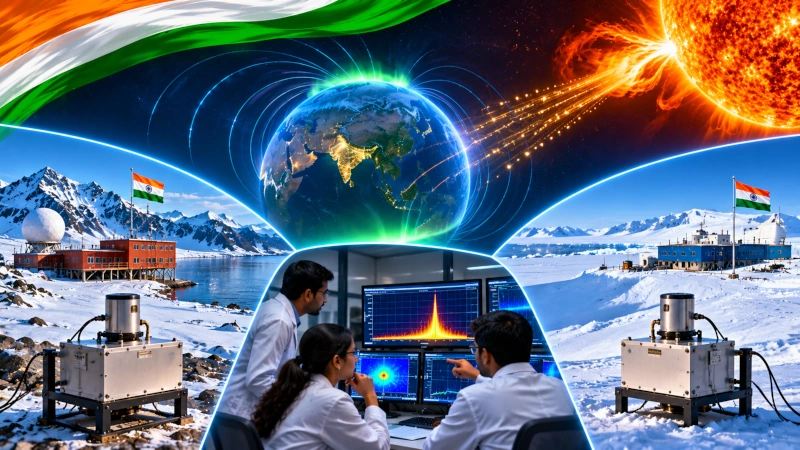
Scientists at the Indian Institute of Geomagnetism (IIG), Mumbai, have demonstrated a new method of detecting extreme solar particle events using gamma-ray detectors stationed in the Arctic and Antarctica. Announced by the Ministry of Earth Sciences on November 26, 2026, the findings establish the scientific potential of an alternative ground-based observation technique. The research could help expand international space-weather monitoring capabilities and improve understanding of interactions between the Sun and Earth.
Detecting Extreme Solar Particle Events
Powerful solar eruptions can accelerate charged particles, predominantly protons, to extremely high energies. When sufficiently energetic particles reach Earth and interact with atmospheric constituents, they generate secondary particles that can be detected by instruments operating at ground level. Such events, known as Ground-Level Enhancements (GLEs), represent some of the most energetic manifestations of solar activity.
The Indian research team investigated GLE #77, which occurred on November 11, 2025. The event was associated with an intense X-class solar flare, a rapidly propagating coronal mass ejection and a significant release of solar energetic particles. These observations provided researchers with an opportunity to examine the effectiveness of gamma-ray detectors in monitoring extreme space-weather phenomena.
India’s Polar Research Stations Enable Scientific Discovery
The Indian Institute of Geomagnetism deployed thallium-activated sodium iodide scintillation detectors, commonly designated NaI(Tl), at Ny-Ålesund in the Arctic and Maitri in Antarctica. These instruments form part of the institute’s research programme investigating cosmic radiation and space-weather phenomena at high latitudes. Their deployment in opposite hemispheres enabled researchers to examine the response to the same solar event under different geographical and geomagnetic conditions.
The observations revealed distinct patterns at the two research stations. Maitri registered a rapid increase in gamma-ray activity, while the Arctic station recorded a more gradual variation. This difference provides a scientific basis for further investigation into how energetic solar particles interact with Earth’s atmosphere.
Validating a New Approach to Space-Weather Monitoring
The researchers examined gamma-ray measurements across different energy ranges and compared them with radiation levels recorded before the solar event. Their analysis considered other possible explanations for changes in gamma radiation, including natural terrestrial radioactivity, atmospheric electrical activity and astrophysical phenomena. This process helped distinguish signals associated with the extreme solar particle event from unrelated radiation sources.
The findings were subsequently compared with observations from conventional neutron monitors and particle measurements obtained through the Geostationary Operational Environmental Satellites (GOES) programme. The consistency between these independent observations supports the use of gamma-ray detectors as complementary instruments for monitoring high-energy solar particle events.
Indian Scientists Collaborate with NASA
The research involved G. Vichare, P. Thakur and C. Selvaraj from the Indian Institute of Geomagnetism, alongside N. Gopalswamy from NASA. Their collaborative work brought together polar observations, satellite measurements and conventional cosmic-ray monitoring data to investigate the characteristics of the solar event. The findings have been published in the peer-reviewed scientific journal The Astrophysical Journal Letters.
The collaboration illustrates the importance of combining geographically distributed research infrastructure with international scientific expertise. Observations from both polar regions are particularly valuable for examining the influence of Earth’s magnetic environment on incoming energetic particles. Such studies can contribute to a more comprehensive understanding of solar activity and its effects on the terrestrial environment.
Towards Cost-Effective Global Space-Weather Monitoring
Conventional neutron monitors have played an important role in detecting Ground-Level Enhancements and studying high-energy cosmic radiation. Gamma-ray scintillation detectors offer a comparatively compact and economical means of supplementing these established instruments. Their wider deployment could make it possible to collect observations from locations where conventional monitoring infrastructure may be difficult or expensive to establish.
Improved geographical coverage could benefit scientific investigations into extreme solar activity and the associated radiation environment. Space-weather research is particularly relevant to satellite operations, human spaceflight, aviation and communication infrastructure. The proposed approach is intended to complement existing observation systems rather than replace them.
Strengthening India’s Polar and Space Science Capabilities
The successful detection of GLE #77 demonstrates the scientific importance of India’s research infrastructure in the Arctic and Antarctica. By establishing observational capabilities in both polar regions, Indian scientists are contributing valuable information to international investigations of cosmic radiation and solar-terrestrial interactions. The findings also highlight the potential of relatively compact scientific instruments to address complex questions in space physics.
The research opens opportunities for developing a wider international network of gamma-ray observation stations, although such a network has not yet been established under this initiative. Continued investment in polar research, atmospheric science and space-weather instrumentation could strengthen India’s contribution to understanding extreme solar phenomena and assessing their potential effects on modern technological infrastructure.
Scientific References
Ministry of Earth Sciences, Government of India — New approach to detecting solar particle events could expand the geographic coverage of ground-based observations, November 26, 2026. PIB Release ID: 2341985.
The Astrophysical Journal Letters — First Detection of a Gamma-Ray Ground-level Enhancement on 2025 November 11 from the Antarctic and Arctic Stations. DOI: 10.3847/2041-8213/aeaee7.
You may also like
-
IIT Kanpur and Rolls-Royce Partner to Advance Aircraft Cabin Noise Reduction Technologies
-
First North-East India-Specific Antivenom Developed Against Neglected Pit Vipers Species
-
ISRO Advances Preparations for First Uncrewed Gaganyaan Mission
-
Indian Scientists Discover Rare Stellar Fossil from the Early Universe
-
India Inaugurates First Dedicated Human Metabolic Chamber at CMC Vellore
