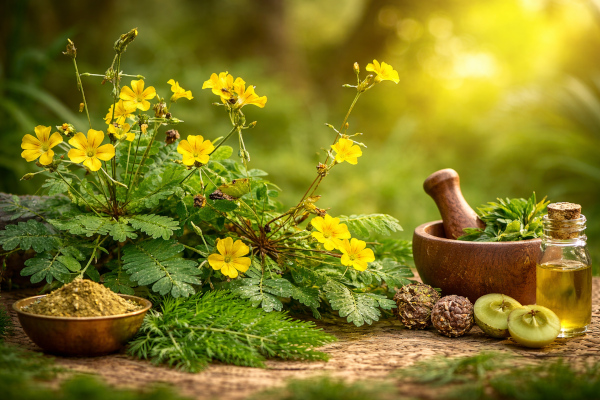
Mukkutti, botanically Biophytum sensitivum (L.) DC., is a small annual herb of the Oxalidaceae family and one of Kerala’s revered Dasapushpam plants. Botanically, it is accepted as a species native to tropical and subtropical Asia and associated with the wet tropical biome. Traditional Indian sources and modern reviews describe it as a medicinal herb used in folk medicine and Ayurveda for inflammatory conditions, minor wounds, burns, urinary complaints, and some respiratory and skin conditions, although most modern evidence is still preclinical rather than large human clinical trials.
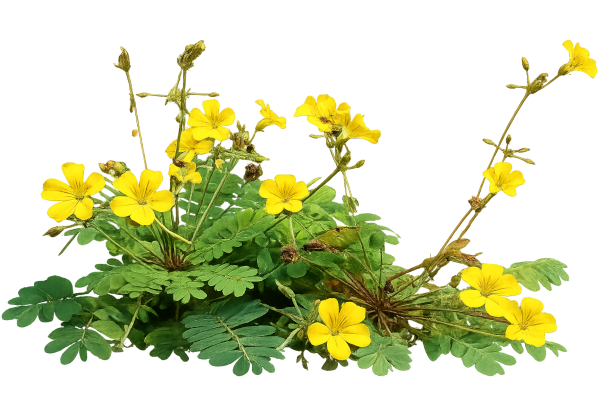
What makes Mukkutti especially memorable is that it looks like a tiny palm or miniature tree rising out of the soil. Authoritative flora sources describe it as an annual herb about 10–40 cm tall, with a simple slender stem, a single rosette of leaves near the top, and many small paired leaflets. Its flowers are small and can be described in flora records as white, pink, lilac, or yellow, though Kerala literature and common field experience very often describe the visible flowers as yellow, which is why many people in South India recognize it instantly during the rains. It typically appears in moist shady places and is often more noticeable in the rainy season.
How to identify Mukkutti in the field
The easiest way to identify Mukkutti is by its overall habit rather than by one isolated feature. Look for a small upright herb, usually growing low to the ground in damp places, with a single stem topped by a crown of compound leaves. Each leaf has many tiny opposite leaflets, giving the plant its “miniature tree” look. India Biodiversity describes the plant as having 6–14 pairs of leaflets, each small and oblong to obovate-oblong, while World Flora and Kew describe the apex rosette and small clustered flowers. If you are identifying it for medicinal use, botanical confirmation matters, because small sensitive plants can be confused in local naming systems.
Mukkutti is usually found on moist ground, field margins, shaded pathways, paddy edges, and rainy-season growth patches rather than in dry open scrub. A good visual clue is that the plant looks neat and symmetrical, almost decorative, despite being a tiny herb. In Kerala’s cultural tradition, it is also remembered as one of the ten sacred herbs used in the Dasapushpam grouping.
Ayurvedic understanding
Ayurvedic and regional herb reviews place Mukkutti among herbs used where there is inflammation, swelling, minor tissue injury, disturbed urinary flow, and certain skin complaints. Older ethnobotanical reviews summarize its traditional use in inflammation, arthritis, wounds, tumours, and burns, while later review literature and experimental work also discuss diuretic, antidiabetic, wound-healing, anti-inflammatory, antioxidant, and anti-urolithiatic activity. This does not mean every traditional claim is clinically proven in humans; it means the plant has a long medicinal reputation and a research trail that partly supports why traditional systems paid attention to it.
From an Ayurvedic style of reasoning, Mukkutti is usually thought of less as a fashionable “super herb” and more as a small corrective herb used where there is local irritation, damp inflammatory states, urinary discomfort, or tissue irritation. In that sense, it fits the kind of herb that may be chosen for localized support rather than dramatic heroic intervention. That traditional profile also explains why it shows up more often in regional practice and Kerala herbal memory than in mass-market pan-Indian formulations.
Home uses in traditional practice
The safest traditional home use of Mukkutti is usually external, not internal. Folk and review literature repeatedly mention the herb for wounds, burns, and local inflammatory conditions. In household practice, that translates to a fresh paste of the cleaned herb being applied to a small, superficial, non-serious area of irritation. This kind of use is traditional and local; it is not a replacement for wound care in deep cuts, infected skin, animal bites, burns covering large areas, or persistent rashes.
Another traditional home-facing use is for mild urinary discomfort, where the plant is remembered in herbal literature as having diuretic relevance. Experimental literature also reports diuretic activity in extracts, which gives some pharmacological support to that traditional use. Still, urinary burning, blood in urine, fever, flank pain, or recurrent stone symptoms should not be handled by self-treatment alone.
Some regional traditions also use Mukkutti in cough, chest heaviness, and minor inflammatory complaints, but internal use is exactly where caution matters most. The evidence base for oral use remains mixed and largely non-human, and preparation style, dose, and suitability vary with age, condition, and constitution. For that reason, internal use is better approached through a qualified Ayurveda physician rather than casual self-dosing.
Traditional preparation forms
The simplest traditional form is fresh paste (kalka) made from the cleaned whole herb. This is mainly for external application in folk use, especially over minor localized skin problems. Because the plant is small, the whole herb is often used rather than separating leaves, stems, and flowers.
A second common form in traditional systems is fresh juice (swarasa) or decoction (kashaya). These are usually the forms discussed when the herb is being used for internal purposes such as urinary or inflammatory complaints. Since source literature does not provide a single universally accepted household dose standard and modern human safety data are limited, it is wiser to leave internal dosage to practitioner guidance.
The dried herb may also be converted into powder (choorna) in herbal practice, but with Mukkutti this is less useful for laypeople unless it comes from a reliable source and is identified correctly. Because the plant is small and seasonal, adulteration or misidentification is a real practical issue in crude-herb trade.
Named formulations and institutional use
A noteworthy modern clue to the plant’s continuing Ayurvedic relevance is the use of Lajjalu Keram / Lajjalu Keram Gel / AYUSH LK Gel in government-linked Ayurveda research programmes for psoriasis. Parliamentary and Ministry of AYUSH documents list “Clinical Evaluation of Nimbatiktam and Lajjalu Keram Gel in the Management of Psoriasis” among completed CCRAS projects, and AYUSH documents also refer to AYUSH LK Gel in the same development ecosystem. This shows that the herb, or a regional identity associated with it, has moved beyond village memory into formal Ayurveda research.
This is useful for readers because it shows two things at once: first, Mukkutti-related traditions were important enough to enter institutional study; second, such use is happening in formulated external products, not just raw-herb household improvisation. That is usually the more sensible modern path for herbs like this.
What modern research finds interesting
The research literature around Biophytum sensitivum repeatedly highlights compounds such as amentoflavone and other flavonoids, and reviews summarize a broad pharmacological interest around anti-inflammatory, antioxidant, immunomodulatory, wound-healing, antidiabetic, nephroprotective, and anti-urolithiatic potential. But the important phrase here is potential. A great deal of this work comes from cell studies, animal studies, or broad review articles rather than large, robust human trials.
That means the herb is promising, traditional, and worthy of respect, but it should not be sold as a miracle cure. Its strongest place remains in careful traditional use, especially external use, and supervised internal use.
Safety and caution
Because the evidence for oral use is still limited and animal literature has reported antifertility activity in extracts, a prudent safety reading is to avoid self-use during pregnancy, while trying to conceive, and during breastfeeding unless guided by a qualified clinician. That is a precaution based on animal data, not proof of harm in ordinary human use, but it is still the sensible line.
It is also better not to self-treat serious conditions such as diabetes, kidney stones, heavy urinary symptoms, persistent skin disease, high fever, or chronic breathing problems with Mukkutti alone. The plant belongs in a thoughtful therapeutic context, not as a replacement for diagnosis.
In essence
Mukkutti is one of those classic Ayurvedic-region herbs that appears tiny in the hand and large in memory. It is culturally rooted, visually distinctive, and medically interesting. Its greatest strengths lie in external traditional use, its place in Kerala herbal heritage, and its quiet but serious presence in modern phytopharmacology research. Used wisely, it remains a fine example of how Ayurveda often notices power in plants that the casual eye steps over.
Reference:
https://powo.science.kew.org/taxon/urn:lsid:ipni.org:names:371965-1
https://www.worldfloraonline.org/taxon/wfo-0000565531
https://indiabiodiversity.org/species/show/228939
https://indiaflora-ces.iisc.ac.in/herbsheet.php?cat=13&id=1447
https://pmc.ncbi.nlm.nih.gov/articles/PMC3358971/
https://pubmed.ncbi.nlm.nih.gov/22654407/
https://ijapr.in/index.php/ijapr/article/view/2552
https://sansad.in/getFile/annex/267/AS125_HqRQbe.pdf?source=pqars
https://ayush.gov.in/resources/pdf/Parliament/budget2023R.pdf
https://www.researchgate.net/publication/221673140_Antifertility_activity_of_Biophytum_Sensitivum
You may also like
-
Ayurveda on Fresh Food Versus Reheated Food: Why Freshly Prepared Meals Are Preferred for Healthy Digestion
-
Ayurveda on Cold Foods and Iced Drinks: Why Food Temperature Matters for Digestion
-
Serum Institute of India-Manufactured Ebola Vaccine Enters Clinical Trial in Uganda
-
Ayurveda and Hydration: How Much Water Should We Really Drink?
-
Warm Water in Ayurveda: When and Why It Is Recommended
:%20A%20Small%20Herb%20with%20a%20Big%20Ayurvedic%20Presence)