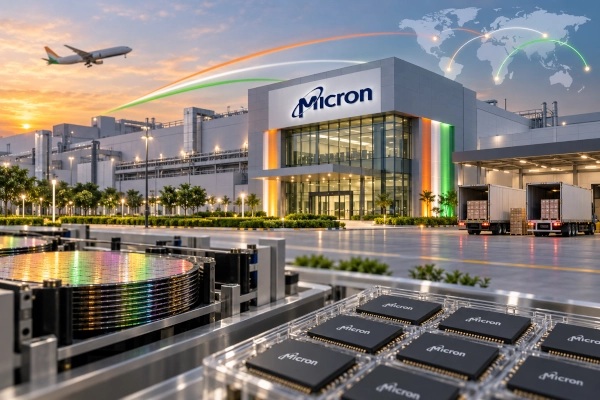
Micron Technology has begun shipping DRAM and NAND memory products from its semiconductor assembly and test facility at Sanand in Gujarat to customers around the world, marking an important step in India’s transition from semiconductor policy and investment commitments to commercial production.
Micron Chairman and CEO Sanjay Mehrotra confirmed the development at SEMICON India 2026 in New Delhi, where he said commercial DRAM and NAND production is now live at Sanand. The facility, inaugurated earlier this year, is the first semiconductor assembly and test plant established under the India Semiconductor Mission.
Sanand Moves From Inauguration to Global Production
Micron formally opened the Sanand facility on 28 February 2026. The plant receives advanced DRAM and NAND wafers produced elsewhere in Micron’s global manufacturing network and converts them into finished memory and storage products through assembly and testing operations.
The company has now moved beyond the commissioning stage and into commercial production, with finished products being shipped to customers globally. This is significant because it places India directly within Micron’s international semiconductor manufacturing network rather than limiting the country’s role to design, software or research activities.
Tens of Millions of Chips in 2026
Micron expects the Sanand facility to assemble and test tens of millions of chips during 2026. The company plans to scale this output significantly in 2027, when annual production is expected to reach hundreds of millions of chips.
Mehrotra said the current production capacity at Sanand already exceeds the memory requirements of India’s entire laptop market. The scale-up planned for next year will therefore support both domestic demand and global shipments from the Gujarat facility.
DRAM and NAND Form the Core of Micron’s India Production
The Sanand facility is focused on DRAM and NAND products, two of the most important categories in the global memory industry. DRAM provides high-speed working memory used in computers, smartphones, servers and data centres, while NAND flash is used for long-term data storage in products ranging from solid-state drives to mobile devices and cloud infrastructure.
The rapid growth of artificial intelligence, high-performance computing and data centres is increasing demand for faster and more power-efficient memory products. Micron has identified this global demand as an important factor behind the expansion of its manufacturing footprint.
$2.75 Billion Combined Investment
The Sanand project represents a combined investment of approximately $2.75 billion by Micron and its government partners. The project was one of the earliest major semiconductor manufacturing proposals approved under the India Semiconductor Mission and became operational within a relatively short period after construction began.
Once fully ramped, the first phase of the facility will contain more than 500,000 square feet of cleanroom space, making it one of the largest single-floor semiconductor assembly and test cleanrooms in Micron’s global network.
India Becomes Part of Micron’s Global Supply Chain
The significance of the Sanand plant extends beyond the volume of chips assembled there. Micron is integrating the facility into a global manufacturing network that includes wafer fabrication and advanced semiconductor operations in the United States, Japan, Singapore and Taiwan.
Advanced memory wafers produced within that global network can now be sent to Gujarat for assembly and testing before being supplied to customers in different international markets. This gives India a defined role in the global semiconductor value chain and provides the country with practical manufacturing experience in high-volume memory products.
More Than 7,000 Direct Employees in India
Micron has been operating in India for several years and currently employs more than 7,000 people directly across its manufacturing, engineering and technology operations. The company says its activities also support tens of thousands of additional jobs across suppliers and the wider semiconductor value chain.
Its Indian presence extends beyond the Sanand factory. Micron operates major engineering centres in Hyderabad and Bengaluru, which form part of the company’s global technology and product-development network.
India Engineering Teams Contribute More Than 3,700 Innovations and Disclosures
Micron’s engineering operations in India began well before construction of the Gujarat manufacturing facility. According to Mehrotra, the company’s teams in Hyderabad and Bengaluru have contributed to more than 3,700 patents, inventions and technical disclosures.
This engineering footprint gives Micron’s India operations a broader role than semiconductor assembly alone. The combination of design and engineering centres with commercial manufacturing allows the company to link Indian technical talent with physical semiconductor production within the same national ecosystem.
Talent Development Expands Alongside Manufacturing
Micron is also building partnerships with universities and training institutions to develop a workforce capable of supporting semiconductor manufacturing and engineering.
The company has partnered with Pandit Deendayal Energy University, NAMTECH and other institutions on specialised training, STEM education and workforce-readiness programmes. Micron has also expanded research partnerships with Indian universities as demand grows for engineers skilled in semiconductor design, manufacturing, packaging and testing.
First Project Under the India Semiconductor Mission
The Sanand facility carries particular significance because it was the first semiconductor project approved under the India Semiconductor Mission to enter commercial operation.
India’s first phase of semiconductor incentives has now moved from approvals to factory construction and commercial output across several projects. The government is attempting to build capabilities not only in semiconductor fabrication but also in assembly, testing, advanced packaging, equipment, materials, chip design and workforce development.
Micron’s commercial production therefore represents an early demonstration of how those incentives are translating into operational semiconductor capacity.
SEMICON India Shows Shift From Plans to Production
The Micron announcement came during SEMICON India 2026, held in New Delhi from 17 to 19 September. The event brought together more than 600 exhibitors, including around 300 international participants, as India sought to demonstrate progress across semiconductor manufacturing, equipment, materials, packaging and design.
Micron’s Sanand facility featured prominently because it provides tangible evidence that semiconductor manufacturing projects announced under the India Semiconductor Mission have begun producing commercial products.
From Domestic Production to Global Exports
The transition from commercial production to international shipments is particularly important for India’s semiconductor ambitions. Building semiconductor plants is only one part of creating a competitive industry; those facilities must also meet global quality standards, achieve dependable production volumes and integrate into international customer supply chains.
Micron’s decision to ship products manufactured at Sanand to customers worldwide means the Gujarat facility is operating within those global commercial requirements.
As output increases from tens of millions of chips in 2026 to hundreds of millions in 2027, Sanand is expected to become an increasingly important node in Micron’s international assembly and testing network.
India’s Semiconductor Story Enters the Manufacturing Phase
Micron’s progress at Sanand illustrates a broader change taking place within India’s semiconductor sector. For years, India possessed significant semiconductor design capability but lacked comparable large-scale commercial manufacturing.
The Sanand plant begins to narrow that gap by combining Indian engineering talent with semiconductor assembly, testing and global distribution.
The next phase will depend on how quickly Micron and other approved semiconductor projects can scale production, deepen localisation and create a domestic supplier network around materials, equipment and advanced packaging.
For now, the shipment of DRAM and NAND products from Gujarat to customers worldwide marks a clear transition from semiconductor ambition to commercial execution.
References
Press Information Bureau — SEMICON India 2026, 17 September 2026
https://www.pib.gov.in/PressReleasePage.aspx?PRID=2311726
Micron Technology — Micron Celebrates Opening of India’s First Semiconductor Assembly and Test Facility, 28 February 2026
https://investors.micron.com/news/press-release/2026/Micron-Celebrates-Opening-of-Indias-First-Semiconductor-Assembly-and-Test-Facility-02-28-2026/default.aspx
Micron Technology — India Newsroom
https://in.micron.com/about/press/news
PTI / Business Standard — Micron to Scale Up Semiconductor Assembly and Testing in India, 17 September 2026
https://www.business-standard.com/industry/news/micron-to-scale-up-semiconductor-assembly-testing-in-india-next-year-126091700349_1.html
ET Electronics — Micron Begins Shipping Memory Products From Gujarat Plant to Global Customers, 17 September 2026
https://electronics.economictimes.indiatimes.com/news/semiconductors/micron-begins-shipping-memory-products-from-gujarat-plant-to-global-customers-sanjay-mehrotra/134302618
You may also like
-
India’s Economic Warfare Challenge: Strategic Autonomy, Energy Security and the Rise of a Global Power
-
India-US Trade Deal Stalemate: Why Washington’s Tariff Pressure Has Failed to Secure an Agreement
-
US Double Standards in Foreign Policy: 16 Recent Cases Involving India, Russia, China and Global Trade
-
India’s Arctic Energy Ambitions: Russian Oil, LNG and a New Sea Route to Indian Ports
-
India and Russia Explore Joint Icebreaker Construction as Maritime Industrial Cooperation Expands
