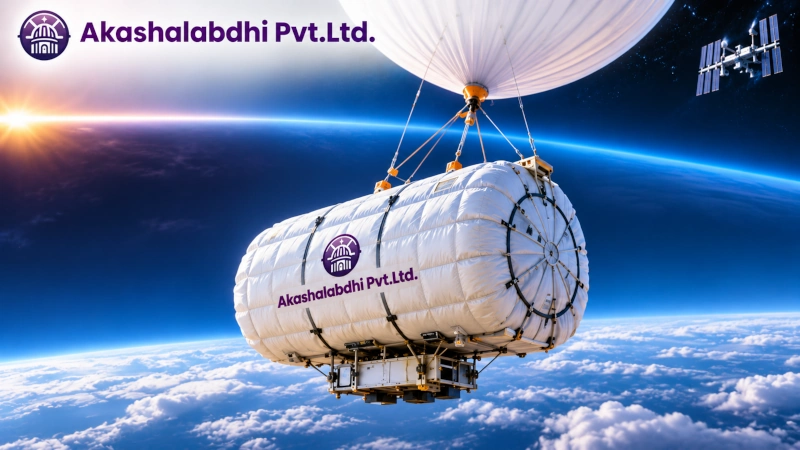
Indian space technology startup Akashalabdhi Space has completed a high-altitude flight experiment involving an expandable structure designed for future orbital habitats, space-based manufacturing facilities and microgravity research laboratories. The experimental mission, conducted on November 3, carried a 250-litre inflatable structure to approximately 30 kilometres above Earth, marking an important development in the company’s efforts to build lightweight, deployable infrastructure for the emerging commercial space economy.
The experiment was conducted using a high-altitude balloon launched through the Tata Institute of Fundamental Research’s National Balloon Facility in Hyderabad. The mission, with a total experimental payload mass of approximately 25 kilograms, evaluated the deployment and inflation of a specially engineered structure designed to expand from a compact configuration and subsequently retain its shape through a rigidisation process. The technology forms part of Akashalabdhi’s ANTARIKSHAB programme, which aims to develop expandable infrastructure for future space stations, orbital manufacturing facilities and scientific research platforms.
Expandable Structures Could Transform Future Space Infrastructure
Conventional space stations and orbital laboratories rely primarily on rigid modules that must fit within the payload fairings of launch vehicles. Their dimensions impose practical restrictions on the amount of usable space that can be transported into orbit, while the structural mass associated with conventional modules increases launch requirements and costs.
Akashalabdhi is developing an alternative approach based on inflatable structures that can be folded into compact packages during launch and expanded after deployment. Once inflated, the structures undergo a rigidisation process intended to maintain their shape without continuous dependence on internal gas pressure. This approach could enable larger working volumes to be established in orbit while reducing the space occupied by structural components during transportation.
The company’s technology is intended for applications ranging from orbital research laboratories and commercial manufacturing facilities to expandable habitation modules. Such systems could support future activities involving pharmaceutical research, advanced materials processing, biological experiments and other industrial operations that benefit from the conditions available in space.
The November 3 experiment provided an opportunity to evaluate several of the engineering principles underlying this approach. By testing a prototype under high-altitude conditions, the company was able to gather information concerning deployment behaviour, structural performance and the operation of supporting spacecraft systems before progressing towards more demanding orbital demonstrations.
Experimental Mission Evaluates Deployment and Structural Rigidisation
The high-altitude flight carried a 250-litre rigidisable inflatable structure designed to demonstrate the transition from a compactly packaged configuration into an expanded form. The experiment examined the mechanisms involved in deployment, inflation and structural rigidisation, which are essential to the development of larger inflatable spacecraft modules.
The mission also evaluated autonomous control systems, avionics, onboard electrical power equipment and telemetry capabilities. These subsystems are necessary for controlling deployable structures, monitoring their condition and transmitting engineering data during future space missions. The balloon flight additionally provided an opportunity to examine flight dynamics and parachute-assisted recovery systems.
At approximately 30 kilometres altitude, atmospheric pressure falls to around one to two per cent of its sea-level value, while temperatures can approach minus 45 to minus 50 degrees Celsius. These conditions expose equipment to environmental stresses that are difficult to reproduce simultaneously during conventional ground testing.
The experiment therefore offered a valuable intermediate testing environment for evaluating structural materials, electronic systems and deployment mechanisms. Although the balloon flight did not reproduce orbital vacuum, sustained microgravity or the complete radiation environment of space, it enabled the company to collect practical engineering data under conditions substantially different from those encountered at ground level.
IISc Experiment Explores Manufacturing Construction Materials for the Moon and Mars
An important feature of the mission was the inclusion of a scientific experiment developed by the Indian Institute of Science (IISc), Bengaluru, examining the possibility of producing construction materials from resources available on the Moon and Mars.
Known as the Microbial Regolith Experiment, the payload was developed by researchers working in Professor Aloke Kumar’s laboratory at IISc. The experiment investigates whether biological processes involving microorganisms can help consolidate regolith, the loose soil and fragmented rocky material covering planetary surfaces, into solid construction materials.
The research addresses an important challenge associated with future human and robotic exploration of the Moon and Mars. Transporting conventional construction materials from Earth would require considerable launch capacity, making the development of techniques that utilise locally available resources particularly valuable for long-duration exploration programmes.
Microbial processes could eventually provide methods for binding or strengthening regolith-based materials, potentially supporting the construction of protective structures, shelters and other infrastructure on extraterrestrial surfaces. Such approaches form part of the wider field of in-situ resource utilisation, which seeks to reduce dependence on supplies transported from Earth.
The high-altitude mission exposed the IISc experiment to near-space environmental conditions, allowing researchers to investigate the response of the experimental system to low temperatures and reduced atmospheric pressure. The scientific results will be assessed following recovery and analysis of the payload, contributing to the development of future biological manufacturing experiments in space.
Experimental Solar Cells Tested Under Near-Space Conditions
The mission also carried an experimental photovoltaic payload developed by Switzerland-based Perovskia Solar. The device was intended to investigate the behaviour of perovskite solar-cell technology under environmental conditions involving low atmospheric pressure, extreme cold and varying solar illumination.
Perovskite solar cells have attracted growing scientific and industrial interest because of their potential to provide lightweight and efficient photovoltaic systems. Their material characteristics make them relevant to applications where mass, flexibility and power-generation efficiency are important considerations, including future spacecraft and deployable space infrastructure.
The experimental payload provided an opportunity to expose the photovoltaic device to a high-altitude environment and collect information that could support further material and device development. Such testing is relevant to the design of future lightweight power-generation systems intended for orbital platforms and other aerospace applications.
By carrying experimental payloads from both IISc and an international technology company, Akashalabdhi’s flight also demonstrated the potential for expandable structures to serve as shared research platforms. This approach could eventually enable universities, research laboratories and commercial enterprises to test specialised technologies using common aerospace infrastructure.
Successful Recovery Provides Additional Engineering Insights
The high-altitude experiment also generated useful observations concerning the mechanical durability of the expandable structure during recovery. According to Akashalabdhi Chief Executive Officer Siddarth Jena, the experimental module absorbed landing impact without the damage that engineers had initially anticipated.
The observation is relevant to future missions involving the recovery of scientific equipment, experimental materials and reusable spacecraft components. The ability of protective systems and structural materials to withstand landing loads can help engineers improve the reliability of recoverable aerospace platforms.
The company’s assessment of the mission was still continuing when the results were first reported. Engineers were examining additional parameters, including the performance of the experimental solar-cell payload and whether the parachute system achieved its targeted terminal descent velocity of five metres per second.
The information gathered during the flight will contribute to further improvements in structural design, onboard systems, deployment mechanisms and recovery technologies. These engineering activities form part of the progressive validation process required before expandable infrastructure can be tested under actual orbital conditions.
ANTARIKSHAB Programme Targets Commercial Space Stations and Orbital Manufacturing
The November 3 experiment forms part of Akashalabdhi’s broader ANTARIKSHAB programme, which seeks to establish technologies for expandable orbital infrastructure. The company’s long-term objective is to develop deployable structures that can support scientific research, industrial manufacturing and habitation activities beyond Earth’s atmosphere.
Expandable spacecraft structures could become particularly important as commercial organisations explore opportunities for establishing privately operated space stations and specialised orbital research facilities. Such infrastructure would require efficient methods of transporting equipment, creating usable internal volumes and accommodating scientific payloads within the constraints of available launch vehicles.
Akashalabdhi’s approach aims to address these requirements through compact launch configurations, lightweight structural systems and deployable modules capable of providing larger working spaces after inflation. The technology could eventually support orbital laboratories, pharmaceutical research facilities, microgravity manufacturing platforms and experimental habitats.
The company is also preparing for a more advanced orbital demonstration involving a larger expandable structure and additional scientific payloads. Its proposed next-stage mission is intended to build upon the engineering information collected during the high-altitude flight and move the technology towards validation in the space environment.
Indian Space Startups Expand into Advanced Orbital Infrastructure
Akashalabdhi’s experiment highlights the growing technological diversity of India’s private space industry, which is increasingly moving beyond satellite manufacturing and launch services into specialised infrastructure for future orbital operations.
The development of expandable habitats requires expertise across several engineering disciplines, including advanced materials, structural mechanics, spacecraft electronics, thermal protection, autonomous control systems and environmental testing. Building these capabilities domestically can contribute to India’s participation in emerging international markets for commercial space infrastructure.
The participation of IISc researchers also demonstrates the importance of collaboration between academic institutions and private space technology companies. By integrating scientific experiments with experimental aerospace platforms, such partnerships can help translate laboratory research into technologies suitable for future space missions.
The successful high-altitude flight represents an important intermediate milestone in Akashalabdhi’s development programme. It provides practical data for refining expandable structures while demonstrating how Indian startups can contribute to emerging technologies for space habitation, scientific experimentation and orbital manufacturing.
As India expands its commercial space ecosystem, the development of deployable infrastructure offers opportunities for domestic companies to participate in the construction of future orbital facilities. Akashalabdhi’s November 3 experiment adds to these efforts by advancing technologies intended to make larger, more versatile space-based structures possible through compact and efficient launch configurations.
References
1. India Today — 4 November 2026
Akashalabdhi Space Tests Inflatable Structure at 30 Kilometres Altitude in High-Altitude Balloon Mission.
https://www.indiatoday.in/science/story/akashalabdhi-space-inflatable-structure-balloon-test-3031958-2026-11-04
2. The Times of India — 4 November 2026
Bengaluru Company Tests Expandable Space Habitat Technology in Near-Space Mission.
https://timesofindia.indiatimes.com/india/a-first-bangaluru-company-tests-expandable-space-habitat-tech-in-near-space-mission/articleshow/135509381.cms
3. Akashalabdhi Space — Official Company Website
Company information, expandable space infrastructure technology and ANTARIKSHAB programme.
https://akashalabdhi.space
4. Akashalabdhi Space — Official Mission Roadmap
ANTARIKSHAB programme development and proposed orbital infrastructure demonstrations.
https://akashalabdhi.space/timeline
Event date: 3 November 2026
Reporting date: 4 November 2026
You may also like
-
IIT Bombay-Incubated Peppermint Robotics Raises ₹100 Crore to Expand Indigenous Robot Manufacturing and Global Operations
-
Tata Power Commissions 300 MW Solar Project in Karnataka, Expands Renewable Energy Portfolio to 12 GW
-
IIT Gandhinagar Startup Cellegant Raises ₹2.61 Crore to Develop Indigenous Hydrogen-Powered Drones
-
HAL Initiates Raw Material Procurement for Indigenous LCA Mk2 Fighter Aircraft Programme
-
Indian Railways Records Highest-Ever October Freight Loading at 145.07 Million Tonnes
