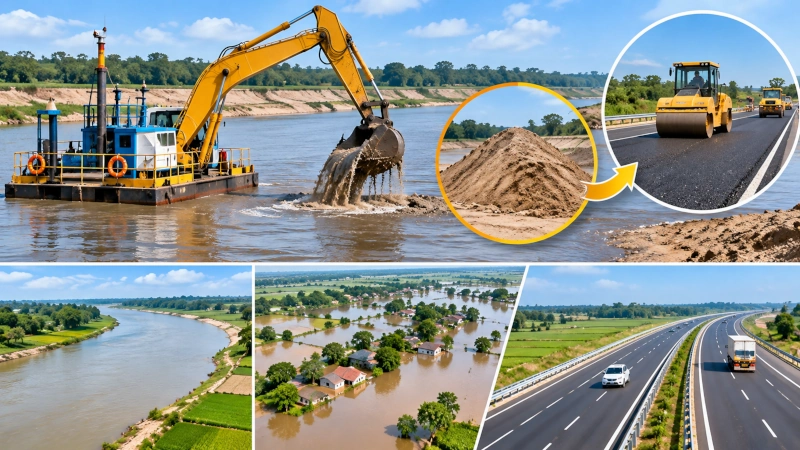
The Ministry of Road Transport and Highways (MoRTH) and the Government of Bihar have signed a Memorandum of Understanding to scientifically remove accumulated silt from rivers and water bodies and utilise suitable excavated material in National Highway construction projects. The initiative, named Nadi Sanjivani, seeks to address recurring flooding, sediment accumulation and the growing demand for highway construction materials through an integrated approach to water-resource management and infrastructure development.
The agreement was signed in New Delhi in the presence of Union Minister for Road Transport and Highways Nitin Gadkari and Bihar Chief Minister Samrat Choudhary. Under the initiative, the National Highways Authority of India (NHAI) has identified the potential to utilise approximately 243 lakh cubic metres of excavated silt in 16 ongoing National Highway projects, while another 835 lakh cubic metres has been proposed for 27 future projects, subject to technical suitability and necessary approvals. The programme is intended to improve the water-carrying capacity of rivers, conserve agricultural land and reduce dependence on freshly excavated earth for highway construction.
Nadi Sanjivani Integrates River Restoration with Highway Development
The Nadi Sanjivani initiative introduces a coordinated framework in which river restoration and infrastructure construction are treated as complementary activities. Sediment removed from identified rivers and water bodies will be assessed for its suitability as construction material, allowing material that meets engineering standards to be used in National Highway projects rather than relying entirely on conventional sources of earth and aggregates.
Bihar’s river systems experience substantial sediment movement, particularly during the monsoon season when rivers originating in Nepal carry large quantities of water and sediment into the state. Over time, excessive sediment accumulation in certain river stretches and water bodies can affect their water-carrying capacity, alter drainage conditions and contribute to local flooding. The problem has significant consequences for agricultural communities, residential settlements and public infrastructure located in flood-prone areas.
The initiative seeks to address these challenges through scientifically planned desilting operations intended to improve drainage and restore water-carrying capacity where assessments establish that sediment removal is appropriate. The excavated material will then be evaluated for possible use in highway construction, creating a potential connection between flood-management activities and infrastructure material requirements.
Union Minister Nitin Gadkari highlighted the possibility of reducing construction costs and conserving productive agricultural land by replacing suitable quantities of freshly sourced earth with material recovered from water bodies. He also indicated that the approach could be considered in other states facing similar challenges, provided appropriate technical assessments and environmental safeguards are maintained.
1,078 Lakh Cubic Metres of Silt Identified for Potential Highway Use
A major component of the agreement involves identifying substantial quantities of excavated material that could support ongoing and future highway projects in Bihar. According to the Ministry of Road Transport and Highways, NHAI has identified 243 lakh cubic metres of suitable silt for utilisation in 16 ongoing projects, while an additional 835 lakh cubic metres has been proposed for 27 future projects.
Together, these quantities represent 1,078 lakh cubic metres, or 107.8 million cubic metres, of potential construction material. However, the figures represent planned and proposed utilisation rather than volumes already excavated or incorporated into highways. Actual use will depend on identifying suitable sediment deposits, completing the necessary technical assessments and securing relevant approvals.
The proposed integration could help highway construction agencies manage the substantial quantities of earth required for embankments, road approaches and other infrastructure components. The availability of locally sourced material may also reduce transportation requirements in certain locations, depending on the distance between excavation sites and construction areas.
Not all river silt is suitable for highway construction. Fine-grained sediments, organic material and other deposits may fail to meet the engineering requirements for particular applications. Consequently, the success of the programme will depend on careful material testing, appropriate processing where necessary and the selection of applications consistent with established highway construction specifications.
Scientific Desilting Aims to Strengthen Bihar’s Flood Management
Bihar faces recurring flood-related challenges arising from its extensive river network, seasonal monsoon rainfall and the movement of water from upstream catchments. Sediment accumulation can aggravate drainage problems in certain locations, while changes in river channels and floodplain conditions can affect settlements, agricultural land and infrastructure.
The Nadi Sanjivani initiative seeks to improve water management by undertaking sediment removal at locations identified through scientific assessment. The government expects appropriately designed desilting operations to improve the capacity of selected water bodies to accommodate and convey water, potentially reducing some local flooding and drainage problems.
However, sediment removal is not a universal solution to flooding. River behaviour depends on multiple factors, including rainfall intensity, catchment conditions, upstream flows, channel geometry and floodplain characteristics. Poorly planned excavation can also destabilise riverbanks, disturb aquatic habitats or alter sediment movement in ways that create new problems downstream.
For these reasons, the agreement requires desilting to be undertaken within prescribed technical limits and at approved locations. The programme will need to balance the removal of excessive sediment with the protection of river ecosystems, embankments, bridges and other structures.
The Ministry of Road Transport and Highways has emphasised that environmental and statutory safeguards will form part of implementation. The effectiveness of the programme in reducing flood risks will ultimately depend on site-specific planning, monitoring and the hydraulic and ecological conditions of the affected waterways.
Bihar Introduces Water Sources Restoration and Silt Management Policy
The initiative will operate in coordination with the Bihar Water Sources Restoration and Silt Management Policy, 2026, which has been formulated to establish a structured framework for restoring water bodies and managing accumulated sediment.
Chief Minister Samrat Choudhary explained that the policy is intended to address the consequences of sediment accumulation in rivers and other water bodies while also facilitating the removal of sand and silt deposited on agricultural land following floods. Such deposits can interfere with cultivation and create additional difficulties for farmers seeking to restore damaged agricultural fields.
The state government expects the coordinated approach to support flood management, agricultural conservation and infrastructure development. Restoring selected water bodies may also improve their usefulness for irrigation, drinking-water storage and groundwater recharge where local hydrological conditions permit.
The policy provides an administrative foundation for identifying restoration requirements and coordinating activities among government departments. Its implementation will be particularly relevant in areas where river sediment management, agricultural protection and infrastructure development involve overlapping responsibilities.
By linking the management of excavated material with existing highway projects, Bihar aims to create a more organised mechanism for handling sediment that would otherwise require separate excavation, transportation and disposal arrangements.
Highway Projects Worth ₹58,340 Crore Under Construction in Bihar
The Nadi Sanjivani initiative will be implemented alongside a substantial programme of National Highway development in Bihar. According to the Ministry of Road Transport and Highways, 39 NHAI projects covering approximately 1,561 kilometres are currently under construction, with an estimated investment of ₹58,340 crore.
Another 11 projects covering approximately 1,982 kilometres are proposed, involving an estimated investment of ₹1,85,200 crore. These developments represent a major pipeline of road infrastructure intended to strengthen regional connectivity, improve freight movement and support economic activity across the state.
Highway construction requires significant quantities of suitable earth and other materials for embankments, approaches, foundations and associated infrastructure. Depending on project specifications and local availability, the use of appropriately tested excavated material could help reduce the need to obtain fresh earth from agricultural or other land.
The ministry expects the availability of suitable silt to improve construction efficiency and potentially reduce costs. However, the actual financial benefits will depend on excavation methods, material characteristics, testing requirements, transportation distances and the engineering applications for which the recovered material is approved.
India’s National Highway network in Bihar has expanded from approximately 4,615 kilometres in 2014 to around 6,500 kilometres in 2026. The government has also undertaken construction of approximately 29 new bridges over major rivers in the state since 2014, supporting improvements in connectivity across its river-dominated landscape.
NHAI and Bihar Government to Establish Monitoring Framework
The MoU establishes a framework for coordinated implementation between NHAI and the Government of Bihar. The state’s Road Construction Department will act as the nodal department, supported by a State-level Coordination Committee responsible for examining proposals, facilitating approvals, monitoring progress and resolving operational issues.
Before desilting begins, the identified water bodies will undergo technical assessments to determine appropriate excavation locations, permissible extraction quantities and potential environmental implications. Operations will be restricted to approved areas and carried out within prescribed technical limits to protect riverbanks, embankments, bridges and surrounding ecosystems.
The suitability of excavated material for highway construction will be determined through testing in accordance with applicable Ministry of Road Transport and Highways specifications and relevant Indian Roads Congress codes. These requirements are intended to ensure that reused material meets the engineering standards necessary for the proposed construction applications.
The implementation framework will also incorporate joint measurement, digital record-keeping, regular monitoring and periodic reconciliation of the quantities extracted, transported and utilised. These measures are intended to strengthen accountability while enabling government agencies to monitor the movement and use of recovered material.
Maintaining reliable records will be important because the programme involves the movement of large quantities of sediment between water bodies and infrastructure sites. Transparent monitoring can help establish whether excavation remains within approved limits and whether recovered material is being used for its authorised purpose.
Circular Economy Approach Could Reduce Pressure on Agricultural Land
The Nadi Sanjivani initiative reflects the principles of a circular economy by seeking productive applications for material generated through environmental restoration activities. Rather than viewing excavated sediment solely as waste requiring disposal, the programme proposes to treat suitable portions as a potential resource for infrastructure development.
The approach could help conserve agricultural land by reducing the need to excavate fresh earth from productive areas. In regions where highway construction requires substantial embankment material, recovering suitable sediment from nearby water bodies may offer an alternative that combines infrastructure requirements with planned restoration activities.
Potential environmental benefits include reduced demand for newly excavated material and improved management of sediment removed from rivers and water bodies. However, these benefits are not automatic. Excavation, processing and transportation also have environmental impacts, making site selection, haulage distances and overall project design important considerations.
The programme’s long-term value will therefore depend on whether material recovery produces measurable advantages over conventional construction practices while maintaining the ecological integrity of affected waterways. Successful implementation would require coordination among engineers, hydrologists, environmental specialists and government authorities.
If these conditions are met, the initiative could provide a model for integrating selected water-body restoration projects with infrastructure construction in other Indian states.
Connecting Flood Resilience, Agriculture and Infrastructure
The agreement between the Ministry of Road Transport and Highways and the Government of Bihar represents an attempt to address three interconnected challenges through a common implementation framework: managing accumulated river sediment, protecting agricultural land and securing construction materials for highway expansion.
Its significance lies in bringing together activities that have traditionally been managed through separate administrative and engineering processes. River restoration is generally associated with water-resource management and environmental protection, while highway construction is concerned with transportation infrastructure and material procurement. The Nadi Sanjivani initiative seeks to coordinate these functions so that suitably planned sediment removal can contribute to infrastructure development.
The scale of the proposed material utilisation is substantial, with 243 lakh cubic metres identified for 16 ongoing highway projects and another 835 lakh cubic metres proposed for 27 future projects. These quantities demonstrate the potential scope of the programme, although they remain subject to technical evaluation, statutory approvals and the practical requirements of construction.
By establishing a coordinated framework for recovering and reusing suitable sediment, Bihar and the Union Government have created an opportunity to connect infrastructure development with more systematic water-resource management. If implemented successfully, the initiative could help improve the condition of selected water bodies, conserve agricultural soil and support highway construction while demonstrating how environmental restoration and infrastructure development can be planned together.
Source: Press Information Bureau, Ministry of Road Transport and Highways, Government of India, November 3, 2026, 4:13 PM IST. Release ID: 2332058.
You may also like
-
Bengaluru Space Startup Akashalabdhi Tests Expandable Space Habitat Technology at 30 Kilometres Altitude
-
India Proposes Expanded Import Network for Medicines and Medical Devices to Improve Healthcare Logistics
-
Thooyamalli Rice of Tamil Nadu: The Jasmine-Like Heritage Grain with GI Recognition
-
JNK India Secures Major Overseas Engineering Order Worth ₹300–600 Crore for Nigerian Energy Project
-
Hindustan Zinc Introduces VedAZ and VedAyush Zinc Alloys for Galvanising Industry
