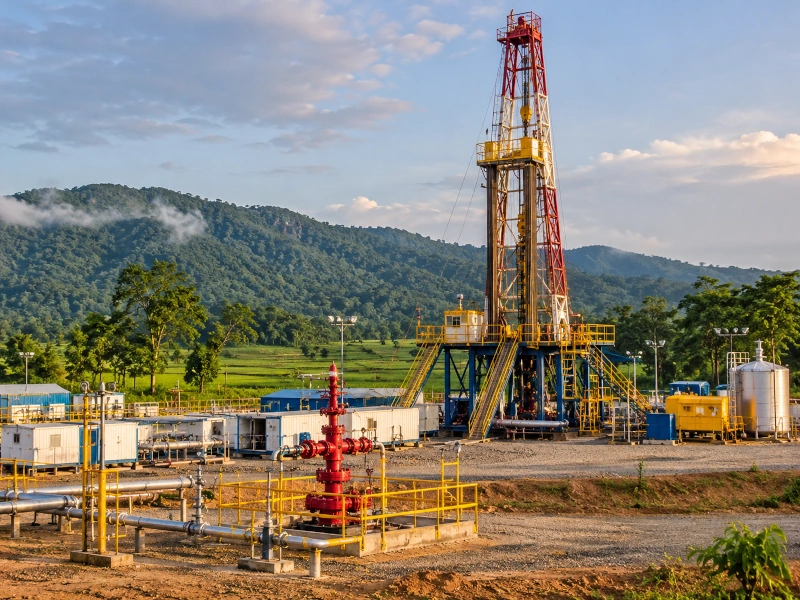
Oil and Natural Gas Corporation Limited (ONGC) has announced two new onshore hydrocarbon discoveries in Assam and Gujarat during the second quarter of the financial year 2026–27, marking further progress in India’s efforts to identify and develop domestic petroleum and natural gas resources. The discoveries, named Amraghat-1 and Vadatal-48, were disclosed by the public sector energy company on 5 November 2026 as part of its quarterly operational and financial performance announcement.
The discoveries represent two different exploration achievements. Amraghat-1, located in Assam’s Cachar district, has been classified as a new prospect discovery following successful natural gas flow from an exploratory well. Vadatal-48, located in Gujarat’s Cambay Basin, has been classified as a new pool discovery after drilling identified an additional hydrocarbon-bearing geological interval beneath an existing oil-producing formation.
Both developments demonstrate the continuing potential of India’s established sedimentary basins, where modern exploration techniques and detailed geological assessments are helping identify previously unrecognised hydrocarbon resources.
Amraghat-1: New Natural Gas Discovery in Assam’s Cachar District
The Amraghat-1 discovery was made in the Cachar District Petroleum Mining Lease area of the Assam–Arakan Fold Belt, a geologically complex region in northeastern India with a long history of petroleum exploration.
ONGC drilled the exploratory well to investigate the hydrocarbon potential of the Upper and Middle Bhuban Formations. These geological formations form part of the sedimentary sequences associated with the region’s petroleum systems.
The exploratory well successfully established natural gas flow, enabling ONGC to notify Amraghat-1 as a new prospect discovery. The result confirms the presence of gas within the investigated geological structure and provides valuable information for further evaluation of hydrocarbon potential in the area.
The discovery is particularly relevant to northeastern India’s energy sector, where natural gas plays an important role in industrial operations, electricity generation and regional economic development. Additional exploration success can support efforts to strengthen domestic gas availability and improve the utilisation of regional energy infrastructure.
Vadatal-48: New Hydrocarbon Reservoir Identified in Gujarat’s Cambay Basin
ONGC’s second discovery, Vadatal-48, was made in the Vadatal Extension-I Petroleum Mining Lease area, located within the Cambay Basin in Gujarat. The well falls under the NELP-VI block CB-ONN-2004/2.
The Cambay Basin is among India’s historically important petroleum-producing regions and contains numerous geological structures associated with oil and natural gas accumulation. Continued exploration of the basin remains important for identifying additional resources within existing producing areas.
Vadatal-48 was originally drilled to produce oil from the Chhatral Pay, an established hydrocarbon-bearing interval. During drilling, however, ONGC encountered an additional sand formation beneath the existing producing horizon.
The newly identified interval was notified as a new pool discovery in the Chhatral Lower Pay. This finding establishes the presence of an additional hydrocarbon accumulation beneath a previously recognised producing formation.
The discovery is significant because it demonstrates the potential for identifying additional reservoirs within mature petroleum-producing regions. Such discoveries can create opportunities for further exploration and reservoir assessment without requiring the identification of entirely new sedimentary basins.
Strengthening Exploration in India’s Established Petroleum Basins
The discoveries in Assam and Gujarat highlight the importance of sustained exploration in regions where petroleum production has been established for decades. Although these basins have undergone extensive geological investigation, deeper formations and previously unidentified reservoir structures can continue to provide opportunities for additional discoveries.
Modern exploration programmes increasingly combine seismic interpretation, geological modelling, specialised drilling techniques and reservoir evaluation to identify hydrocarbon accumulations that may have been overlooked during earlier exploration campaigns.
In the Assam–Arakan Fold Belt, structural complexity creates challenges for accurately identifying potential reservoirs. Exploration success therefore contributes valuable information to the geological understanding of the region.
In the Cambay Basin, the identification of the Chhatral Lower Pay demonstrates how drilling beneath established producing horizons can reveal additional hydrocarbon-bearing intervals. Such findings provide a basis for further technical evaluation and potential expansion of existing field development programmes.
Together, the discoveries reinforce the value of continued investment in exploration technology, geological research and domestic petroleum resource assessment.
ONGC Expands Exploration into the Mahanadi Deepwater Basin
Alongside the two onshore discoveries, ONGC reported an important development in its deepwater exploration programme under the National Offshore Exploration Scheme.
The company confirmed that its first exploratory well, MNDWO181HDB-1, drilled in Open Acreage Licensing Policy block MN-DWHP-2018/1 in the Mahanadi deepwater region, had been established as gas-bearing.
The development forms part of ONGC’s exploration activities under the Samudra Manthan initiative, which seeks to strengthen India’s efforts to identify hydrocarbon resources in offshore and deepwater sedimentary basins.
Deepwater exploration requires specialised drilling equipment, advanced geological interpretation and sophisticated offshore operating capabilities. Successful identification of gas-bearing formations in these environments contributes to the technical understanding of India’s offshore petroleum potential.
The Mahanadi result complements ONGC’s onshore discoveries by demonstrating exploration progress across different geological environments, from established producing basins to relatively less-explored deepwater regions.
Domestic Hydrocarbon Discoveries and India’s Energy Security
India remains substantially dependent on imported crude petroleum to meet its energy requirements. Increasing domestic exploration and improving recovery from existing producing fields are therefore important components of the country’s long-term energy security strategy.
New hydrocarbon discoveries can strengthen the domestic resource base and create opportunities for additional production following geological appraisal, reserve assessment and field development.
For ONGC, exploration remains essential to sustaining production over the long term, particularly as established oil and gas fields experience natural reservoir depletion. Identifying additional hydrocarbon accumulations allows the company to evaluate new development opportunities while continuing to improve production from mature fields.
The discoveries at Amraghat-1 and Vadatal-48 demonstrate how systematic exploration can produce new results in both northeastern and western India. Their geological significance lies not only in the identification of hydrocarbons but also in the additional information they provide for future exploration across these sedimentary basins.
ONGC’s Wider Investment in India’s Oil and Gas Infrastructure
The discovery announcements accompany a substantial programme of investment in ONGC’s offshore production infrastructure.
In its quarterly disclosure, the company announced the award of two major development projects in the Western Offshore region involving a combined investment of approximately ₹11,800 crore. These projects are expected to unlock an estimated 22 million tonnes of oil equivalent in hydrocarbon potential.
ONGC also awarded the Pipeline Replacement Project-X, involving an investment of more than ₹4,300 crore for the installation of new subsea pipelines and replacement of ageing offshore infrastructure.
These investments demonstrate the company’s parallel focus on exploration, development of additional hydrocarbon resources and improvement of existing production facilities.
The combination of new discoveries, offshore development projects and infrastructure modernisation forms part of ONGC’s broader efforts to strengthen India’s domestic petroleum production capabilities.
Expanding India’s Indigenous Energy Resource Base
The Amraghat-1 and Vadatal-48 discoveries represent another step in India’s continuing efforts to identify additional oil and natural gas resources within its territory.
The successful establishment of natural gas flow in Assam and identification of a new reservoir interval in Gujarat demonstrate the continuing geological potential of India’s established petroleum basins. Together with the gas-bearing exploration well in the Mahanadi deepwater region, these developments reflect the geographical breadth of ONGC’s exploration activities.
As India advances its energy security objectives, continued investment in geological research, advanced drilling technologies and domestic exploration will remain essential for developing a stronger indigenous hydrocarbon resource base.
ONGC’s latest discoveries contribute to this national effort by expanding knowledge of India’s subsurface resources and creating new opportunities for future petroleum and natural gas development.
You may also like
-
Guyana Offers to Supply Up to 20% of India’s Crude Oil Needs, Eyes Deeper Energy Partnership
-
Tata Motors Acquires Italy’s Iveco Group, Creates World’s Fourth-Largest Commercial Vehicle Enterprise
-
India Introduces Scientific Pig Breeding Standards to Improve Livestock Productivity in Northeast
-
Government Connects Indian Startups with 31,540 Scientific Equipment Listings Through I-STEM
-
India, Philippines in Advanced Talks for $800 Million BrahMos Missile Deal
