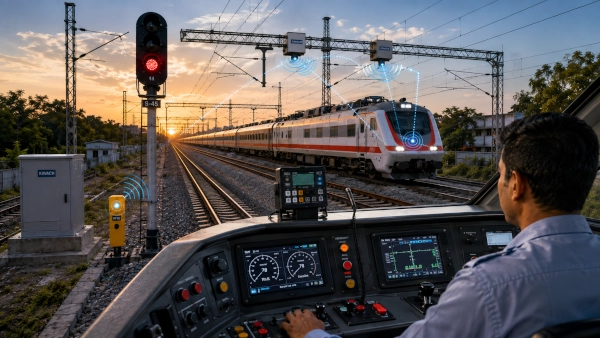
India is undertaking one of the largest railway safety technology deployments in the world with KAVACH, its indigenously developed Automatic Train Protection system.
Designed by the Research Designs and Standards Organisation (RDSO) in collaboration with Indian industry, KAVACH represents a major shift in the way safety is built into Indian Railways. Instead of depending entirely on the reaction of the locomotive pilot when a dangerous situation develops, the system continuously monitors the train and can automatically intervene when prescribed safety limits are violated.
The technology is particularly important for a railway network as large and operationally complex as India’s, where passenger trains, high-speed services, suburban trains and extremely heavy freight traffic often share the same corridors.
By 13 July 2026, KAVACH Version 4.0 had been commissioned across 2,490 route kilometres, including important stretches of the Delhi–Mumbai and Delhi–Howrah corridors. Indian Railways has simultaneously taken up trackside implementation across another 21,937 route kilometres.
KAVACH is therefore moving beyond the experimental stage and becoming an important component of India’s national railway safety architecture.
What Exactly Is KAVACH?
KAVACH is an Automatic Train Protection — ATP — system.
Its basic purpose is straightforward: the system constantly checks whether a train is being operated within the safe parameters permitted by railway signalling and operating conditions.
When those parameters are violated and the locomotive pilot does not take the necessary corrective action, KAVACH can intervene automatically.
Among its principal functions are:
- preventing or mitigating Signal Passed at Danger — SPAD — incidents
- supervising train speed
- automatically applying brakes when required
- displaying signalling information inside the locomotive cab
- protecting against certain collision scenarios between KAVACH-equipped trains
- assisting train operation in difficult visibility conditions such as fog
- communicating emergency information through the railway network.
The crucial difference is that KAVACH does not merely warn the driver.
It can take control of braking when necessary.
That additional layer of protection is what makes ATP technology important in modern railway systems.
When a Loco Pilot Misses a Red Signal
One of the classic railway safety risks is a train passing a signal showing danger.
This is known internationally as SPAD — Signal Passed at Danger.
A locomotive pilot may fail to stop because of human error, misjudgement, reduced visibility, fatigue or other circumstances.
KAVACH continuously obtains information about the authorised movement of the train.
If the system determines that the train is approaching a point beyond which it must not proceed, it calculates whether braking action is required.
If the locomotive pilot does not respond sufficiently, KAVACH automatically applies the brakes.
The system therefore introduces an independent electronic safety layer between human error and a potentially dangerous railway situation.
Protection Against Overspeeding
Railway speed limits are considerably more complex than the maximum speed printed for a train.
A locomotive may have to reduce speed because of curves, station approaches, loop lines, track conditions, temporary restrictions or other operational requirements.
KAVACH supervises these limits.
During a widely publicised demonstration in 2022, the system automatically reduced the speed of a locomotive from 60 km/h to 30 km/h as it entered a loop line, demonstrating its ability to enforce a lower permitted speed even when the train was moving faster.
This means KAVACH is not simply a collision-warning device.
It is continuously involved in ensuring that the train remains within its authorised operating envelope.
How KAVACH Knows Where the Train Is
KAVACH is not a single box installed inside a locomotive.
It is an entire railway safety ecosystem involving equipment on the train, beside the tracks and at stations.
Indian Railways says implementation requires several major infrastructure components.
RFID tags are installed along the track.
The onboard system uses information obtained from these tags, together with onboard speed and distance measurements, to determine the train’s location.
Station KAVACH equipment interfaces with signalling systems and provides the information required to determine authorised train movements.
Telecommunication towers and communication networks allow safety information to be exchanged.
Optical fibre cable provides a high-capacity communications backbone.
Finally, locomotives themselves require onboard KAVACH equipment capable of processing information and operating the braking interface.
The result is a distributed digital safety network rather than an isolated locomotive device.
A Train Continuously Communicating Its Position
The technical sophistication of KAVACH becomes clearer when examining the RDSO specification.
Under KAVACH 4.0 requirements, the functional onboard system transmits information about the train’s location to stationary KAVACH equipment at very short intervals.
The system works with information including train position, speed, direction, movement authority and track profile.
This creates a continuously updated picture of how the train is moving in relation to the signalling system and the infrastructure ahead.
The locomotive effectively becomes part of an intelligent railway network.
From TCAS to KAVACH
India’s indigenous ATP programme evolved over several years of research, experimentation and field trials.
KAVACH was originally associated with the development of the Train Collision Avoidance System — TCAS.
Passenger-train field trials began in February 2016.
Following operational experience and independent safety assessment, three firms were approved during 2018-19 for supplying KAVACH Version 3.2.
The system was subsequently adopted by Indian Railways as the National Automatic Train Protection system in July 2020.
This is significant because India did not merely purchase a standard foreign ATP system and adapt it to its railway network.
RDSO worked with Indian industry to develop a system specifically intended for the enormous scale, traffic density, climatic conditions and operating complexity of Indian Railways.
Why KAVACH 4.0 Matters
Operational experience with Version 3.2 resulted in further improvements.
After KAVACH 3.2 had been deployed across approximately 1,465 route kilometres on South Central Railway, Indian Railways incorporated lessons from actual operation into the next-generation system.
RDSO approved the specification for KAVACH Version 4.0 on 16 July 2024.
Version 4.0 introduced several major improvements.
These include:
Higher location accuracy
The system has improved capability to determine train position, an essential requirement when trains operate close to signals, stations and complicated junctions.
Better handling of large railway yards
Complex station areas may contain numerous lines, points and signals. Version 4.0 improves the information available about signal aspects in such environments.
Station-to-station communication through optical fibre
The communications backbone allows KAVACH systems at different stations to exchange information efficiently.
Direct interface with electronic interlocking
Modern railway signalling increasingly depends on electronic interlocking systems. KAVACH 4.0 can interface directly with these systems, bringing automatic train protection closer to the signalling infrastructure itself.
These capabilities enabled Indian Railways to begin moving towards much larger-scale deployment.
2,490 Route Kilometres Already Commissioned
As of 13 July 2026, KAVACH Version 4.0 had been successfully commissioned across 2,490 route kilometres.
Of this, approximately 1,344 route kilometres were on the Delhi–Mumbai corridor.
Another 1,146 route kilometres were on the Delhi–Howrah corridor.
Important commissioned sections included stretches connecting Delhi, Palwal, Mathura, Nagda, Vadodara and Virar, as well as the Vadodara–Ahmedabad route.
On the eastern corridor, KAVACH deployment included sections involving Tundla, Kanpur, Subedarganj, Lucknow, Gaya and the Howrah region.
These are among India’s most strategically important and heavily used railway corridors.
Another 21,937 Route Kilometres Under Implementation
The larger story lies in what comes next.
Indian Railways reported in July 2026 that trackside KAVACH implementation was being taken up across another 21,937 route kilometres.
The programme covers the Golden Quadrilateral, Golden Diagonal, High Density Network and other identified routes.
This represents the transition from limited corridor deployment towards a national network architecture.
Separate projects continue to be sanctioned.
In July 2026, for example, Indian Railways approved approximately 680 route kilometres of KAVACH 4.0 deployment on Northern Railway, including the Rewari–Delhi and Shakurbasti–Bathinda sections and feeder lines, at a project cost of ₹206 crore.
In June, another 631 route kilometres on East Coast Railway were approved for KAVACH deployment at a cost of ₹270 crore.
Ahmedabad Division has also received additional approvals for KAVACH 4.0 installation across 598 route kilometres.
The Infrastructure Behind KAVACH Is Already Massive
Installing KAVACH requires substantial physical and digital infrastructure.
By July 2026, Indian Railways reported that approximately:
11,253 km of optical fibre cable had been laid
1,668 telecom towers had been installed
958 station data centres had been established
7,721 route kilometres of trackside equipment had been installed
and
6,045 locomotives had received KAVACH equipment.
Work had additionally been taken up for installing KAVACH equipment on another 7,435 locomotives and 1,200 EMU/MEMU trainsets.
This illustrates why national deployment cannot happen simply by installing a device inside locomotives.
Every kilometre covered involves coordinated modification of signalling, telecom, trackside and rolling-stock infrastructure.
More Than 94,000 Railway Personnel Trained
Technology of this complexity cannot function without trained personnel.
By July 2026, Indian Railways had trained more than 94,000 technicians, engineers and operating personnel in KAVACH technology.
This included approximately 57,000 locomotive pilots and assistant locomotive pilots.
Training is particularly important because ATP does not replace railway operating procedures.
Rather, it creates an additional layer of protection around them.
Drivers still operate trains, signallers still control routes, and railway staff continue to maintain infrastructure. KAVACH intervenes when defined safety boundaries are crossed.
SIL-4: The Highest Safety Integrity Category
KAVACH is designed as a Safety Integrity Level 4 — SIL-4 — system.
SIL ratings are used internationally for safety-critical systems where failure could have serious consequences.
SIL-4 represents the highest level in this framework and demands extremely stringent engineering, verification and failure-management requirements.
Indian Railways therefore describes KAVACH as a highly technology-intensive railway safety system requiring the highest-order safety certification.
Earlier government documentation described the probability of a dangerous failure under the certified system in extremely low terms, illustrating the engineering standard demanded from its critical safety functions.
KAVACH and Fog
North Indian winters create one of the railway network’s most difficult operating environments.
Dense fog can dramatically reduce a locomotive pilot’s ability to see trackside signals and landmarks.
KAVACH cannot remove fog, but because signalling and movement-authority information is electronically available to the onboard system, it provides an additional safety layer when external visibility deteriorates.
Indian Railways specifically identifies safe operation during inclement weather as one of the benefits of the system.
This becomes increasingly important on high-density corridors where reduced visibility can affect both safety and punctuality.
KAVACH Does Not Mean Every Railway Accident Becomes Impossible
It is important to understand what the system does — and what it does not do.
KAVACH is primarily an Automatic Train Protection system.
Its strength lies in addressing defined operational risks including signal violations, overspeeding and certain collision scenarios.
Rail accidents, however, can also result from broken rails, bridge failures, landslides, rolling-stock defects, obstructions, infrastructure failures, sabotage and other causes.
KAVACH therefore cannot substitute for track inspection, modern signalling, rolling-stock maintenance, bridge monitoring or other safety programmes.
Instead, it becomes another powerful layer in a broader railway safety architecture.
That distinction is important because describing KAVACH simply as an “anti-collision device” understates both its sophistication and its actual role.
Part of a Much Wider Railway Safety Upgrade
The deployment is occurring alongside major improvements elsewhere in Indian Railways.
By June 2026, 6,671 stations had electronic interlocking and complete track circuiting, while 10,395 level-crossing gates had been interlocked.
Indian Railways also reported considerable reductions in rail fractures and weld failures compared with levels recorded more than a decade earlier.
Safety-related expenditure has also expanded substantially.
The allocation for railway safety-related activities reached approximately ₹1.20 lakh crore for 2026-27, compared with ₹39,200 crore in 2013-14.
KAVACH must therefore be viewed as one component — albeit an extremely important technological component — of this larger transformation.
An Indigenous Railway Technology with Export Potential
The strategic importance of KAVACH extends beyond safety.
Train protection systems are among the most safety-critical and technologically demanding components of railway infrastructure.
Countries traditionally depend on specialised international signalling corporations for such technologies.
India’s development of its own ATP platform therefore creates domestic expertise in signalling electronics, safety-critical software, communications, cybersecurity, locomotive interfaces and railway systems integration.
The original KAVACH programme was explicitly developed by RDSO in collaboration with Indian industry, creating an indigenous industrial ecosystem around the technology.
As India’s railway equipment exports expand, KAVACH could potentially become another railway technology offered to countries operating conventional, mixed-traffic networks.
Its greatest international advantage may be precisely the environment for which it was designed: a railway system that must operate safely despite enormous traffic density, varying rolling stock, extreme climates and complex infrastructure.
₹3,874.9 Crore Already Utilised
Large-scale deployment inevitably requires substantial investment.
Indian Railways reported that expenditure on KAVACH works had reached approximately ₹3,874.9 crore up to June 2026.
A further ₹2,066.24 crore was allocated for 2026-27.
As coverage expands from a few thousand kilometres towards tens of thousands, investment will have to continue not only in equipment but in telecommunications, signalling integration, certification, training and maintenance.
The scale of India’s network means that KAVACH deployment will necessarily be a multi-year programme rather than an overnight conversion.
Building an Indian Digital Shield for the Railways
Indian Railways carries enormous numbers of passengers while simultaneously transporting coal, minerals, containers, automobiles, foodgrain and industrial commodities across the country.
Few railway systems anywhere operate at comparable scale or complexity.
That makes automatic protection increasingly important as India raises line speeds, introduces new passenger trains and increases network capacity.
KAVACH gives Indian Railways something more fundamental than another electronic device.
It creates a machine-enforced safety layer capable of watching train speed, signalling authority and movement continuously — even when the human operator makes a mistake.
Its evolution from experimental trials in 2016 to a National ATP platform and KAVACH 4.0 deployment across major trunk routes represents an important achievement of Indian railway engineering.
The most significant phase, however, is only beginning.
With more than 21,000 route kilometres under implementation, thousands of locomotives being equipped and a nationwide digital communications infrastructure being constructed around it, KAVACH is gradually becoming what its name literally suggests:
a protective shield around the Indian railway network.
For a country developing faster trains and carrying ever greater traffic on one of the world’s largest railway systems, that indigenous shield may ultimately become one of the most important safety technologies Indian Railways has ever deployed.
Sources: Ministry of Railways and Press Information Bureau releases; Research Designs and Standards Organisation KAVACH technical specifications. Latest deployment figures cited are those officially reported by Indian Railways in July 2026.
You may also like
-
India’s Economic Warfare Challenge: Strategic Autonomy, Energy Security and the Rise of a Global Power
-
India-US Trade Deal Stalemate: Why Washington’s Tariff Pressure Has Failed to Secure an Agreement
-
US Double Standards in Foreign Policy: 16 Recent Cases Involving India, Russia, China and Global Trade
-
India’s Arctic Energy Ambitions: Russian Oil, LNG and a New Sea Route to Indian Ports
-
India and Russia Explore Joint Icebreaker Construction as Maritime Industrial Cooperation Expands
