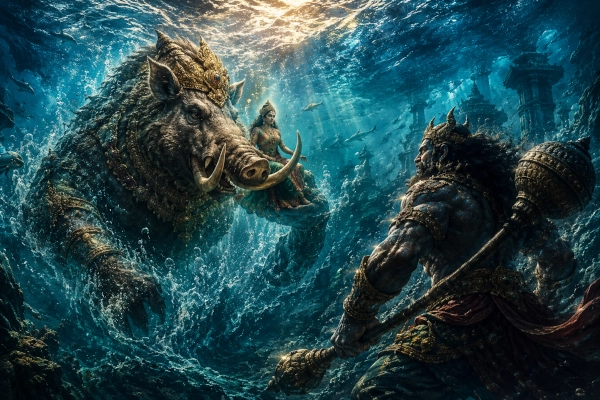
Among the most dramatic battles preserved in the Puranic tradition is the confrontation between Varaha, the boar incarnation of Vishnu, and the Daitya warrior Hiranyaksha. The episode, described prominently in the Bhagavata Purana and the Vishnu Purana, unfolds on a scale far beyond ordinary warfare. The Earth herself has disappeared beneath the primordial waters, creation has been thrown out of balance, and a powerful Asura stands in the path of restoration.
Vishnu does not descend in the form of a king, archer or warrior prince. He takes a form suited to the crisis itself. He becomes Varaha, the mighty cosmic boar, capable of plunging into the depths, finding the submerged Earth and raising her once more into the light.
What follows is more than a duel between two powerful beings. It is a rescue mission, an underwater battle, a test of strength, a contest of arrogance and restraint, and ultimately a struggle over whether cosmic order will be restored.
Hiranyaksha, the Warrior Who Sought an Equal
Hiranyaksha was born to the sage Kashyapa and Diti and belonged to the formidable Daitya lineage. Along with his brother Hiranyakashipu, he grew into a being of immense strength and ambition. Yet Hiranyaksha possessed something more dangerous than physical power. He developed an obsessive hunger for battle.
He wandered through the worlds searching for opponents worthy of his strength. Armed with his great mace and emboldened by repeated victories, he challenged powerful beings wherever he went. His confidence hardened into arrogance, and the more others withdrew before him, the more certain he became that no warrior could withstand him.
His search eventually led him to Varuna, lord of the waters. Hiranyaksha demanded battle, confident that even the ruler of the ocean would be unable to resist his challenge. Varuna declined and instead told him that there was only one being capable of satisfying his desire for combat.
That being was Vishnu.
For Hiranyaksha, the answer seemed almost like an invitation. At last, he believed, he had found the opponent he had been searching for.
He did not yet understand that he was being directed toward his destruction.
The Earth Sinks Beneath the Cosmic Ocean
While Hiranyaksha searched for battle, a far greater crisis had already engulfed creation. The Earth had sunk beneath the vast cosmic waters. Without Bhudevi restored to her proper place, the ordered world could not continue as it should.
Brahma and the sages contemplated the catastrophe. Then, in one of the most extraordinary moments in the Puranic imagination, a tiny boar appeared.
At first the creature seemed insignificant. Then it began to grow.
Its body expanded rapidly, becoming vast and luminous. What had appeared small enough to overlook became a colossal presence filling the heavens. The sages immediately understood that this was no ordinary animal.
Vishnu had manifested as Varaha.
The form was perfectly suited to the mission. A boar instinctively digs into the earth and penetrates mud and difficult ground with its snout and tusks. The cosmic Varaha would now plunge into the primordial waters and recover the Earth herself.
With a tremendous roar, Varaha entered the ocean.
The waters churned around him as he descended through depths inaccessible to ordinary beings. His immense form moved through the darkness until, far below the surface, he found Bhudevi.
Varaha lifted the Earth upon his tusks.
For a moment, the entire crisis seemed to have been resolved.
Then Hiranyaksha arrived.
A Rescue Mission Becomes a Battlefield
The Daitya saw Varaha carrying the Earth and immediately challenged him. Hiranyaksha mocked the divine boar, hurled insults at him and demanded that he fight.
Yet Varaha did not allow the enemy to dictate the sequence of events.
The Earth had to be secured first.
This is one of the most striking elements of the episode when viewed through the lens of warfare. Hiranyaksha wanted the confrontation to become a contest of pride and strength. Varaha remained focused on the actual objective.
Bhudevi had to be rescued.
Only after the Earth had been brought toward safety did Varaha fully turn his attention to the challenger.
The mission came before the duel.
Now, with Bhudevi secured, Vishnu faced Hiranyaksha.
The cosmic rescue had become a war.
Mace Against Mace
The battle opened with tremendous violence.
Varaha and Hiranyaksha confronted one another with massive maces. Each blow carried extraordinary force. The impact of weapon against weapon echoed across the battlefield, while the gods and sages watched with mounting anxiety.
Hiranyaksha was not a symbolic villain waiting to be defeated. He was a formidable warrior in his own right. He possessed enormous strength, courage and battlefield experience. He had challenged powerful beings across the worlds and had grown accustomed to watching opponents hesitate before him.
Against Varaha, however, he encountered something completely different.
This was not another celestial warrior who might be overwhelmed through aggression.
This was Vishnu himself, operating in a form built for the environment and the mission.
The two combatants struck at each other again and again. Their maces crashed together with such force that the battle seemed capable of shaking the surrounding worlds.
For Hiranyaksha, this was the battle he had always wanted.
For Varaha, it was merely the obstacle that stood between danger and restoration.
When the Weapon Is Lost
At one stage in the combat, Varaha’s mace was struck away.
For an ordinary warrior, the loss of a primary weapon in the middle of close combat could have been disastrous. Hiranyaksha might have believed that he had finally created an opening.
Yet Varaha’s power did not depend upon a single weapon.
The moment reveals an important difference between the two combatants. Hiranyaksha’s confidence rested heavily upon brute force and mastery of weapons. Varaha possessed the ability to adapt instantly.
The battle continued.
Vishnu could summon divine weapons such as the Sudarshana Chakra, but the confrontation increasingly moved into close quarters. Hiranyaksha attacked with renewed fury, believing that raw power could still turn the battle in his favour.
It could not.
The more intensely he fought, the more clearly his greatest weakness emerged.
He could not imagine a form of power greater than his own.
Maya Enters the Fight
When physical force failed to break Varaha, Hiranyaksha turned to supernatural deception.
The battlefield became filled with disturbance and illusion. Darkness, frightening manifestations and confusion arose around the combatants. What had begun as a direct duel now expanded into psychological and sensory warfare.
The use of maya is one of the most fascinating recurring elements in Puranic warfare. Victory does not always depend solely upon stronger weapons. The ability to confuse perception, create false threats, conceal reality and overwhelm the opponent’s senses can become equally important.
In modern military language, one could loosely compare such methods to deception, electronic warfare, camouflage or the manipulation of battlefield awareness.
The objective remains the same.
If an enemy cannot correctly understand what is happening around him, even overwhelming physical strength becomes difficult to use effectively.
But Hiranyaksha’s illusions could not confuse Vishnu.
The deceptions were broken.
Once again, the Daitya discovered that a method that might overwhelm ordinary opponents had little effect against the being before him.
The Battle Against Time
The confrontation was not merely a contest of strength. It also carried a sense of urgency.
Brahma and the celestial beings were concerned that the battle should be brought to a conclusion before conditions became more favourable to the Daitya.
This introduces another important principle of warfare into the story: timing.
No battlefield remains unchanged forever.
Light changes. Weather changes. Reinforcements arrive. Exhaustion sets in. Supply lines weaken. Tactical advantage shifts.
A warrior or commander who possesses an advantage must recognise when to use it decisively.
Varaha therefore moved toward the end of the battle.
There was no reason to prolong a duel whose outcome had already become clear.
The Earth had been rescued.
The enemy remained.
The threat now had to be removed.
The Fall of Hiranyaksha
The battle finally closed at short range.
Varaha struck Hiranyaksha with devastating force.
The mighty Daitya, who had wandered through the worlds demanding an opponent worthy of him, collapsed.
The warrior who had searched endlessly for battle had finally found the one enemy he could not overcome.
His strength had carried him across realms.
His courage had allowed him to challenge celestial powers.
His arrogance had convinced him that those victories proved universal superiority.
But none of those qualities could save him when he confronted Vishnu.
Hiranyaksha fell, and the obstruction to cosmic restoration was removed.
Bhudevi Rises Again
With the Daitya defeated, the deeper purpose of the incarnation became fully visible.
Varaha raised Bhudevi from the primordial waters and restored the Earth to her proper place.
This is the true climax of the episode.
The death of Hiranyaksha is important, but it is not the ultimate objective.
The victory lies in restoration.
Varaha did not descend to prove that he was stronger than the Daitya. He descended because the Earth had to be recovered.
That distinction separates the two warriors completely.
Hiranyaksha fought because battle confirmed his identity.
Varaha fought because battle was necessary to complete the mission.
One sought glory through power.
The other used power as an instrument of order.
Mission Before Pride
When read as a war story, the most striking decision Varaha makes may be the simplest one.
He refuses to abandon the rescue of Bhudevi merely because Hiranyaksha demands immediate combat.
The enemy wants a duel.
Varaha has an objective.
He secures the objective first.
Only then does he fight.
The principle remains recognisable even in modern warfare. A commander protecting a convoy cannot abandon it simply because an enemy attempts to lure him away. A fighter escort cannot chase every hostile aircraft if doing so exposes the aircraft it was assigned to protect. A rescue force cannot allow the enemy’s provocations to become more important than the people it was sent to save.
The opponent must never be allowed to redefine the mission.
Hiranyaksha tried to turn the event into a contest between warriors.
Varaha refused.
The Earth came first.
The Form Was Chosen for the Battlefield
The Varaha incarnation also demonstrates one of the most compelling ideas found throughout the stories of Vishnu: the form changes according to the threat.
The Earth was submerged beneath enormous waters.
The mission therefore required a being capable of moving naturally through that environment and physically raising the Earth.
Vishnu became the cosmic boar.
The logic resembles the development of specialised military platforms. A tank is designed for one environment. A submarine is designed for another. Aircraft operate in an entirely different domain. Amphibious vehicles exist because the boundary between land and water creates its own tactical challenges.
The battlefield determines the machine.
In the Puranic imagination, the battlefield determines the avatar.
Varaha is therefore not simply an animal form chosen for symbolism.
He is a mission-specific manifestation.
A Puranic Vision of Underwater Warfare
The setting makes the story especially unusual.
Most great ancient battle narratives unfold on land. Others describe celestial warfare or aerial chariots.
The Varaha episode moves the conflict beneath the cosmic ocean.
It is warfare in an environment hostile to ordinary movement and visibility. The depths themselves become part of the challenge.
Varaha enters that world naturally.
Hiranyaksha, who had already moved through the oceanic realm in search of combat, also possesses the ability to operate there.
The encounter therefore becomes one of the most striking examples of subsurface combat in the Puranic tradition.
The image is extraordinary.
Far below the surface, amid darkness and immense waters, two colossal beings clash while the Earth itself hangs in the balance.
It is difficult to imagine a more dramatic battlefield.
Hiranyaksha’s Fatal Miscalculation
Hiranyaksha’s greatest error was not weakness.
It was the inability to recognise the limits of his own strength.
Repeated victory can become dangerous because it changes the way a warrior sees the world. Opponents stop being evaluated individually. Past success begins to substitute for present analysis.
Hiranyaksha had defeated or intimidated so many adversaries that he assumed every future conflict would follow the same pattern.
When Varaha appeared, he did not pause to reassess.
He mocked him.
He challenged him.
He attacked him.
He believed that if enough force were applied, victory would inevitably follow.
This is one of warfare’s oldest mistakes.
The enemy before you is not necessarily the same as the enemies behind you.
Hiranyaksha finally encountered an opponent whose strength could not be measured by his previous experience.
By the time he understood that difference, the battle was already lost.
The Warrior and the Protector
The deepest contrast in the story lies in the motives of the two combatants.
Hiranyaksha wants conflict because conflict allows him to display power.
Varaha accepts conflict because power must be used to protect something greater.
The Puranic tradition does not reject martial strength. Varaha is overwhelmingly powerful. He fights directly and violently when required.
The difference lies in purpose.
Power used only to dominate becomes arrogance.
Power used to restore balance becomes protection.
That is the moral structure beneath the battlefield.
Hiranyaksha may appear to be the more aggressive warrior, but Varaha is the more complete one because he never loses sight of why the battle is being fought.
The Prelude to Narasimha
The death of Hiranyaksha also sets in motion another great Puranic conflict.
His brother Hiranyakashipu becomes consumed with fury over his death.
Hiranyakashipu then undertakes extraordinary austerities, obtains powerful protections from Brahma and eventually establishes his own domination over the worlds.
That crisis leads to the appearance of Narasimha.
The two stories therefore form a remarkable pair.
Against Hiranyaksha, Vishnu confronts overwhelming physical aggression in a hostile environment and assumes the form of Varaha.
Against Hiranyakashipu, Vishnu confronts a ruler protected by carefully constructed conditions of invulnerability and assumes the form of Narasimha.
In both cases, the avatar is shaped by the nature of the threat.
One enemy requires a being capable of entering the cosmic waters.
The other requires a being capable of existing between categories.
The response is never random.
It is adaptive.
One of the Great Warcraft Moments of the Puranas
The battle between Varaha and Hiranyaksha contains nearly every element of a great war narrative.
There is a world-threatening crisis, a submerged Earth, a rescue mission, a specialised divine warrior, an underwater battlefield, close combat with maces, supernatural deception, divine weapons, urgency and finally a decisive confrontation between arrogance and disciplined purpose.
Yet the most important lesson lies beneath all of that spectacle.
The battle is never the objective.
Hiranyaksha wanted battle because victory would confirm his power.
Varaha wanted Bhudevi restored.
One warrior chased combat.
The other completed a mission.
When Varaha finally rose from the primordial waters carrying the Earth upon his tusks, the image represented something far greater than the defeat of a single Daitya.
The world itself had been recovered.
The waters that had swallowed Bhudevi could no longer hold her.
The warrior who tried to prevent her restoration had fallen.
And Vishnu, in the form perfectly suited to the crisis, had once again restored cosmic order.
That is why the battle of Varaha and Hiranyaksha beneath the primordial waters stands among the greatest Warcraft moments of the Puranas.
You may also like
-
Sindhu: The Indus Kingdom of Jayadratha in the Mahabharata
-
Kuninda or Kulinda: The Himalayan Realm of the Mahabharata in Uttarakhand and Himachal Pradesh
-
Durga versus Mahishasura: Weapons, Battlefield Tactics and the Triumph of Shakti
-
Kuluta: The Kullu Valley Kingdom of the Mahabharata
-
Trigarta: The Kangra–Jalandhar Kingdom of the Mahabharata
