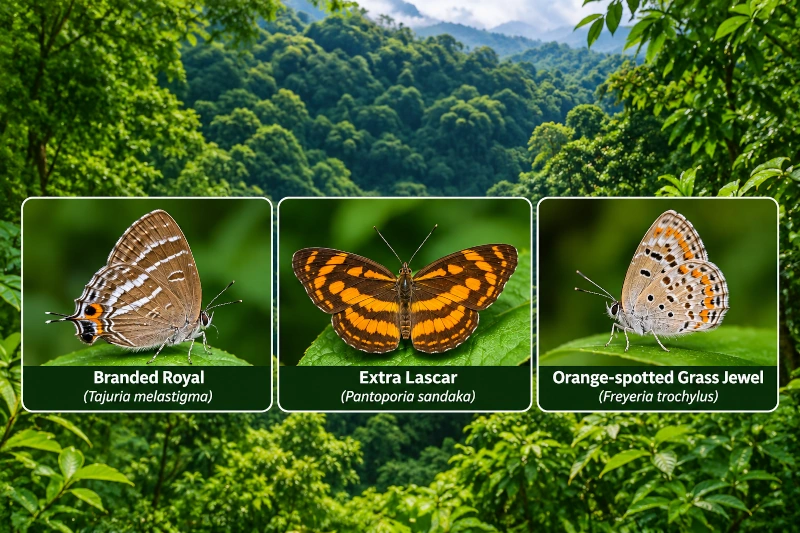
Three butterfly species have been recorded for the first time in Kerala’s Silent Valley National Park during a three-day biodiversity survey conducted from November 13 to 15, 2026. The survey documented 189 butterfly species across the protected forest and its buffer areas, providing fresh information on the remarkable insect diversity of the Western Ghats.
The three newly recorded species are Branded Royal, Extra Lascar and Orange-spotted Grass Jewel. Their documentation adds to the known butterfly diversity of Silent Valley National Park in Palakkad district, one of India’s important tropical evergreen forest ecosystems.
The survey was jointly organised by the Kerala Forests and Wildlife Department and the Malabar Natural History Society (MNHS), with the participation of approximately 68 researchers, naturalists, butterfly enthusiasts and trained volunteers.
Three New Butterfly Records from Silent Valley
The three butterflies identified during the survey represent additions to the national park’s documented species records rather than species newly discovered by science.
The Branded Royal is a relatively rare forest-dwelling butterfly distinguished by characteristic wing markings. Its presence within Silent Valley provides an additional record of the butterfly fauna associated with the protected forest landscape.
The Extra Lascar is recognised by its distinctive brown and orange wing patterns. The species belongs to a group of butterflies whose wing markings and colouration are useful characteristics for identification during field surveys.
The Orange-spotted Grass Jewel is among India’s smallest butterflies and is generally associated with grasslands and open scrub habitats. Its presence within the surveyed landscape demonstrates the importance of examining different habitat types rather than restricting biodiversity assessments to dense evergreen forests.
The observations extend the documented distribution of these species within Silent Valley and provide additional information for future ecological surveys and conservation studies.
Survey Records 189 Butterfly Species
According to Muhamed Jafer Palot of the Zoological Survey of India, who participated in the survey, researchers recorded 189 butterfly species during the three-day exercise.
The fieldwork covered 15 locations across Silent Valley National Park and its buffer zone, allowing researchers to examine butterfly populations in different forest habitats and environmental conditions.
The survey teams documented species diversity, distribution patterns, breeding habitats, larval host plants and nectar sources.
Researchers also examined differences in butterfly occurrence across altitudes and habitats, along with seasonal variations in their activity.
The exercise was designed to gather information beyond the identification of individual species, providing a broader understanding of the ecological conditions supporting butterfly diversity within the protected landscape.
Silent Valley’s Butterfly Diversity
Silent Valley National Park forms part of the Western Ghats biodiversity hotspot and the Nilgiri Biosphere Reserve. Its forest ecosystems include tropical evergreen forests, montane vegetation and adjoining grassland habitats.
These habitats support a wide variety of insects, birds, mammals, reptiles and other wildlife, including species endemic to the Western Ghats.
According to the park’s management plan for 2022–2032, approximately 205 butterfly species have been documented in Silent Valley and adjoining areas, including Attappadi.
Muhamed Jafer Palot clarified that the figure in the management plan includes species recorded from the wider landscape and should not be interpreted as a count restricted entirely to the national park’s core area.
The latest survey’s observation of 189 species represents the diversity documented during the three-day field exercise, rather than the total number of butterfly species known from the entire Silent Valley landscape.
The detailed findings of the survey are expected to be compiled following the completion of the fieldwork.
Importance of Butterflies in Forest Ecosystems
Butterflies play an important ecological role in forest ecosystems, particularly through their interactions with flowering plants and their dependence on specific vegetation during different stages of their life cycle.
Many butterfly species rely on particular host plants for egg-laying and larval development, while adult butterflies obtain nectar and other nutrients from flowers and natural sources.
Their distribution is therefore closely associated with vegetation, habitat characteristics, seasonal conditions and the availability of food resources.
Changes in butterfly diversity and population composition can provide useful indications of changes in habitat conditions and ecological processes.
Biodiversity surveys that document butterflies alongside larval host plants, nectar sources and breeding habitats provide information relevant to understanding these ecological relationships.
The Silent Valley survey’s emphasis on distribution patterns, host plants and habitat preferences will contribute to the existing knowledge of butterfly ecology in the Western Ghats.
Systematic Biodiversity Monitoring in the Western Ghats
Regular biodiversity surveys are important for understanding the distribution of species within protected forests and identifying changes in their occurrence over time.
Silent Valley’s combination of evergreen forests, higher-altitude habitats and adjoining open vegetation creates different ecological conditions within a relatively compact landscape.
Surveying these habitats allows researchers to document species that may be overlooked during observations confined to particular forest areas.
The latest exercise involved researchers, naturalists and trained volunteers working with the Kerala Forests and Wildlife Department, demonstrating the contribution of collaborative field studies to biodiversity documentation.
The recording of Branded Royal, Extra Lascar and Orange-spotted Grass Jewel provides additional distribution records that can be incorporated into future scientific assessments of Silent Valley’s butterfly fauna.
The findings also highlight the importance of maintaining detailed species checklists and periodically updating them through systematic surveys.
New Records Strengthen Knowledge of Silent Valley’s Biodiversity
The identification of three butterfly species previously unrecorded within Silent Valley National Park adds another dimension to the growing documentation of the protected area’s biological diversity.
The three-day survey, which recorded 189 butterfly species across 15 locations, provides researchers with information on species occurrence, habitat preferences, breeding environments and food plants.
The participation of the Kerala Forests and Wildlife Department, the Malabar Natural History Society and researchers associated with the Zoological Survey of India reflects the role of institutional collaboration in documenting the biodiversity of the Western Ghats.
The latest findings reinforce Silent Valley National Park’s importance as a centre of biodiversity research and conservation, while demonstrating how systematic field surveys continue to improve scientific understanding of India’s natural heritage.
You may also like
-
Rare Willow Warbler Recorded for First Time in Karnataka at Mangaluru Grasslands
-
Scientists Discover New Flowering Plant Disporopsis crispata in Arunachal Pradesh, First Record of Genus in India
-
Critically Endangered Spoon-Billed Sandpiper Returns to Bengal Coast After 8,000-Km Migration from Russia
-
Assam Releases 240 Critically Endangered Black Softshell Turtle Hatchlings into Roumari Beel
-
Golden Rattlepod Flowers Transform Munnar’s Yellapetty Hills into a Sea of Yellow
