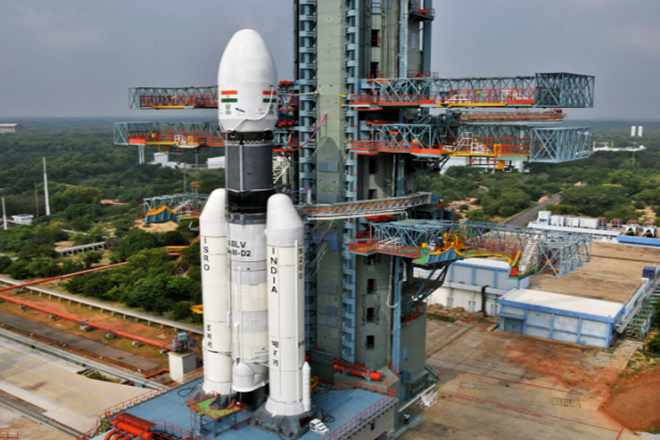
Chennai: The Indian Space Research Organisation (ISRO) is planning to launch its GSLV MkIII-D2 mission, carrying India’s high throughput communication satellite GSAT-29, on November 14, subject to weather conditions.
GSLV MkIII-D2 is the second developmental flight of Geosynchronous Satellite Launch Vehicle (GSLV) Mark III. In this flight, the vehicle will carry the 3,423 kg GSAT-29 satellite and place it in Geosynchronous Transfer Orbit (GTO). GSLV MkIII is the fifth-generation launch vehicle developed by ISro and it is designed to place a satellite of up to 4,000 kgs in GTO.
The rocket is scheduled to take off from the second launch pad at Satish Dhawan Space Centre SHAR, Sriharikota subject to weather conditions, said Isro.
GSLV MkIII-D2 will inject the satellite into GTO with a required inclination to the equator. The satellite will be placed in its final Geostationary Orbit (GEO) using the onboard propulsion system. It may take a few days after separation from launcher to reach its orbital slot, said Isro.
GSLV MkIII is a three-stage heavy lift launch vehicle developed by ISRO. The vehicle has two solid strap-ons as first stage, a liquid propellant core as the second stage and a cryogenic as third stage. GSLV Mk III is designed to carry 4 ton class of satellites into Geosynchronous Transfer Orbit (GTO) or about 10 tons to Low Earth Orbit (LEO), which is about twice the capability of GSLV Mk II.
GSAT-29 is a multibeam, multiband communication satellite weighing 3423 kgs. The spacecraft will be located at 55 °E longitude and designed for a mission life of 10 years. The satellite carries Ka/Ku-band high throughput communication transponders intended to meet the communication requirements of users including those in remote areas. In addition, several new technologies such as Q/V-band payload, data transmission through optical communication link will be demonstrated. This will help in realizing future advanced satellites.
This is the 33rd communication satellite built by Isro.
Source: Business Standard
Image Courtesy:TFE
You may also like
-
Indian Researchers Combine AI and Infrared Spectroscopy to Detect Parkinson’s-Linked Biochemical Changes in Fruit Flies
-
IIT Hyderabad Develops Lung-Derived Bioink for 3D Bioprinting and Regenerative Medicine
-
Indian Scientists Discover Molecular Switch That Can Regulate Cellular Autophagy
-
Scientists Map Earliest Glow of Hydrogen, Opening A New Window to the Universe
-
Indian Researchers Study RAD51 DNA-Repair Gene Variant in Prostate Cancer
