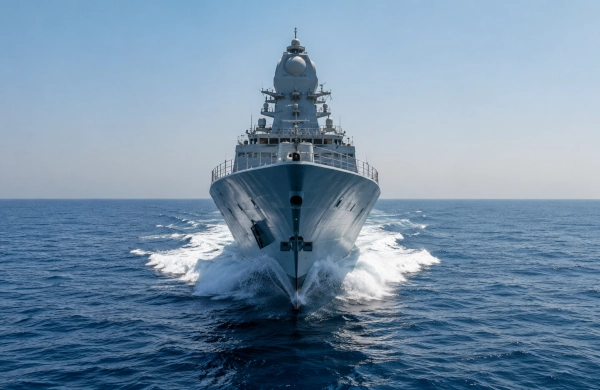
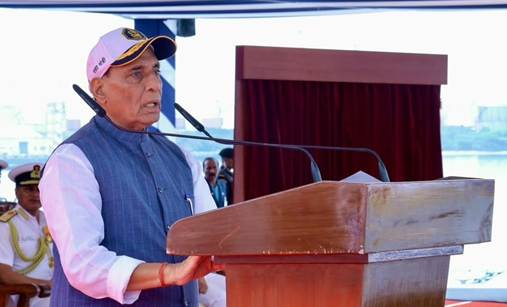
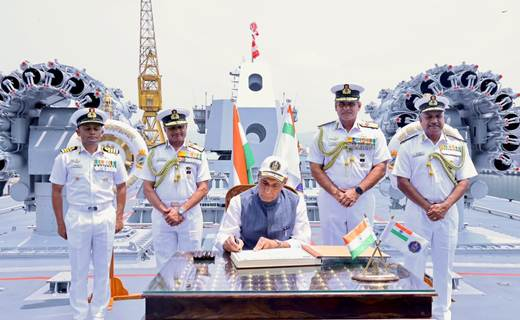
India added another powerful indigenous warship to its naval fleet on July 11, 2026, with the commissioning of the advanced stealth frigate INS Mahendragiri at Visakhapatnam. The ceremony was presided over by Defence Minister Rajnath Singh, marking a major milestone in India’s drive to build a technologically advanced, combat-ready and self-reliant maritime force.
INS Mahendragiri has joined the Indian Navy’s Eastern Fleet, also known as the Sunrise Fleet. The frigate will strengthen India’s maritime combat capabilities along the eastern seaboard and extend the Navy’s operational reach across the Indian Ocean Region.
Built with more than 75 per cent indigenous content, the warship represents the growing capabilities of India’s naval design, shipbuilding and defence-manufacturing ecosystem.
Sixth Project 17A Frigate Commissioned
INS Mahendragiri is the sixth Project 17A stealth frigate to enter service with the Indian Navy within approximately 18 months.
The first ship of the class, INS Nilgiri, was commissioned in January 2025. It was followed by INS Udaygiri and INS Himgiri in August 2025, INS Taragiri in April 2026 and INS Dunagiri in June 2026.
The rapid induction of these advanced frigates reflects the expansion of India’s indigenous warship-construction programme and the ability of domestic shipyards to deliver sophisticated naval platforms within increasingly shorter timelines.
INS Mahendragiri was designed by the Indian Navy’s Warship Design Bureau and constructed by Mazagon Dock Shipbuilders Limited in Mumbai.
The frigate has been designed to undertake a broad range of maritime missions, including fleet air defence, anti-surface warfare, anti-submarine warfare, maritime surveillance, interdiction operations and humanitarian assistance and disaster relief missions.
Advanced Weapons and Combat Systems
INS Mahendragiri has a displacement of approximately 6,670 tonnes and can achieve speeds of up to 28 knots.
The warship carries a sophisticated combination of missile systems, underwater weapons, sensors, electronic warfare equipment and network-centric combat systems designed to counter aerial, surface and underwater threats.
The frigate can be equipped with the BrahMos supersonic surface-to-surface cruise missile, providing it with a powerful long-range strike capability against enemy warships and land-based targets.
Its air-defence configuration includes multifunction radar and medium-range surface-to-air missiles capable of detecting, tracking and engaging hostile aircraft, helicopters, drones and incoming missiles at extended ranges.
The ship’s anti-submarine warfare capabilities include indigenous rocket launchers, torpedo launchers and an Integrated Anti-Submarine Defence System. An embarked multi-role helicopter further expands its ability to detect and engage submarines beyond the range of the ship’s onboard sensors.
INS Mahendragiri is also equipped with an electronic warfare suite and a Close-In Weapon System for protection against missiles and aircraft that penetrate its outer defensive layers.
These systems allow the frigate to operate as part of a naval task force or independently during extended deployments across distant waters.
Designed for Stealth and Survivability
The Project 17A frigates incorporate advanced stealth features intended to reduce their radar, infrared, acoustic and visual signatures.
The shape of the hull and superstructure, along with the careful positioning of weapons, sensors and communication systems, helps reduce the ship’s detectability during maritime operations.
INS Mahendragiri features a Combined Diesel or Gas propulsion arrangement, enabling the vessel to balance fuel-efficient cruising with the high-speed performance required during combat operations.
An Integrated Platform Management System allows the crew to monitor and control propulsion, power generation, machinery, damage-control systems and other essential ship functions through a centralised digital network.
The combination of stealth, speed, sensors and layered defensive systems gives the frigate strong survivability in complex maritime combat environments.
Expanding India’s Blue-Water Reach
Defence Minister Rajnath Singh described INS Mahendragiri as a symbol of India’s progress towards self-reliance in warship construction and maritime defence technology.
He stated that the frigate would protect India’s maritime interests both near the coast and across the deep oceans.
The induction of the warship will strengthen India’s blue-water naval capability—the ability to conduct sustained maritime operations far from national shores.
INS Mahendragiri will support the Indian Navy’s presence across the Indian Ocean Region, including important sea lanes connecting the Persian Gulf, the Red Sea, the Arabian Sea, the Bay of Bengal, the Malacca Strait and the wider Indo-Pacific.
These maritime routes carry a major share of India’s international trade, energy imports and essential cargo. Protecting them remains central to the country’s national security and economic stability.
Conventional Strength and Emerging Technology
Rajnath Singh highlighted the changing character of modern warfare, shaped by artificial intelligence, drones, cyber operations, space-based capabilities, hypersonic weapons and unmanned systems.
He emphasised that conventional military capabilities continue to form the foundation of credible national defence.
Advanced technologies and traditional combat platforms increasingly operate as part of a unified military network. Warships such as INS Mahendragiri can integrate information from aircraft, satellites, unmanned systems, coastal sensors and other naval vessels to build a wider operational picture.
This network-centric capability enables faster decision-making, coordinated targeting and more effective responses to threats across large maritime areas.
The Defence Minister stated that India would continue investing in next-generation technology while simultaneously strengthening conventional platforms, trained personnel and operational readiness.
Protecting India’s Maritime Economy
INS Mahendragiri enters service at a time when maritime security has become closely connected with economic security.
India depends heavily on secure sea routes for the movement of crude oil, natural gas, coal, industrial materials, food products and manufactured goods.
Naval operations increasingly include the protection of merchant vessels, anti-piracy missions, surveillance of strategic waterways and assistance during regional crises.
During Operation Urja Suraksha, the Indian Navy safely escorted 18 merchant vessels carrying essential cargo valued at more than ₹9,000 crore amid instability in West Asia.
Such missions illustrate the Navy’s role in protecting India’s economic lifelines in addition to defending the country against conventional military threats.
INS Mahendragiri will add another capable platform for escort missions, maritime-domain awareness, sea-lane protection and rapid deployment during regional emergencies.
India as a Security Partner in the Indo-Pacific
The Indian Navy has emerged as an important first responder and security partner across the Indo-Pacific.
Its responsibilities include humanitarian assistance, disaster relief, anti-piracy patrols, search-and-rescue operations, evacuation missions and the protection of commercial shipping.
India’s maritime approach is guided by the vision of Security and Growth for All in the Region, or SAGAR, and the broader MAHASAGAR framework.
Through these initiatives, India seeks to promote maritime stability, regional cooperation, capacity building and the free movement of lawful commerce across international waters.
INS Mahendragiri will contribute to these objectives by providing the Navy with an advanced platform capable of sustained operations, multinational exercises and coordinated maritime-security missions.
More Than 200 Indian Industries Contributed
The construction of INS Mahendragiri involved more than 200 Indian industries, including a large number of micro, small and medium enterprises.
The project created demand across sectors such as specialised steel, electronics, sensors, propulsion equipment, software, precision engineering, communications, weapon integration and logistics.
Indigenous warship construction therefore supports a broader industrial ecosystem extending far beyond the shipyard itself.
Each advanced naval project helps India develop specialised design knowledge, skilled manpower, manufacturing infrastructure and systems-integration expertise that can be applied to future destroyers, frigates, submarines and unmanned platforms.
The high level of indigenous content in INS Mahendragiri reflects the increasing involvement of Indian public-sector units, private companies, start-ups and MSMEs in the defence supply chain.
Faster Construction and Testing
The Project 17A programme has also established new benchmarks in warship delivery.
According to Chief of the Naval Staff Admiral Krishna Swaminathan, the period between the launch and delivery of the ship was reduced by approximately 50 per cent, from 63 months to 31 months.
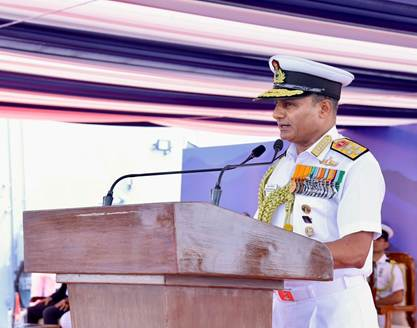
The overall construction period fell by around 20 per cent, declining from approximately 95 months to 75 months.
Technical analyses that would ordinarily require between five and seven sea trials were completed during a single sea trial.
These improvements reflect closer cooperation among Mazagon Dock Shipbuilders Limited, the Indian Navy, equipment manufacturers, MSMEs, trial agencies, the Warship Overseeing Team and the ship’s crew.
The reduction in construction and testing time also demonstrates the growing maturity of India’s naval shipbuilding processes and systems-integration capabilities.
Symbolism of Mahendragiri
The frigate is named after the Mahendragiri mountain range in the Eastern Ghats, a landscape associated with strength, endurance and steadfastness.
The ship carries the motto “Mighty, Majestic, Matchless,” reflecting its role as a frontline surface combatant of the Indian Navy.
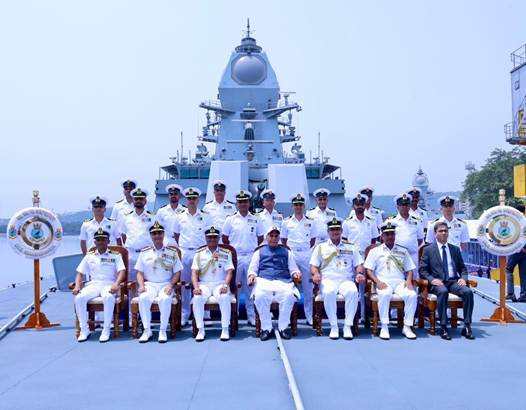
The commissioning ceremony included the traditional breaking of the commissioning pennant and the maiden hoisting of the National Flag onboard the vessel.
Senior naval officers, veterans, representatives of the shipbuilding industry and officials associated with the construction programme attended the ceremony.
A Major Addition to the Eastern Fleet
The induction of INS Mahendragiri gives the Eastern Naval Command another modern platform for operations across the Bay of Bengal and the wider Indo-Pacific.
The frigate can operate with aircraft carriers, destroyers, submarines, maritime-patrol aircraft and other fleet assets during complex naval missions.
Its combination of long-range missiles, air-defence systems, anti-submarine weapons, stealth characteristics and modern sensors makes it capable of defending naval formations while also conducting offensive maritime operations.
INS Mahendragiri represents the progress India has made in designing and constructing high-end warships through domestic capabilities.
Its commissioning strengthens India’s eastern seaboard, expands the Navy’s blue-water reach and reinforces the country’s position as a major maritime power in the Indian Ocean Region.
As India continues to modernise its naval forces, platforms such as INS Mahendragiri will form the backbone of a future-ready fleet capable of protecting the nation’s maritime territory, commercial interests and strategic influence across distant seas.
Reference: PIB
You may also like
-
PRAHAAR: India’s First National Counter-Terrorism Policy and Strategy
-
Takshak Heavyweight Torpedo: How India’s Indigenous Submarine Weapon Compares With the World’s Leading Torpedoes
-
Embraer Builds Dual Aerospace Strategy in India Through C-390 Military and E175 Regional Aircraft Programmes
-
NextLeap Tests Indigenous Jet Engine for Long-Range Stryker Kamikaze UAV
-
Côte d’Ivoire Military Delegation Visits HAL, Shows Interest in India’s Indigenous Aerospace Platforms
