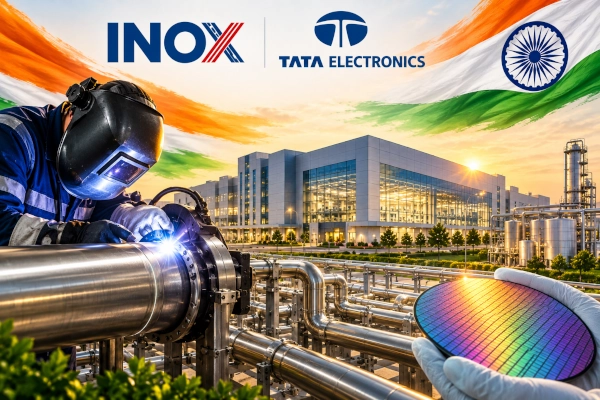
India’s semiconductor manufacturing programme is beginning to create opportunities far beyond the companies that will actually fabricate chips. INOX India Limited, better known for its cryogenic engineering and equipment business, has secured its first orbital-welding order for work at Tata Electronics’ semiconductor fabrication facility at Dholera in Gujarat, marking its entry into the specialised infrastructure required to build and operate advanced semiconductor fabs.
The order was confirmed by INOX India Chief Executive Officer Deepak Acharya following SEMICON India 2026. The company has not disclosed the financial value of the contract, but the work involves orbital welding for ultra-high-purity piping within the Dholera complex. INOX India is already bidding for additional semiconductor infrastructure projects as it develops this activity into a new area of business.
Nearly 400 Kilometres of Piping Inside the Fab
The scale of the infrastructure hidden behind semiconductor manufacturing is evident from the Dholera project itself. According to Acharya, one Tata Electronics project requires almost 400 kilometres of piping to connect different manufacturing tools and supporting systems across the facility.
Only around 50 to 60 per cent of this network is expected to use stainless-steel piping, while the remainder includes thermoplastic systems. These pipelines will transport gases, cryogenic liquids, chemicals, slurry, water and ultra-high-purity water required by different stages of semiconductor production.
This is not conventional industrial piping. Semiconductor fabrication requires exceptionally clean environments because even extremely small contaminants can interfere with manufacturing processes. Gases, chemicals and liquids reaching fabrication equipment must therefore travel through systems designed and installed to stringent purity standards.
The joining of these pipelines consequently becomes a precision manufacturing task in its own right.
Orbital Welding Brings Precision to Semiconductor Piping
Orbital welding is an automated welding process in which a welding head travels around a stationary tube or pipe. Parameters such as welding current, travel speed and heat input can be tightly controlled, producing consistent joints with considerably greater repeatability than ordinary manual welding.
The technique is particularly suited to high-purity stainless-steel piping used in semiconductor plants, pharmaceutical manufacturing, aerospace systems and other industries where the internal condition of a pipeline is critical.
For a semiconductor fab, poor-quality welding can introduce particles or contaminants into the process system. Those contaminants can subsequently reach manufacturing equipment through speciality gases or chemicals and interfere with the extremely small structures being created on semiconductor wafers.
INOX India’s Dholera order therefore represents entry into one of the less visible but technologically important layers of semiconductor manufacturing infrastructure.
India Needs Hundreds of Specialised Welders
The contract has also highlighted a workforce requirement that will grow as India constructs more semiconductor facilities. Acharya has said that one Tata project alone could require at least 400 welders with the necessary specialised skills.
India currently does not have this workforce available at sufficient scale. INOX India has trained an initial batch and plans to deploy around 10 trained welders first. The company intends to train another 30 to 40 personnel every month as semiconductor infrastructure work expands.
INOX India is also looking beyond welding. Its plans encompass installation, commissioning, non-destructive testing and associated process-piping activities, potentially allowing the company to participate in a larger portion of the infrastructure work surrounding semiconductor manufacturing equipment.
INOX India Had Already Begun Building the Skills
The company began preparing for this opportunity before securing the Dholera orbital-welding contract. In June 2026, INOX India and ITM SLS Baroda University announced a collaboration to develop an Orbital Welding and Process Piping Skill Excellence Centre at the university’s Paldi campus in Vadodara.
The centre is specifically intended to build technical skills required for semiconductor fabrication facilities and advanced electronics manufacturing plants. Its training areas include installation, fabrication and maintenance of ultra-high-purity gas-distribution systems, semiconductor process utilities and advanced orbital-welding applications.
The initiative is significant because semiconductor localisation ultimately depends on more than constructing fabs or acquiring manufacturing equipment. India also needs technicians, engineers and specialist contractors capable of installing and maintaining the systems surrounding those machines.
INOX India is attempting to build precisely that capability.
Cryogenic Engineering Opens a New Semiconductor Business
The move into semiconductor infrastructure is also a logical extension of INOX India’s existing engineering capabilities. The company designs and manufactures vacuum-insulated cryogenic equipment used for storing, transporting and distributing liquid gases including LNG, hydrogen, oxygen and nitrogen.
Semiconductor fabs depend extensively on sophisticated gas-handling and distribution systems. Although semiconductor applications impose considerably stricter purity requirements than many conventional industrial operations, the underlying expertise in cryogenic storage, transportation, process systems and specialised piping provides INOX India with an existing engineering base from which to expand.
The company has already secured more than ₹30 crore of orders connected with the Dholera project for tanks, storage systems and transportation equipment. It has also supplied equipment for Micron’s semiconductor facility at Sanand and Tata Electronics’ semiconductor projects at Dholera and in Assam.
INOX India has international semiconductor exposure as well. Its management has pointed to equipment supplied for semiconductor-related facilities in the United States, Taiwan and Singapore.
The orbital-welding order moves the company further into the actual integration of semiconductor manufacturing infrastructure rather than limiting its role to equipment supply.
Speciality Gases Could Become Another Opportunity
Another important part of the emerging ecosystem is speciality gases. Semiconductor manufacturing consumes a range of gases under tightly controlled conditions, making their production, storage and distribution an important component of fab infrastructure.
INOX Air Products is establishing a speciality-gas facility near Tata Electronics’ Dholera plant. Locating such capacity close to the semiconductor complex can simplify logistics and potentially support future pipeline-based supply arrangements.
This development illustrates how semiconductor manufacturing can pull adjacent industries into a new supply chain. Cryogenic engineering companies, gas producers, precision piping specialists, chemical suppliers, logistics providers and technical-training institutions can all become part of the ecosystem surrounding a fabrication plant.
Dholera Is Taking Shape as a Semiconductor Manufacturing Cluster
Tata Electronics is building a 300-mm, or 12-inch, semiconductor fabrication plant at Dholera with a planned investment of approximately US$11 billion. The facility is being developed with Taiwan’s Powerchip Semiconductor Manufacturing Corporation and is expected to have a planned monthly capacity of 50,000 wafers.
The fab is designed to manufacture analog and logic integrated circuits using process technologies ranging from 28 nanometres to 110 nanometres. Tata Electronics expects chips produced at Dholera to serve applications spanning automotive electronics, communications, computing, mobile devices, artificial intelligence, Internet of Things systems and data storage.
The project has consequently begun attracting an extensive supporting ecosystem.
Tata Electronics recently announced a collaboration with Malaysia’s Kelington to support critical infrastructure and systems required to bring the Dholera fab towards operational readiness. The partnership also envisages developing local engineering capabilities and technical talent in India.
Tata Electronics has separately entered partnerships covering semiconductor materials, chemicals, equipment, technology, logistics and workforce development. Its collaboration with Japan’s Sojitz Corporation and NRS Corporation, for example, is aimed at developing a supply and storage framework for critical semiconductor materials used at Dholera.
These developments show that the Dholera project is gradually evolving from a single semiconductor factory into a broader industrial cluster.
The Industrial Ecosystem Behind a Made-in-India Chip
A semiconductor wafer emerging from a fab represents only the visible end product of an extraordinarily complex industrial system. Behind it are cleanrooms, lithography machines, deposition and etching equipment, ultra-pure water plants, vacuum systems, speciality gases, chemicals, cryogenic equipment, high-purity piping, precision welding, hazardous-material logistics and thousands of trained engineers and technicians.
India’s semiconductor programme therefore cannot be measured solely by the number of fabs approved or the volume of chips eventually produced. A deeper measure of localisation will be the extent to which Indian companies acquire the ability to build, operate, maintain and eventually manufacture the specialised systems surrounding those fabs.
The INOX India order is modest when compared with the ₹91,000-crore scale of the Dholera semiconductor project. Its significance lies elsewhere. An Indian engineering company that built its capabilities around cryogenic technology is now applying those capabilities to ultra-high-purity semiconductor infrastructure, while simultaneously developing a domestic workforce to perform the work.
As more such capabilities emerge in process piping, speciality gases, chemicals, precision engineering, semiconductor equipment and materials, a larger portion of the value created by India’s semiconductor expansion can remain within the country.
The first orbital-welding order at Dholera is therefore not simply another industrial contract. It is an early indication that the infrastructure beneath India’s semiconductor ambitions is itself beginning to develop an Indian supply chain.
References
INOX India Limited — “INOXCVA & ITM SLS Baroda to Develop an Orbital Welding & Process Piping Skill Excellence Centre for Building India’s Semicon Talent Pool”, 18 June 2026
https://inoxcva.com/news-and-events-inner.php?id=317
Tata Electronics — “Tata Electronics and Kelington Collaborate to Accelerate Operational Readiness of Dholera Fab”, 18 September 2026
https://www.tataelectronics.com/w/tata-electronics-and-kelington-collaborate-to-accelerate-operational-readiness-of-dholera-fab
Tata Electronics — Semiconductor Foundry — Dholera Fab
https://www.tataelectronics.com/semiconductor-foundry
Tata Electronics — “Tata Electronics, Sojitz Corporation and NRS CORPORATION Announce Partnership to Develop Semiconductor Materials Supply Chain for Dholera Fab”, 18 September 2026
https://www.tataelectronics.com/w/tata-electronics-sojitz-corporation-and-nrs-corporation-announce-partnership-to-develop-semiconductor-materials-supply-chain-for-dholera-fab
Press Information Bureau — “India Semiconductor Mission, Tata Electronics, and Tata Semiconductor Manufacturing Sign Fiscal Support Agreement for Semiconductor Fab”, 5 March 2025
https://www.pib.gov.in/Pressreleaseshare.aspx?PRID=2108602
Moneycontrol — “INOX India Bags First Orbital Welding Order, to Work on Piping at Tata Electronics’ Dholera Chip Facility”, 22 September 2026
Electronics For You — “INOX India Wins First Orbital Welding Order for Tata Electronics’ Dholera Fab”, 23 September 2026
https://www.electronicsforyou.biz/industry-buzz/inox-india-wins-first-orbital-welding-order-for-tata-electronics-dholera-fab/
Trim the repeated ecosystem conclusionsClarify the INOX India order scope
You may also like
-
ideaForge Secures ₹151 Crore Government Support to Develop YETI Heavy-Lift Autonomous Logistics Drone
-
JSR Dynamics Advances Indigenous Jet-Powered Weapons and Guided Rockets
-
Pune Startup Hyperonic Engineering Develops Indigenous Hydrogen Refuelling Systems for Clean Transportation
-
IIT Madras Startup Folium Sensing Develops Fibre-Optic Technology to Monitor Railways, Pipelines and Border Security
-
IIT Roorkee Startup Metastable Materials Develops Indigenous Technology to Recover Critical Battery Metals
