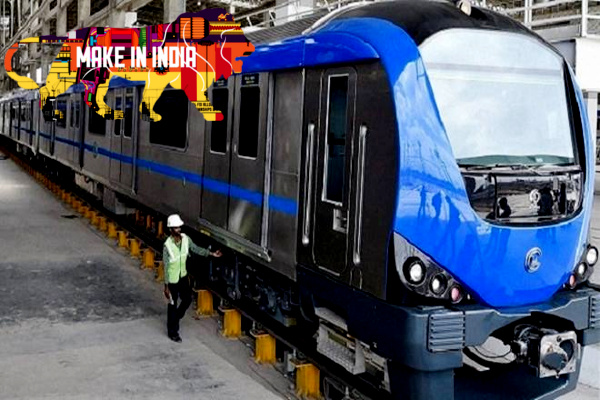
India’s rapidly expanding metro rail network is moving closer to becoming the second largest in the world, with Union Housing and Urban Affairs Minister Manohar Lal saying the country could surpass the United States within the next two years.
Speaking in Indore on September 5 after the expansion of the city’s metro service, the minister said India’s operational metro network has now reached around 1,170 km across 26 cities. He placed the corresponding network in the United States at around 1,386 km, leaving India roughly 216 km behind.
If the current expansion continues, India could therefore move ahead of the United States and become second only to China in terms of operational metro rail network length. China remains far ahead, with the minister citing a network of around 8,000 km.
The latest milestone continues a major expansion of urban rail infrastructure over the past decade. Official data from the Ministry of Housing and Urban Affairs show that India had only 248 km of operational metro lines across five cities in 2014. By March 2026, the network had crossed 1,155 km and spread to 26 cities, already making India the world’s third-largest metro rail network.
The pace at which new lines are being commissioned has also increased sharply. According to the ministry, metro construction and commissioning averaged only around 0.68 km a month before 2014. It has subsequently increased to around six km a month. Daily metro ridership has meanwhile risen from roughly 28 lakh passengers in 2013-14 to more than 1.15 crore passengers.
Indore contributed to the latest expansion with the opening of another major section of its Yellow Line. Commercial metro operations had previously been limited to approximately six km between Gandhi Nagar and Super Corridor-3. The expanded service now takes trains up to Malviya Nagar Chauraha, increasing the operational route to around 17 km and bringing 16 stations into passenger service.
The wider Indore Metro project is being developed as a ring-line system connecting important residential, commercial and transport centres across the city. The Government of India originally sanctioned the project at a total completion cost of ₹7,500.80 crore.
India is simultaneously building additional metro corridors in existing networks while extending rail-based mass transit to more cities. Government investment in metro infrastructure has risen substantially, with annual budgetary support increasing from around ₹5,798 crore in 2013-14 to nearly ₹29,550 crore in 2025-26.
The expansion has also increasingly incorporated domestic manufacturing. More than 2,100 metro coaches had been manufactured by BEML under the Make in India programme by March 2026.
With new corridors under construction in several cities and extensions being progressively commissioned, the gap separating India from the United States has narrowed considerably. The government’s immediate objective is now to move from the world’s third-largest operational metro network to the second-largest, marking another major expansion of India’s urban mass-transit infrastructure.
You may also like
-
SCI and India’s Push for a Larger Indigenous Maritime Fleet
-
Jawahar Dweep Becomes India’s First Plastic-Free Oil Terminal at Mumbai Port
-
Tata Projects and MDS Aero Partner to Build Advanced Aero-Engine Test Infrastructure in India
-
Centre Approves ₹1,176 Crore Six-Lane Bridge Across Teesta River on NH-10 at Sevoke
-
Essar-Backed Mesabi Metallics Announces $18 Billion US Steel Investment Linking Minnesota Mine With Iowa Plant
